
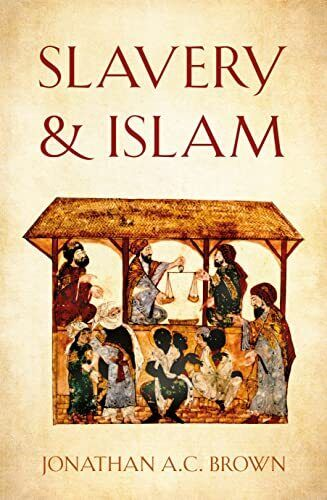
“Book Review: Slavery & Islam by Dr. Jonathan A.C. Brown”
Reviewer’s Book Watch, Vol. 24, No. 1, (January 2024)
By Dr. John Andrew Morrow
Slavery & Islam
Jonathan A. C. Brown
Oneworld Academic
https://oneworld-publications.com/imprint/oneworld-academic
9781786076359, $40.00 HC, $27.00 PB, $19.99 Kindle, 448pp
https://www.amazon.com/Slavery-Islam-Jonathan-C-Brown/dp/1786076357
In Slavery & Islam, Dr. Jonathan A.C. Brown, the Alwaleed bin Talal Chair of Islamic Civilization at Georgetown University, devotes over four hundred pages to support his conviction that slavery and concubinage are permissible according to the Qur’an and the teachings and practice of the Prophet Muhammad (570-632) (2020: 70, 96). He is adamant that God and His Messenger allowed, condoned, and supported them (2020: 7, 9, 202). In his words, “the permissibility of slavery and concubinage is undeniable in the Qur’an” (Brown 2020: 196).
Rather than abolish sexual slavery, Brown asserts that Muslim jurists embraced the practice fully and took it to its maximum (2020: 81, 82). He admits that “the number of concubines taken by Muslims jumped dramatically with the early Islamic conquests” (Brown 2020: 114). Brown also stresses that, in Islamic law, “consent for sexual relations was assumed or irrelevant” (2020: 96, 281). Not only does he argue that sex slaves played a central role in Arab and Ottoman slavery, but he goes as far as to trivialize the age of consent (2020: 278-281). Moreover, he argues that freedom is not a fundamental human right in Islamic law (Brown 2020: 299-302; Clarence-Smith 2006: 22) and treats serial polygamists, who had hundreds of sex slaves, as moral exemplars (Brown 2020: 82).
Brown equates opposition to the institution of slavery and sexual servitude as opposition to the Messenger of God (2020: 196, 199-200). He considers those who oppose slavery but refuse to condemn the Prophet to be hypocrites (Brown 2020: 96). When faced with dissenting views on the disputed subject of the legitimacy of slavery in Islam, Brown’s strategy is to respond with a loaded trick question and a theological trap: “Did the Prophet Muhammad commit a grave moral wrong?” (2020: 196). For Brown, a Muslim does not remain a Muslim if he or she answers in the affirmative. Consequently, he provides a jurisprudential justification for the practice of takfir, namely, the ex-communication of so-called heretics and apostates (Brown 2020: 198, 393, note 205; 405), and provides ample evidence that Muslims have a long history of enslaving other Muslims who do not share their ideology (Brown 2020: 106-109; 303-307; 370: note 24; 406, note 31 and 32; see also Clarence-Smith 42-45).
Brown may claim to believe that “slavery is wrong,” however, he makes an important disclaimer: “as a Muslim myself, I cannot condemn it as grossly, intrinsically immoral across space and time. To do so would be to condemn the Qur’an, the Prophet Muhammad and God’s law as morally compromised” (275). However, rather than support Islamic abolitionists, he assumes the role of the Devil’s Advocate, devoting an inordinate amount of time in his book to dismissing, debunking, and repudiating their arguments as violating the Qur’an, the sunnah, and the shari’ah. If one rejects the views of Muslim scholars who spurn slavery, is one an opponent or supporter of this evil and abominable institution? In fact, Brown wonders whether slavery is in the DNA of Islam (204). In his words, “we cannot pretend it is not part of our religion” (Brown 4).
Brown’s entire work is an ideological defense of Slave Master Islam. That it comes from a white American Muslim is even more abhorrent. This is the product of a conscious choice. His work is not simply a survey of historical opinions on the permissibility of enslavement, human bondage, sexual captivity, subjugation, and violation. It is a validation of those views. Alternative interpretations of Islam, which are abolitionist and emancipatory, are amply available. He is perfectly familiar with their arguments and evidence, namely, that sexual relations are only permissible in wedlock and that the Prophet Muhammad reportedly stated that slave traders were the worst human beings (Brown 392, note 199; 237). Brown, however, has deliberately decided to denounce them.
The fact remains that there is not a single verse in the Qur’an that commands slavery. The verses that touch upon the topic are descriptive. They deal with a temporal socio-economic reality. Slavery is neither an article of faith nor is it a religious obligation. In fact, the Qur’an encourages and even requires Muslims to emancipate enslaved people (2:177; 47:4, 24:33). As far as the exponents of Islam’s spiritual, moral, ethical, and egalitarian tradition are concerned, the Qur’an, the Prophet, and Islam introduced a system that would reform the practice of slavery and abolish it entirely and forever. Rather than select the sharp and narrow path, Brown has selected the wide and shallow one of the classical Islamic status quo. And since he likes to confront critics with a question, this review ends with a question, not of my own, by one that God poses in the Qur’an: “What will make you know what the steep path is? It is the freeing of a slave” (90:12-13).
[For a full response to Dr. Jonathan A.C. Brown’s book, please read Islam & Slavery (Academica Press, 2023).]
 Dr. John Andrew Morrow