
Zafar Bangash
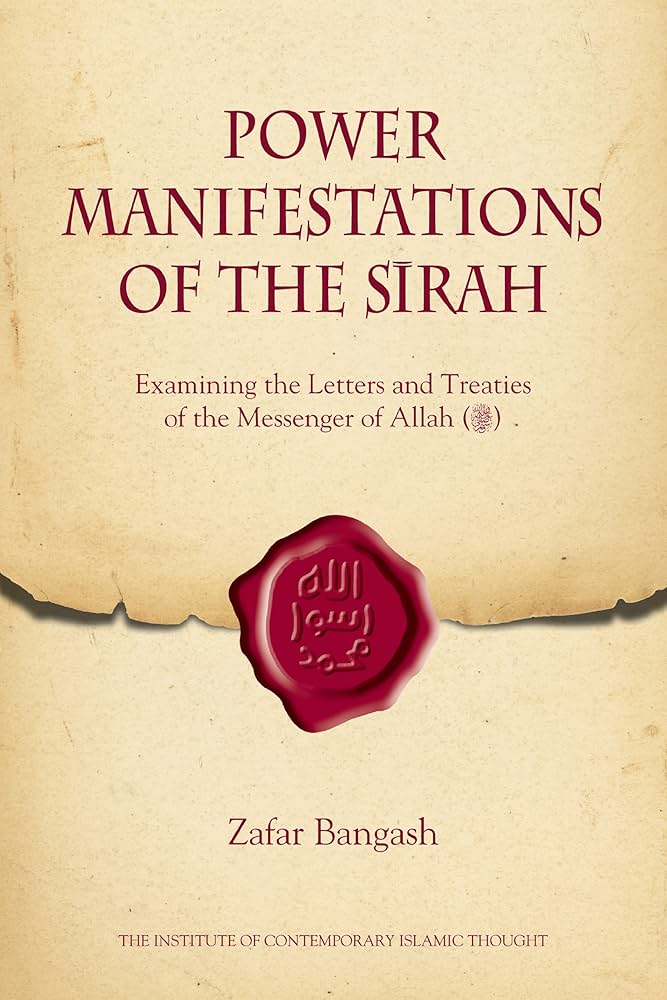
Power Manifestations of the Sirah: Examining the Letters and Treaties of the Messenger of Allah (pbuh) by Zafar Bangash.
September 2024
Most Muslims’ understanding of the Seerah (life-history) of the Prophet (peace be upon him—pbuh) is largely anecdotal. Others follow a chronological order of events in Prophetic history as outlined in Seerah books. Little or no effort is made to analyze major events in Prophetic history and what impact they had on the struggle to establish the Islamic State in Madinah.
There is one book that charts a new course in Seerah studies and brings out the importance of the letters and treaties of the messenger of Allah (pbuh). Power Manifestations of the Sirah: Examining the Letters and Treaties of the Messenger of Allah (pbuh) by Zafar Bangash focuses on the political documents around which the first wave of the Islamic movement was launched 1450 years ago.
The Prophet’s (pbuh) letters and treaties highlight his role as a statesman par excellence, underpinned by his role as a Prophet. The divine Word is intimately intertwined with every facet of Islam’s temporal expression on earth.
This book moves beyond the minutiae of events in the Prophet’s (pbuh) life that emphasize acts of personal piety. Examining the founding political documents, the author charts the establishment of the city state of Madinah and Islam’s expansion as a world power. He uses them to illuminate how the Prophet (pbuh) practiced politics as grounded in the Qur’an.
The book operates on the canvas of ideas. It compellingly charts the shift from a chaotic political system influenced by tribal loyalties, elitism, and class interests to one grounded on deliverance of care and universal justice to the diverse constituents of an Islamic state.
While the key documents, of necessity, follow a chronological order, their analysis is meant to show the progression of the Prophet’s role as the leader of a small community of Muslims in Makkah, to the head of state administering Madinah and eventually, the Arabian Peninsula.
It also needs clarifying that from a long list of some 124,000 Prophets, only a handful acquired temporal power. This has led to the erroneous assumption that it was not part of their responsibility. Every Prophet was tasked with two primary tasks: communicate the divine message to people and implement its injunctions in society. The latter task was contingent upon a sizeable number of people accepting it to implement it in society. Unfortunately, this was not the case with most Prophets.
Based on this historical reality, most people have assumed that acquiring temporal power and authority were not part of the role of Prophets. This faulty understanding has been most strikingly corrected by the last and final Messenger of Allah (33:40) to all humanity (7:158). He acquired absolute power in the Arabian Peninsula in the short period of 23years.
Yet far from resorting to the sword—as deliberately and mischievously projected by the orientalists—it was the pen that facilitated the extraordinary growth in Islam’s power. True, the sword had to be used where necessary for self-defence, but it was not the primary instrument of expansion.
This is also evident from the 10-year period of the Prophet’s life in Madinah. During these 10 years, there were at least 68 military campaigns and battles, yet the total loss of human life was only 270. This comprised 120 martyrs in Muslim ranks and 150 of the enemy combatants.
Contrast this with what the collective west has inflicted on the world—primarily Muslims—in the last 20 years and the barbaric nature of the west becomes clear. At least 32 million people have been slaughtered worldwide. It is still ongoing.
From the Covenant of Madinah—referred to as the first written Constitution in the world—to the Treaty of Hudaibiyah or the Prophet’s Farewell Sermon during his one and only Hajj—we see an extraordinary effort to practice fairness and equity in society. The Covenant of Madinah not only spelled out the rights and responsibilities of all the constituencies, the Prophet (pbuh) himself adhered to its articles very strictly. Compare that to today’s international treaties and agreements. The powerful wantonly disregard them while insisting that their opponents abide by them.
Power Manifestations is an extraordinarily important book. It has not only become one of the enduring classics of Islamic studies winning the best Seerah Book award, it has also inspired others to examine other treaties of the Prophet (pbuh). One of them is Dr John Andrew Morrow’s book, Covenant of the Prophet with the Christians of the World.
Much more work needs to be done in Seerah studies but Zafar Bangash’s Power Manifestations has laid the groundwork and direction for future studies.
Zafar Bangash
02 Sep 2024 The Seerah of the Prophet (pbuh)
Power Manifestations of the Sirah: Examining the Letters and Treaties of the Messenger of Allah (pbuh) by Zafar Bangash.
Most Muslims’ understanding of the Seerah (life-history) of the Prophet (peace be upon him—pbuh) is largely anecdotal. Others follow a chronological order of events in Prophetic history as outlined in Seerah books. Little or no effort is made to analyze major events in Prophetic history and what impact they had on the struggle to establish the Islamic State in Madinah.
There is one book that charts a new course in Seerah studies and brings out the importance of the letters and treaties of the messenger of Allah (pbuh). Power Manifestations of the Sirah: Examining the Letters and Treaties of the Messenger of Allah (pbuh) by Zafar Bangash focuses on the political documents around which the first wave of the Islamic movement was launched 1450 years ago.
The Prophet’s (pbuh) letters and treaties highlight his role as a statesman par excellence, underpinned by his role as a Prophet. The divine Word is intimately intertwined with every facet of Islam’s temporal expression on earth.
This book moves beyond the minutiae of events in the Prophet’s (pbuh) life that emphasize acts of personal piety. Examining the founding political documents, the author charts the establishment of the city state of Madinah and Islam’s expansion as a world power. He uses them to illuminate how the Prophet (pbuh) practiced politics as grounded in the Qur’an.
The book operates on the canvas of ideas. It compellingly charts the shift from a chaotic political system influenced by tribal loyalties, elitism, and class interests to one grounded on deliverance of care and universal justice to the diverse constituents of an Islamic state.
While the key documents, of necessity, follow a chronological order, their analysis is meant to show the progression of the Prophet’s role as the leader of a small community of Muslims in Makkah, to the head of state administering Madinah and eventually, the Arabian Peninsula.
It also needs clarifying that from a long list of some 124,000 Prophets, only a handful acquired temporal power. This has led to the erroneous assumption that it was not part of their responsibility. Every Prophet was tasked with two primary tasks: communicate the divine message to people and implement its injunctions in society. The latter task was contingent upon a sizeable number of people accepting it to implement it in society. Unfortunately, this was not the case with most Prophets.
Based on this historical reality, most people have assumed that acquiring temporal power and authority were not part of the role of Prophets. This faulty understanding has been most strikingly corrected by the last and final Messenger of Allah (33:40) to all humanity (7:158). He acquired absolute power in the Arabian Peninsula in the short period of 23years.
Yet far from resorting to the sword—as deliberately and mischievously projected by the orientalists—it was the pen that facilitated the extraordinary growth in Islam’s power. True, the sword had to be used where necessary for self-defence, but it was not the primary instrument of expansion.
This is also evident from the 10-year period of the Prophet’s life in Madinah. During these 10 years, there were at least 68 military campaigns and battles, yet the total loss of human life was only 270. This comprised 120 martyrs in Muslim ranks and 150 of the enemy combatants.
Contrast this with what the collective west has inflicted on the world—primarily Muslims—in the last 20 years and the barbaric nature of the west becomes clear. At least 32 million people have been slaughtered worldwide. It is still ongoing.
From the Covenant of Madinah—referred to as the first written Constitution in the world—to the Treaty of Hudaibiyah or the Prophet’s Farewell Sermon during his one and only Hajj—we see an extraordinary effort to practice fairness and equity in society. The Covenant of Madinah not only spelled out the rights and responsibilities of all the constituencies, the Prophet (pbuh) himself adhered to its articles very strictly. Compare that to today’s international treaties and agreements. The powerful wantonly disregard them while insisting that their opponents abide by them.
Power Manifestations is an extraordinarily important book. It has not only become one of the enduring classics of Islamic studies winning the best Seerah Book award, it has also inspired others to examine other treaties of the Prophet (pbuh). One of them is Dr John Andrew Morrow’s book, Covenant of the Prophet with the Christians of the World.
Much more work needs to be done in Seerah studies but Zafar Bangash’s Power Manifestations has laid the groundwork and direction for future studies.
 Dr. John Andrew Morrow