
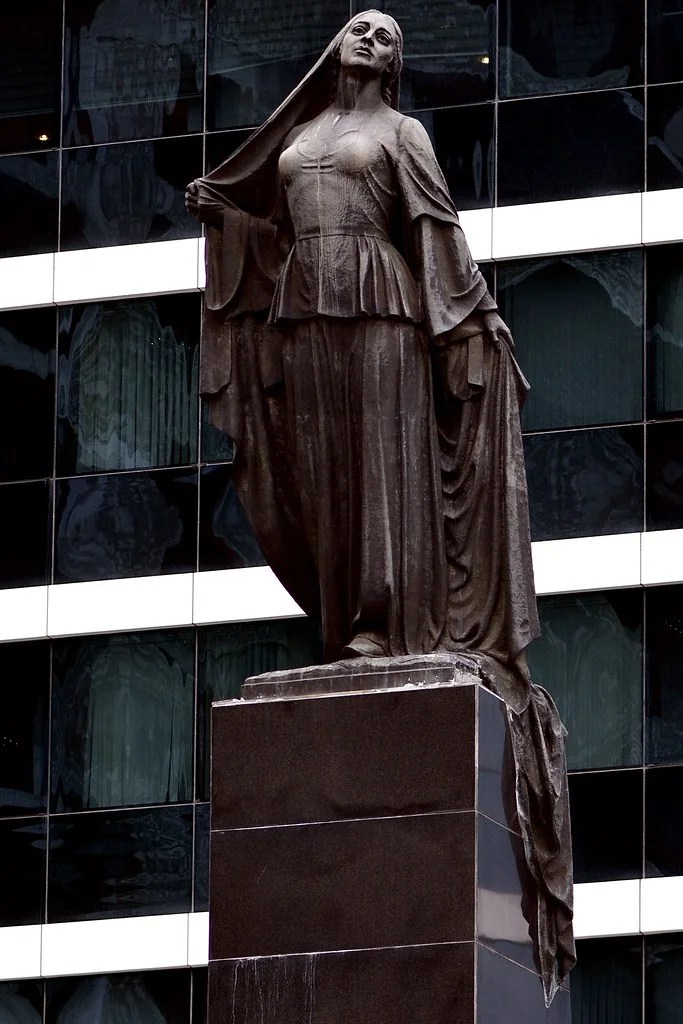
By Dr. John Andrew Morrow
Qasim Amin (1863-1908)
“If men feared that women would be tempted, why were not men ordered to wear the veil?”
Qasim Amin (1863-1908)
The shari‘ah does not stipulate the use of the veil… This custom is a product of the interaction among nations. Muslims were attracted to the veil, approved it, exaggerated its use, and dressed it up in religious raiment, just as other harmful customs have become firmly established in the name of religion, but of which religion is innocent…. The … face-cover and the veil are not part of the shari‘ah, in terms either of piety or morality. They have been handed down to us from ancient civilizations that preceded Islam and have continued to survive…
Qasim Amin (1863-1908)
Veiling is the symbol of an ancient ownership.
Qasim Amin (1863-1908)
The veil and the cloistering of women is “the most abominable kind of slavery.”
Qasim Amin (1863-1908)
The first step for women’s liberation is to tear off the veil and totally wipe out its influence.
Mohammed Alexander Russell Webb (1846- 1916)
The purdah is not part of the Mohammedan system, but is a custom borrowed from the Hindus and other Eastern people, who practiced it long before Mohammed was born. During the Prophet’s life, as well as the reign of the early caliphs, Arabian women were perfectly free to go about as they pleased, and a woman could travel alone in any part of the country by day or night, without being subjected to assault or insult. The idea of seclusion arose from a misconception of the following passage of the Koran: “And speak to the believing women, that they refrain their eyes and observe continence; and that they display not their ornaments… And let them not strike their feet together, so as to discover their hidden ornaments.” This injunction was intended to induce women to dress modestly and could not have meant that they should be secluded.
‘Abdul-Baha’ (1844-1921)
The veiling of women is a barrier to teaching and learning. The divines have exaggerated… to the point that they would not allow even the voice of a woman to be heard, even though it is generally admitted that Aisha, the wife of Muhammad, was present when people put questions to him, and he/she gave the answer, and during the circumambulation of the Ka‘ba she raised the cry, without a cloth over her mouth or veil on her head… Later they increased [the restrictions] to the point that they made women prisoners and prevented them from teaching or learning, and they sank into deep abasement. This was why Eastern women were excluded from making any progress… Chastity is required, and limits and restraints are … necessary … to a degree that does not prevent women from learning and teaching. For the Law of God is the basis for virtues, they should not be hindered from acquiring virtues. An educated woman is better than an ignorant woman…while preserving chastity and virtue.
Tahar Haddad (1899-1935)
There is a strong similarity between veils women place over their faces to prevent immorality, and the muzzle that is placed on the snouts of dogs to prevent them from biting passers-by.
Sultan Mohamed Shah, Aga Khan III (1877-1957)
A … cause of our present apathy is the terrible position of Muslim women… There is absolutely nothing in Islam, or the Qur’an, or the example of the first two centuries, to justify this terrible and cancerous growth that has for nearly a thousand years eaten into the very vitals of Islamic society… The ‘Abbasids, borrowing from the practice of the later Persian Sassanian kings, developed the present system … which means the permanent imprisonment and enslavement of half the nation. How can we expect progress from the children of mothers who have never shared, or even seen, the free social intercourse of modern mankind? This terrible cancer that has grown since the third and fourth century of the hijra must either be cut out, or the body of Muslim society will be poisoned to death by the permanent waste of all the women of the nation.
But purdah… itself did not exist till long after the Prophet’s death and is no part of Islam. The part played by Muslim women at Kardesiah and Yarmuk the two most momentous battles of Islam next to Badr and Honein, and their splendid nursing of the wounded after those battles, is of itself a proof to any reasonable person that purdah, as now understood, has never been conceived by the companions of the Prophet. That we Muslims should saddle ourselves with this excretion of Persian custom, borrowed by the ‘Abbasids, is due to that ignorance of early Islam which is one of the most extraordinary of modern conditions.
Sultan Mohamed Shah, Aga Khan III (1877-1957)
The external burqa [veil] is not for you, but [better] for your is a veil of the heart, have modesty in your heart, fill your heart with modesty all the time. You [women] should not cast your eye on other men except your husbands; do not have any thoughts for other men. If in your mind there is desire for other men, you will not gain from your prayers.
Sultan Mohamed Shah, Aga Khan III (1877-1957)
I have always sought to encourage the emancipation and education of women. In my grandfather’s and my father’s time the Ismailis were far ahead of any other Muslim sect in the matter of the abolition of the strict veil, even in extremely conservative countries. I have absolutely abolished it; nowadays you will never find an Ismaili woman wearing the veil. Everywhere I have always encouraged girls’ schools, even in regions where otherwise they were completely unknown. I say with pride that my Ismaili followers are, in this matter of social welfare, far in advance of any other Muslim sect.
Mahmoud Mohamed Taha (1909-1985)
Islam’s original precept is al-sufur [unveiling]. The purpose of Islam is chastity, emanating from within men and women, and not imposed through closed doors and long robes. There is no way to achieve inner chastity, however, except through education and discipline, and this requires a transitional period when chastity is encouraged through the veil, hence the rule of imposing it.
Mahmoud Mohamed Taha (1909-1985)
Al-hijab, as practiced at present, is a continuing abrogation of the freedom of al-sufur [uncovering], designed by shari‘ah to be a safeguard for the immature believers (al-mu’minin). Only true submitters (al-muslimin) can shoulder the responsibility of al-sufur [undressing]; hence they are not subject to al-hijab [covering/veiling].
Mahmoud Taleghani (1911-1979)
The hijab is not compulsory.
Mahmoud Taleghani (1911-1979)
While this [hijab] is not obligatory for [Muslims], how can we say that the religious minorities of Christians, Zoroastrians, and Jews should wear hijab — most of whom, especially the Jews and Zoroastrians that I have encountered, observe the old Iranian tradition [of hijab]? It is not even obligatory for them.
King Hassan II (1929-1999)
There is no such thing as an ‘Islamic’ headscarf; 2) Between the veil and education, choose education; 3) the law of the land is the law. Respect French law.
Tedjini Haddam (1921-2000)
Tedjini Haddam, who was a rector of the Great Mosque in Paris, explained that all that was required is that “a woman be decently dressed.”
Zaki Badawi (1922-2006)
There has never been an Islamic obligation for women to cover at any time. In fact, veiling the face is an innovation that has no foundation whatsoever in Islam… The hijab veil (which covers all of a Muslim woman’s hair) is also not obligatory.
Muhammad Ishaq al-Fayyad (b. 1930)
Using force and intimidation in promoting the hijab is not effective.
Mohamad Ali Ayazi
Citing Morteza Motahhari, Mohammed Beheshti, (b. 1928-1981) and Mahmoud Taleghani, Ayatullah Ayazi stated that “forcing women to wear hijab is not a religious practice and is against the Islamic code, the shari‘ah.”
Syed Osman Sher (b. 1935)
Can the women now be protected from molestation simply by wearing an outer garment, or by being recognized as Muslims? . . . Are the Muslims living in the dark streets of Makkah and Medina of those days that they need protection through such contrivances? If a veil is prescribed for the streets, is it applicable also when a woman is inside a building among the family members, close relatives, and friends? Does it become obligatory for a woman to cover herself from head to foot, sometimes only to bare the eyes?
Shah Karim al-Husayni Aga Khan IV (b. 1936)
It was a bold step, but more social than religious. Originally, the veil had nothing to do with Islam and the veil was worn in pre-Islamic Arabia. The veil was, initially, what distinguished a free woman from a slave. The slave woman who was not wearing a veil could be bought and exchanged. The woman wearing the evil was not at the disposal of society. The veil has become no longer a symbol but folklore.
Muhammad Kazem Mousavi Bojnourdi (b. 1942)
According to this ayatullah, hijab should not be imposed by force upon women.
Moiz Amjad (b. 1962)
Islam does not make it mandatory for women to cover their heads.
Sultan Abdumajeed
Abdulmajeed argued that “the idea that all Muslim women are required by Islam to veil themselves (in any form) is false and damaging to women, to Islam, and to people who might otherwise consider accepting Islam as their faith.”
Amir Hossein Torkashvand (b. 1964)
As Zahra Jalaeipour, the Iranian researcher, relates:
According to Torkashvand, there are three different views on the meaning of the word ‘awrah in Shia fiqh. The first view is the most popular and dominant and is approved by the majority of the ‘ulama’. In this view, ‘awrah in men is the part between their knees and navel, and for women, it refers to all parts of the body except for the face and hands. A number of marjas believe the foot can also be shown. The second view, which Torkashvand called the ‘original view,’ is in his
opinion the correct view about the limits of ‘awrah for both men and women. In this view, ‘awrah for men refers only to the middle part (the genitals), and for women it refers to the part of the body between the shoulders and the knees. According to this view, covering the rest of the body — the head, neck, arms, and knee to foot — is not compulsory. The third view that Torkashvand mentioned is that ‘awrah for both men and women is the same and refers only to the genitals. (2016: 108)
Hassan Yousefi Eshkevari (b. 1950)
Jalaeipour summarizes his findings as follows:
First, … we should determine whether hijab is justified on … the Qur’an. After scrutinizing all words in the Qur’an that relate to hijab and evaluating their meaning at the time, he found that … hijab in Shia fiqh was not based on Qur’anic evidence. Eshkevari believes that we cannot attest that covering the head is vajeb (compulsory) based on the Qur’an.
Secondly, even if … we were to assume that the common interpretation of hijab is based on the Qur’an, it would … not be a fixed and unchangeable law…. Islamic law has two different types of laws… “devotional laws,” like daily prayers, fasting and pilgrimage… [and] “social laws,” … about inheritance, slavery, marriage, war, [and] hijab … Social laws have changed in different times and are not fixed in the … way that devotional laws are…. Hijab law is a “social law” and not a “devotional law…” it can change from period to period and place to place, regardless of how it was described in the Qur’an.
Thirdly, even were hijab both based on Qur’an and a devotional or unchangeable Islamic law, there is … no Islamic basis to believe that one has the right to compel others to observe the law by force, as the current Iranian government does. Eshkevari … is committed to the principles of Islam, and … believes that many Islamic laws like hijab are changeable. He mentions six reasons in his human rights article (Eshkevari, 2010) to argue that the social laws of Islam can change.
Eshkevari emphasized that we should justify hijab rationally… There are at least two important reasons for hijab: … modesty, and … identity…. The issue of identity falls outside the realm of religion, and modesty does not necessarily require covering the head and neck. It can be achieved differently in contemporary societies — especially in places like Europe, where the headscarf is not common… Unlike many jurists, he believes that a woman can be modest and, at the same time, not cover her hair…. Eshkevari engages with the issue not simply in jurisprudential terms but also in more rational terms. The issue of the veil in and by itself does not seem to signify anything integral to a woman’s religious practice or faith here.
Warith Deen Mohammed (1933-2008)
It is believed in the circle of learned scholars in the religion that the
hair on women should be covered… In our community…we don’t make any big to-do about it. If some woman is seen with her hair uncovered, we don’t raise the roof, because I understand that where there is some sex appeal in women’s hair, there is also religious symbolism attached. This symbolism is good, but I don’t think we should enforce these laws too fanatically. If we do, we might cause people of higher intellect to underestimate our intelligence. They might think we are superstitious or fanatical people, and we don’t want them to think that.
Nasr Hamid Abu Zayd al-Damanhuri (d. 2010)
The concept of ‘awrah is bound by culture and time.
Ahmad Ghabal’s Edict (1954-2012)
- The principle of covering the ‘awrat for male and female Muslims is necessary.
- Jurists have different opinions about what is included in the ‘awrat (especially in relation to women).
- The majority of jurists have considered covering the head necessary for free (non-slave) Muslim women, and they hold the head and neck too among parts included in the ‘awrat.
- Ibn Junayd Iskafi, who is one of the famous Shi‘i jurists and who lived in the same generation as the masters of Shaykh Mufid, considered the parts comprising the ‘awrat in men and women as the same and equal.
- All the Shi‘i jurists (indeed, all the Islamic jurists) considered covering the head and the neck unnecessary for Muslim women who were slaves; rather, much like … Saduq and a group of clerics from Qum (in the time of … Saduq), they considered it illegal… for slave women to cover the head; whereas covering the ‘awrat was necessary from them.
- Sahib-i Javahir considered covering parts of the body (with the
exception of the face, hands, and feet as far as the ankle, the neck, and
head hair) as consensual (ijma‘i). In other words, regarding those
exceptions, the opinions of the jurists varied, and no agreement existed. - He cites the words of … Tabataba’i, the master of Sahib-i Javahir and Sahib-i Madarik [and] says that covering the “head and neck” is unnecessary in their opinion, and he writes, “Judge Ibn Baraj had attributed to some Shi‘i clerics [the belief] that covering the head and neck is unnecessary.”
- Sahib-i Javahir has expressed his opinion in this manner:
“Covering head hair is based upon [observing] caution.” Indeed, [he gave] a stronger… [opinion for caution]; therefore, he has not issued a clear fatwa for the need [to cover] it; rather based on caution and probability, firstly he has [expressed] caution and… preferred covering it. - From all of these studies it is clear that the issue is controversial, and the consensus of Muslims on this act (covering the head and neck) has not been reached.
- Some [Qur’anic] verses and reliable narrations appear [to support] its non-compulsory nature (like 33:59…) although there are also some verses and reliable narrations that mention the necessity to cover the head…. The requirement to harmonize (jam‘i ‘urfi) necessary proofs and non-necessary proofs depends on the contexts. If [the harmonization] is practiced according to this rule, the conclusion of the verses and narrations support the non-necessity of covering the head and neck, and only affirm preference (isthihab).
Regarding the aforementioned topic, I consider it necessary to cover the body based on scientific proofs, but covering the head and neck is legally desirable (mustahabb-i shar‘i).
Ahmad Ghabal (1954-2012)
What difference exists between slave women and non-slaves in terms of incitement [to corruption]…? At the time of the Imams some of the female slaves were from Iran and Europe, and they were more beautiful and attractive due to the variety in hair color than many of the Arab women in Mecca, Medina, and Yemen; [so] it is necessary to find a suitable response to defend the rationality of the Muhammadan shari‘ah in today’s world, just as in the past. Since the source of beauty in the head and neck lies in the beauty of the “eyes, eyebrow, nose,
teeth, chin, and their arrangement,” and Islam has considered it unnecessary to cover these, what particular attraction is there in a woman’s hair and neck that the necessity of covering them has made this kind of topic so prominent among Muslims?
Ahmad Ghabal (1954-2012)
The issue of hijab is [about] covering the body, not covering the head and neck. I don’t understand all this sensitivity about a single strand of hair? Where have they got it from? In fact, these discussions reflect demagoguery more than a scientific discussion. What does it mean when according to a jurist a single strand of hair causes God’s throne to tremble, and then the very same jurist says that it is not necessary to cover the shape of a woman’s body.
Muhammad Muhaqiq Damad (d. 1968) and Muhammad Mehdi Shams al-Din (d. 2001)
They both declared that veiling in the Qur’an was only recommended, and no necessity could be applied to it.
Javed Ahmed Ghamidi (b. 1952)
The Pakistani philosopher believes that there are only four injunctions that pertain to Muslim women: lowering the gaze, wearing modest clothing, covering the bosom, and not exhibiting themselves in front of unrelated men
Farhad Shafti
According t o Shafti, wearing a khimar is not a religious act, nor does it pertain to modesty.
Abul-Ghasem Fanaei (b. 1959)
One cannot conclude that hijab meant covering the whole body except for the hands and face in all places and times on the basis of two verses in the Qur’an…. The hijab verses in the Qur’an have two connotations. Firstly, they ask practicing Muslim believers not to show off (tabarroj) to attract the sexual attention of men other than their mahrams.
Secondly, they articulate that hijab’s main function is to protect women from men’s harassment and to keep them safe when they go outside. Both connotations lead to the conclusion that hijab cannot mean the same thing in different times and places. For example, if you are in Spain, wearing a bikini by the sea might not be seen as showing off or be a danger to women’s safety. In other places, not wearing a scarf could make women stand out and also make them unsafe. Therefore, unlike most Shia jurists, … hijab does not have a fixed and inflexible
limitation, and that people who live in different parts of the world can have different ways of practicing hijab… We cannot label hijab as one predefined mode of covering.
Mohsen Kadivar (b. 1959)
In “Understanding the Revelation of the Verses on the Hijab,” Kadivar
provides much needed historical context: 1) The Arabs of the Hijaz were poor
and uncivilized; 2) They wore a single long piece of cloth with an opening for
the head and neck or merely a loin cloth. The head, neck, and parts of the chest,
arms, and legs were exposed. Since the cloth was not sown, and the sides
moved, other parts of the bodies of men and women were also customarily
exposed; 3) The Arabs of the time did not view nudity negatively. Men and
women circumambulated the Ka‘bah completely in the nude. What is more,
“they did not make a great effort to conceal their gaze at other people’s sexual
organs;” 4) The elite may have lived in stone or mud homes; however, most
people lived in habitations made of date-straw or in tents. They did not have
many rooms, or any rooms at all, and lacked doors and curtains. It was normal
for people to peer into the living places of other people; 5) They had no private
toilets. People used to respond to the call of nature in public and used to talk and
tease each other. Both men and women socialized in such settings; 6) Bathing
was limited due to water scarcity and would take place in public, in rivers,
ponds, and pools. There was no such thing as sexually segregated bathing. It was
normal for men and women to bathe in public while completely naked; 7)
Sexual relations were unfettered, including promiscuity, prostitution, spouseswapping, and other practices (Ridgeon 237).
In “Fundamental Qur’anic Questions about the Hijab,” Kadivar notes that
the Qur’an was concerned with women covering their private parts and their
bodies except for the arms below the elbows and the legs below the knees. The
parts that remained uncovered were 1) the chest; 2) the head and the neck; and
3) the forearms, shins, and calves to the feet (Ridgeon 238-239). Kadivar then
proceeds to examine the Qur’anic verses related to covering. He finds two points
of importance in 33:59: firstly, that women should draw their cloaks around
themselves; and secondly, the reason for this command, namely, their being
pestered (Ridgeon 239). He notes that the term jilbab is ambiguous as it has
three meanings: 1) a sheet that covers the body; 2) a wimple and scarf, and 3), a
shirt and baggy clothes (Ridgeon 239-240). The verse does not describe or
explain the jilbab; it emphasizes how it is used, namely, drawing it around,
which in turn has two meanings, to bring close or to lower (Ridgeon 240).
Considering the type of clothing worn at the time, which had slits along the
sides, it is clear to Kadivar that the verse was not introducing a new form of
clothing but encouraging women to cover the exposed parts of their attire
(Ridgeon 240). “The new message of the verse,” he notes, “is this: cover the body properly with clothes” (Ridgeon 240). “Whether prohibiting or
permitting,” he stresses, “the verse has nothing to do with covering the head and
hair” (Ridgeon 240).
In “The Reason for Covering,” Kadivar provides two possible reasons: 1) to
be recognized as pure, chaste, and noble; and 2) to be recognized as free women
as opposed to slaves since, supposedly, immoral men would not harass free
women who wore this distinct attire (Ridgeon 240). This second interpretation,
which is very prevalent, poses problems. As Kadivar observes, “the result of
[this] corruption is that innocent slaves remain defenseless before immoral
people” (Ridgeon 240). Such a possibility “opposes Qur’anic righteousness and
Islamic standards” (Ridgeon 240). The verse, notes Kadivar, does not explicitly
address the covering of the hair. As such, to fulfil the explicit reason, “it is
sufficient for a believing woman to guard her body” (Ridgeon 241).
For Kadivar, 24:31 is the most important Qur’anic verse dealing with
covering. It requires believers to lower their gaze and to cover their private parts
(Ridgeon 241). Women, in particular, have the added responsibility to avoid
displaying their finery and to cover their chests, breasts, and necks with the
khimar (Ridgeon 241). As Kadivar notes, the Qur’an distinguishes between two
types of finery, their hidden beauty, namely, their private parts, and their outer
beauty (Ridgeon 242). It is only the hidden beauty that must be concealed in the
public sphere. The parts of a woman’s body that were visible at the time of
revelation, including the forearms, lower legs, face, neck, and hair, fall into the
category of “that which is visible” (Ridgeon 242). “The principal message of the
verse,” concludes Kadivar, “is the prohibition of nakedness. Taking off clothes
in front of those who are not mahram is not allowed” (Ridgeon 242).
In “Covering the Juyub with the Khimar,” Kadivar notes that the term
khimar has three meanings: 1) a head covering, 2) a cloak, and 3) a shawl
(Ridgeon 242). Whatever it is, the article of clothing was intended to cover the
juyub, which can refer to 1) the parting in two sides of a garment; 2) the
cleavage of a woman’s chest; and 3) a woman’s private parts (Ridgeon 242).
When the Qur’an asks women to “draw their khumur over their juyub,” it refers
to covering the cleavage of the breasts, the private parts, and even any other
opening or closing that causes arousal (Ridgeon 243). For Kadivar, the verse
requires women to cover from the neck to the knees and upper arms (Ridgeon
243). It does not, however, “indicate the necessity of covering the hair and head”
(Ridgeon 243). As for the verse “except that which is visible,” Kadivar notes
that there is no Qur’anic basis for the fatwas that limit this to the face, hands,
and feet (Ridgeon 244).
In “The Hijab in Shi‘i Narrations,” Kadivar examines premises, covers
discussions, and makes many findings, namely: 1) not one command about hijab
is attributed to the Prophet; 2) not one command on the principle questions of
the hijab is attributed to ‘Ali; 3) there is not a single hadith about hijab on the
authority of Fatimah; 4) nearly all the commands related to hijab appear two centuries after the Prophet and are attributed to Muhammad al-Baqir, Ja‘far alSadiq, Musa al-Kazim, and ‘Ali al-Rida; 5) there is not a single narration by
multiple reporters about the commands of hijab; 6) most commands on hijab
lack corroboration and few feature sound chains of transmission; 7) there are
contradictory traditions regarding the requirement to cover the hair during ritual
prayers; 8) the extent of covering in front of relatives is less than the usual limit;
9) the claim that the outer beauty is limited to the face and hands is based on a
single tradition from Imam Sadiq; however, in other traditions it includes what
is under the khimar, and above the wrists, and includes the forearms; 10) the
meaning and extent of jilbab and khimar are inconsistent in the traditions; 11)
some men living at the end of the second century of the hijra, during the time of
‘Ali al-Rida, had never heard that it was prohibited to see the hair of women and
they were required to cover it; 12) traditions attributed to Ja‘far al-Sadiq state
that a man can look at a woman’s hair at the time of a marriage proposal; 13) it
is permissible to look at the hair of non-Muslim women and any other part they
normally uncover; 14) it is permissible to look at the hair of women who refuse
to cover it; 15) it is related that Musa al-Kazim and ‘Ali al-Rida required
pubescent girls to cover their hair in front of non-mahrams; 16) Imam Rida is
reported to have distinguished between looking at women in a manner that was
chaste and looking at them lewdly and with lust; 17) a tradition claims that
Fatima stated that men should not see women while another unreliable one
claims they even had to cover in front of blind men; and, finally, 18) a tradition
on the authority of Ja‘far al-Sadiq claims that the Prophet stated that “Women
are ‘awrat. Cover ‘awrat in the house” (Ridgeon 261-263). Kadivar concludes
that the principal commands regarding hijab appeared nearly two and a half
centuries after the Prophet, based on traditions attributed to Ja‘far al-Sadiq
(Ridgeon 263). The fatwas mandating hijab are all based on these traditions
(Ridgeon 263). The conclusion is so self-evident that Kadivar sees no need to
mention it.
For Kadivar, it is not only the rulings regarding the hijab and women that
need to be revised, but all rulings. In his view, all rulings should be tested
against four criteria: reasonability, justice, ethics, and effectiveness (2023a).
Although Muslims should preserve principles and standards, any rulings must
address today’s needs, contexts, and standards (2023a). He also believes that
human dignity must be considered when deriving rulings (2023b). Finally, he
stresses that for anything to be Islamic, it must first be reasonable, just, moral,
and functional (2023c). For Kadivar, these principles must inform any reform of
women’s attire.
Moslem Khalafi (b. 1969)
As Minoo Mirshahvalad summarizes, Khalafi:
provides a list of extremely permissive and extremely restrictive narratives about hijab. Khalafi observes that some Shi‘a accounts are so limitative that they clearly legitimize the imprisonment of women… Some reports, with authentic origins, are so permissive that they allow women to pray without any headcover and men to look at their beautiful faces even with sexual intention…. He asks a very important
question… Considering the existing contradictions in the Shi‘a reports on modesty and women’s attire, he asked, “Why have only those narratives that necessitate the veil gained visibility in Iran?”
Mohammad Hashim Kamali (b. 1944)
There is no mandate on veiling (hijab) and face cover (niqab) in the Qur’an and Sunnah. The … evidence in these sources shows that during the Prophet’s time women participated in public life and most of the women companions did not practice the hijab, except for the wives of the Prophet, who began to practice it after the revelation of the Qur’anic verse (33:59) concerning them. Even after this event, other female companions did not practice the hijab, as they knew that the
Qur’anic directive was addressed to the Prophet’s wives only. Women’s participation in the life of the community during this time was dignified and social encounters took place at the initiative of men and women as and when the occasion arose. Women were also allowed to take part in congregational prayers and attend the mosques without restrictions.
The Qur’an advocates modesty and decorum and cautions against provocative behavior … (cf., 7:26, 7:31, 24:30, 24:60, and 33:53). This is the basic message but the text does not specify exactly how modesty is achieved. Modesty is important for the upkeep of moral standards in society, and the Qur’an has addressed it without any quantitative specifications of the kind that subsequently preoccupied the jurists and cultural trend setters in different times and places. The Qur’an reminds
the believers, men and women alike, to lower their gaze and avoid “temptatious” behavior. Covering the body parts during worship and social encounters is treated in the fiqh writings on ‘awrah, on which the leading schools have also recorded differential rulings and interpretations over details. Yet suitable coverage of body parts for purposes of worship and mosque attendance is generally accepted by
all the fiqh schools.
Ziauddin Sardar (b. 1951)
Modesty cannot become the rainment of righteousness of an entire society when it is the burden and obligation of only one half of the population. Traditional interpretation in fact performs an inversion of Qur’anic principles by making women responsible for the lack of moral probity and modesty, not to say the sexual obsession of men. Reading verses 24:30 and 31 together make it abundantly clear how perverse this habit is. In fact, it is not so much perverse as potentially perverted, a license for lechery, which is exactly what the Qur’an’s balanced approach seeks to end. (334)
I can see no Qur’anic warrant for burqas, chadors, abayas, and niqab. There is no legal requirement, sanctioned by the Qur’an of the Prophet that compels Muslim women to wear specific dress, to hide their faces in public, or to shroud themselves from top to bottom. Had this been the case, the injunction of the Qur’an for men and women to “lower their gaze” would hardly make any sense. And I find the whole notion that certain men, in the guise of moral police, should go around telling women to cover themselves totally reprehensible. And there are just as many women prepared to serve as harridan scourges ready to tell other women that not even a strand of hair should be allowed on public view.
Gamal al-Banna (1920-2013)
According to Gamal al-Banna, neither the Qur’an or the authentic sunnah require women to cover their hair. As he explained, the veil is not an Islamic tradition; it is pre-Islamic. As for the Qur’an it commands women to cover their chests, not necessarily their hair.
Hassan al-Turabi (d. 2016)
The Qur’an did not refer to this thing as hijab. This was called khimar and was worn over the chest only… you keep hearing hijab, hijab, hijab… When the words are distorted, they mislead people.
Mohamed al-Talbi (1921-2017)
What does the Qur’an say about the veil? Nothing. Absolutely nothing. Nowhere does it address a woman’s head. God did not reveal the Qur’an to teach women how to fix their hair. Islam is not the veil. It is a religion.
Mehdi Karroubi (b. 1937)
I am personally against the mandatory hijab. When the hijab became mandatory after the revolution, it was the wrong thing to do. It was a political decision and a bad one.
Joseph A. Islam
There is no specific reference to covering of the hair [in the Qur’an]. What is more,
the Arabic word hijab has never been used to signify or insinuate this.
Lafif Lakhdar (1934-2013)
[Forbidding the hijab] restores esteem to a woman’s body. How so? A man’s body is partly shameful — from the navel to the knee. A woman’s body is shameful in its entirety, apart from the face and the hands. Muslim women aren’t equal to Muslim men even in the value of their bodies! One French psychoanalyst thinks that French Islamists demand [that women] wear the hijab because a woman’s hair makes them think of hair she has elsewhere, and this inflates their passions. This reduces women to sex. The subconscious meaning of this is that every woman with her hair uncovered is a whore whom any Muslim is entitled to violate. This is why the Islamic jurisprudents forbade Muslim slave girls to wear the hijab, and likewise non-Muslim women — i.e., Muslims have the right to violate them whenever they want.
Kassim Ahmad (1933-2017)
The tudung or full-fledged headscarf is not ordained by God. The corrupt religious scholars insists on Muslim women to cover their ‘aurat. ‘Aurat is an Arabic word meaning nakedness. Thus a woman’s hair is not her ‘aurat or nakedness. I would put to men’s chauvinism to conceal the beauty of their women. God knows better and ordains appropriately to conceal their beauty. Seventy years ago women did not wear the tudung. My mother never did. Her contemporaries never did. They wore selendang, a partial headcover… the complete headcover is a new teaching after the theocratic revolution in Iran in 1979. I am sure the Iranian women themselves will revolt against this unhealthy attire that allows no air to run over her hair… Some people regard this as fashion. However, not all Muslim women agree with this. A fashion that has negative results … is not to be tolerated.
Muhammad Shahrur (1938-2019)
As Abdul Mustaqim, the Indonesian Islamic scholar, further explains:
In the case of woman’s attire … Shahrur considers the minimum limit of woman’s attire to … covering the chest (breasts) and genitals so as not to be naked. Its maximum limit is the covering of the whole body excluding the palms of one’s hand and one’s face… The woman who does not wear hijab has in fact fulfilled God’s stipulation…. Women who cover their whole body including the face are considered to have gone beyond … God’s limits… Women who cover their face and their whole body are “not Islamic.”
Muhammad Shahrur (1938-2019)
In a society where poverty was prevalent and clothing scarce, the Qur’anic verses mandating women to cover their bosoms with their khimars (Q. 24:31) and to draw their jalabib closer to their bodies (Q. 33:59) did not mean … that women were expected to cover completely. Rather … these Qur’anic verses are best interpreted as general guidelines about modesty and morality, as a recommendation to Muslim women to cover their chests with the same pieces of cloth they were already wearing… Hijab in Islam is much less about clothing, much less about an injunction to wear specific attire, than it is about adopting a modest demeanor, remaining humble, and avoiding pride and conceit.
Muhammad Shahrur (1938-2019)
A woman’s body is divided into two parts: a) an exposed (visible) part: the verse says, “except what (must ordinarily) appear thereof” (illa ma zahara minha); these outer parts are what can be seen of a female body: the head, back, shoulders, arms, legs, and such, constituting her physical appearance (in public); b) an unexposed (invisible) part: parts of her body that God has not exposed to the eyes; a woman’s unexposed part is called juyub.
Muhammad Shahrur (1938-2019)
Women are required to cover their upper private parts (breasts and armpits) in addition to their lower private parts, her thick ‘awrah (this constitutes the lower limit for all women). This definition, however, does not cover dresses for special occasions (parties, opera, concerts, etc.). As for the concept of “from the navel to the knee,” we conclude that fiqh jurists unashamedly invented this.
Hassan Rouhani (b. 1948)
The hijab in the Qur’an is for women’s protection but what we’ve done is holding the hijab over women like a club.
Mahmoud Ahmadinejad (b. 1956)
I said during the 2005 elections that I oppose the forced hijab and I repeated it 50 times.
Mahmoud Ahmadinejad (b. 1956)
Is the appearance of our children’s hair really a problem facing our people today? Let them make their hair however they want, what business is it to me and you?
Zahra Rahnavard (b. 1945), Faezeh Hashemi Rafsanjani (b. 1963), Mostafa Tajzadeh (b. 1956), Ahmad Montazeri (b. 1955)
Mandatory hijab was a wrong decision from the beginning and the passage of time has made it obvious. Although there are serious theological differences as to whether the hijab is necessary or not, and to what extent women should cover their hair, there’s no dispute about the fact that imposing the hijab does not have a defensible legal basis in shari‘ah law.
Khaled Abou El Fadl (b. 1963)
Aarguing that women … are a walking, talking, bundle of seduction… strikes me as morally offensive.
Khaled Abou El Fadl (b. 1963)
Whether a person covers his or her ‘awrah or not, he or she should not be made to suffer from the indiscretions or impiety of others. Put bluntly, whether a person is sexually aroused or not is entirely irrelevant as to what the object of arousal must or must not do. The laws and imperatives of modesty ought to be set by God and not by immoral individuals who are violating the law of God.
Khaled Abou El Fadl (b. 1963)
Women, Muslim, and non-Muslim, in Medina, normally would wear long head-covers — the cloth usually would be thrown behind the ears and shoulders. They would also wear vests open in the front, leaving their chests exposed… The practice of exposing the breasts was common until late in Islam. Several early authorities state that the Qur’anic verse primarily sought to have women cover their chests up to the beginning of the cleavage area.
Khaled Abou El Fadl (b. 1963)
It is an error for a Muslim woman to continue wearing the headscarf, or the hijab if doing so brings such a person undue attention or puts her at risk of harm of any sort, or even stands as an obstacle to her ability to testify on behalf of God and to educate non-Muslims as to the truth of the Islamic message…
Many scholars have argued that khimar by definition is a piece of cloth that covers a woman’s entire body and is drawn upon the face, so in effect, enclosing a woman’s entire body in a veil. Many others have argued that a khimar is a piece of cloth that covers the hair and the entire body except for the face… Both schools of thought — that which contends that the khimar covers the face, and that which contends that the khimar covers the hair but not the face — are ahistorical in presuming the existence of an historical practice that has not been proven.
The evidence that the khimar in pre-Islamic Hijaz covered the face or covered the hair is simply not there. The only thing that the verse allows us to say conclusively is that Muslim women were called upon to draw a piece of cloth (khimar) over the juyub (bosoms) — whether it covered the hair or the face, we don’t know. In other words, the Qur’an in this verse calls upon women to cover their bosoms. Anything beyond that would require extensive research into the social practices of khimar dressing at the time of revelation, and the historical evidence is far more diverse and complex than many contemporary scholars assume it to be…
What is considered to be zinah, or the ornaments, is a question of applied ethics — i.e. it differs from one place to another and from one time to another. What is considered to be immodest ornamental displays of beautification in a part of Africa could be entirely different than the same in Mongolia. In essence, the Qur’an is counseling against the immodest flouting of physical appearance. There is no evidence that displaying of the hair is by definition a part of a woman’s zinah.
Depending on the place and context, a woman could be modest while not covering her hair, and the opposite is also true. A woman can cover her hair but still be immodest by displaying her zinah. In many ways … it is clear that the Qur’an is repeating and reaffirming a long established biblical command to lower the gaze, be modest, and avoid displays of flashiness and vain conceit…
It bears emphasis that if one takes both Qur’anic revelations, what seems clear to me is that the Qur’an is placing great emphasis on modesty and humility. The narratives on khimar and jilbab do not necessarily generate the kind of uniform and determinative headgear and attire known as the hijab in our contemporary age…
If the hijab causes women to stand out, and brings unwanted attention to them, and poses the risk of bringing harm to women — and considering that per the social habits and customs of the United States, a woman exposing her hair would not be considered immodest or licentious to any extent — it is permissible for a woman NOT to wear a head-covering in the United States… It is contrary to the purposes of shari‘ah for a woman to expose herself to harm of any kind simply for
the purposes of covering her hair. Indeed, it is far more consistent with the purposes of shari‘ah for a woman to place more emphasis on educating her fellow citizens about Islam and Muslims instead of focusing on her physical appearance…
It is … ironic that in the modern age the hijab has become symbolic of Islamic identity. Historically and theologically, headcovering is found among certain Christian and Jewish sects and is supported in these traditions with textual injunctions which are far more clear and determinative than in their Islamic counterpart. It is … ironic that modern Muslims, at least since the late 1970s, have chosen to make the head-covering an integral component of identity politics
when their own scriptural injunctions are far less dispositive than their Jewish and Christian counterparts. There is nothing uniquely Islamic about the hijab except for the fact that Muslim social movements, at least since the late 1970s, have chosen to make it a part of Islamic catechism… Humility, modesty, and personal piety are far more worthy in Allah’s eyes than any formal physical attire regardless of its sanctified appearance.
Khaled Abou El Fadl (b. 1963)
At the time of the Prophet … that hijab was not an issue and was not raised as a topic until a year before the Prophet’s death, meaning that many Muslim women worked on their iman and their belief for ten and in some cases fifteen years before they had to even think about the matter of hijab… When it comes to converts or people who have not been practicing Muslims for most of their lives and then decide to become religious, first, work on ‘aqidah, your iman, your understanding of the wisdom and the purpose of Islam before you start delving into the legalities of hijab or no hijab… Every convert or practicing Muslim is a living, breathing, ambassador of Islam in the West… There are priorities … that pertain to the sincerity and substance of our agency on behalf of Allah’s message… The matter of hijab of a Muslima in this day and age has become of a highly exaggerated importance.
Khaled Abou El Fadl (b. 1963)
As Khaled Abou El Fadl has concluded, the claims that the Qur’an requires women to cover the face or the hair but not the face “are ahistorical in presuming the historical existence of an historical practice that has not been proven.” The only thing that we can say for sure is that the Qur’an called upon women to cover their bosoms. He also objects to the equation of ‘awrah and zinah, namely, personal, and private parts, with beauty in general.
As Abou El Fadl explains, what is considered to be zinah is a matter of applied ethics: “it differs from one place to another and from one time to another.” In other words, “What is considered to be immodest ornamental displays of beautification in a part of Africa could be entirely different than the same in Mongolia. In essence, the Qur’an is counseling against the immodest flouting of physical appearance.” As far as he is concerned, “there is no evidence that displaying of the hair is by definition a part of a woman’s zinah.” In fact, “depending on the place and context, a woman could be modest while not covering her hair, and the opposite is also true. A woman can cover her hair but still be immodest by displaying her zinah.” For Abou El Fadl, “it is clear that the Qur’an is repeating and reaffirming a long-established biblical command to lower the gaze, be modest, and avoid displays of flashiness and vain conceit.” It is an ethical order and not a legislative one.
Ahmed Subhy Mansour (b. 1949)
With niqab and hijab dominating over most countries of the Muhammadans, as supposedly religious duties forced on Islam for no reason, we see how fornication, rape, and sexual harassment thrive among the gravest sins in such countries of Shiites and Sunnites: the former allow fornication by allowing Shiite women to remarry many times (for pleasure of both sexes) without the required three-month waiting period, and the latter allow “sex jihad” like ISIS terrorists as well as Salafist and MB terrorists in their times of armed aggressions. Let us not forget that the Sunnite Wahabi ISIS terrorists allow in their religion rape of captured women! Yet, those fanatics of Shiites and Sunnites prohibit lawful items such as arts, singing, and music and allow the prohibited sins of murder, rape, fornication, looting, and massacring of innocent peaceful ones. Hence, the overemphasis on growing beards, wearing male and female djellaba, and wearing hijabs and niqabs are over signs of covering up vices, corruptions, immorality, fornication, eating from ill-gotten money, etc. and are signs of earthly, man-made, fabricated creeds that have clergymen; hence ISIS terrorists commit rape and massacres while imposing niqab on women.
Ahmed Subhy Mansour (b. 1949)
When we compare a woman in niqab and another woman in a bikini, the latter is making a small mistake or small sin (i.e., showing her cleavage and upper legs, thus disobeying Qur’anic advice in this respect) that may be forgiven by atoning for it by good deeds and imploring God’s pardon, as long as she does not commit the grave sin of fornication, whereas the former is falling into the trap of polytheism, a major sin that makes her deserve Hell if she dies without repenting
the sin of ascribing such falsehood (i.e., niqab) to Islam.
Ahmed Subhy Mansour (b. 1949)
The veil/hijab and/or the niqab… have nothing to do with Islam.
Ahmed Subhy Mansour (b. 1949)
There is nothing called veil / hijab / niqab / burqa in Islam.
Ahmed Subhy Mansour (b. 1949)
Mansour laments the fact that women have been “erroneously convinced that Islam includes such falsehoods as niqab (the full veil covering the face and the whole body), veils (cloth covering hair, ears, neck, and cleavage), and head scarves (cloth covering hair and ears).”
Ahmed Subhy Mansour (b. 1949)
It is a crime against God to add to His shari‘ah laws (about women required to cover chests and legs in public) the invented notion of covering their hair by the so-called veil as an obligation or to force them to wear the so-called niqab. There are no dress codes in Islam at all for both genders; those women who wear niqab is committing a major sin by thinking that they are doing a “religious” ritual or practice, whereas those wearing bikinis are making a small mistake that may be pardoned by doing good deeds. The worst women of all are those committing fornication; yet they are less sinning in comparison to clergymen of Wahhabism and the rest of earthly, man-made creeds/doctrines/religions that ascribe falsehoods to God’s religion and shari‘ah laws.
Ahmed Subhy Mansour (b. 1949)
There is no veil/hijab or niqab in Islam… Those who assume that the veil/hijab and/or the niqab are part of Islam are polytheistic disbelievers who ascribe lies to God’s Religion; women are to cover their legs and chests; it is ok for them in True Islam (i.e., Qur’anism) to never cover their heads, hair, necks, and hands/arms indoors and outdoors and during prayers and pilgrimage. God will forgive your being forced to wear niqab during pilgrimage; make sure that you believe in the fact that niqab and hijab are never part of Islam.
Tareq Oubrou (b. 1959)
The veil is not a religious obligation… It is false to affirm that there is a verse in the Qur’an that obliges a Muslim woman, regardless of her culture of origin, to cover her head… Islam never created a dress code: it simply responded to existing cultures.
Hannibal Genseric
When the veil first made its appearance, its purpose was to hide prostitutes from the eyes of the population in order to distinguish them from other women. “Respectable” women were those who were not veiled. In archaic Semitic and Middle Eastern traditions, long before the appearance of Islam, the veil was a symbol of submission of a woman to a man, indicating that she belonged to him, be it, her husband and, if she was not married, her father, his brother, or even his
uncle (if the others were deceased). At all times and in all places, fundamentalist sects of all religions have perpetuated this archaic tradition. Today, the veil has a political and sectarian meaning, it has nothing to do with the Muslim religion.
Salah Horchani
The wearing of the veil, a custom, initially, urban and pagan, is culturally of non-evangelical Christian origin, and that nowhere in the Qur’an is it mentioned that the wearing of the headscarf (neither the veil nor, a fortiori, the burkini and the niqab) is a prescription for believers any much more than the wearing of beards, skull caps, qamis and mustaches is a prescription for believers…
For a Muslim, wearing the headscarf, the veil, the burkini, the niqab, the beard, the skullcap, the qamis and the mustache is, in reality, an individual, partisan, social, cultural choice, …, or an aesthetic one, free or made out of fear, under pressure, constraint, threat, blackmail,… or the sheep effect of Panurge, when individuals follow others without even thinking, or simply to live in peace in a neighborhood, for example, not tolerating being looked down upon by others, but in no case is it a choice motivated by any real religious obligation.
Edip Yüksel (b. 1957)
Righteous men and women should not dress provocatively. An affirming woman should wear a dress (33:59) and cover her chest. God uses flexible language to allow culture, time, climate, age, and social dynamics and other factors to play a role in the decision. The underlying reason for this recommendation is the protection of women from potential harassment by males. There is nothing in the Qur’an that
instructs the government or the society to force women, in the name of God, to cover themselves. A punishment neither in this world nor in hereafter is issued.
While the male clerics and the followers of their misogynistic teachings are sunk up to their eyebrows in the mud of shirk, the only unforgivable sin, somehow, they are scrupulously obsessed with imposing dress codes on women. When they attain
power, they bury women alive in black sacks. Does sanctifying the dress code of Christian nuns have anything to do with their psychological and sexual problems? The verses recommending that monotheist women cover themselves aim to protect them from the harassment of unrighteous men. Ironically, women are now harassed more by the self-righteous men.
It is up to women, not men, to determine the length of their dresses, and whether they will cover their breasts or not. It is one thing to remind a monotheist woman nicely to be modest for her protection and to maintain social order. But to use this issue to patronize and subjugate women is not what the Qur’an expects from us. Even worse is to impose this recommendation on women who are not affirmers of
the Qur’an, since that violates additional Qur’anic principles.
The male clerics who covered their intelligence by their obsessive interference with women’s hair and dress, do not even notice the lesson in verse 7:26. Despite the verse informing us that women used to walk in the street with their faces uncovered in front of Muhammad (33:52), they still have the audacity to preach to women to cover their faces with veils. See 33:55. For the Biblical account of women’s dress, which is mostly ignored by Christians, see Genesis 24:65; Jeremiah 4:30; Ezekiel 16:10; Zephaniah 1:8; 1Timothy 2:9; 1 Peter 3:3; 1 Corinthians 11:15.
Edip Yüksel (b. 1957)
Let them walk [around] naked. It is much better than fabricating dress codes in the name of God. “The best attire is righteousness (7:26).
Shabir Ally
According to Shabir Ally, there is no clear mandate for the hijab in the Qur’an or the sunnah and there is no evidence that failing to cover one’s hair is a sin for a woman. He also opposes mandatory hijab in Muslim majority nations.
Ghaleb Bencheikh (b. 1960)
The veil is an attack on human dignity.
Muhammad Sadiq
Accepting orders from others than God is idol-worship. That is how serious the matter of hijab / khimar is. Is it possible that women who wear hijab in the name of Islam, believing that God has ordered it are committing idol-worship as God did not order it? No, the “Imams” did. These women have found for themselves gods other than the One Who revealed the Qur’an, complete, perfect, and fully detailed.
Cyrille Moreno al-‘Ajami
1. Contextually, this verse has a strictly limited and circumstantial character that cannot be generalized. 2. This verse only concerns the wives of the Prophet and the Muslims of Medina. 3. This verse does not prescribe, in any literal sense, wearing any kind of veil. This logical position also applies to 24:31, the so-called “veiling verse.” 4. This verse decrees a mode of dress aimed to outplay Muhammad’s opponents and was not motivated by a code of modesty. 5. This verse does not indicate that Muslim women are required to distinguish themselves from non-Muslim women by wearing specific attire. 6. This verse does not suggest that Muslim women must conceal their bodies to protect themselves from the appetite of men. 7. In reality, the Qur’an condemns men who harass Muslim women.
Cyrille Moreno al-‘AjamiI
If the veil expresses the lack of liberty and inequality of women, it contravenes the egalitarian recommendations of the verse and others.
Soheib Bencheikh, the Grand Mufti of Marseille (b. 1961)
The hijab is not a religious symbol.
Usama Hasan (b. 1971)
A rationalist reading would argue that uncovered female hair does not generally cause sexual temptation in modern Western societies (and others), and that, therefore, the requirement to cover the hair should no longer apply. This has been the view of modernist reformers such as … Ahmad Khan of British India and the late … Zaki Badawi, former Imam and Khatib of the Regent’s Park Mosque and founder of the Muslim College, both in London… The veil … mentioned in this ayah is a means, not an end: the purpose is to cover the chest area, not the head…. Women in Arabia would cover their heads to protect them from the heat of the sun, but sometimes leave their breasts exposed, as found in some Islamic descriptions of the Jahiliyyah period and in some Byzantine-era depictions from Syria… The commandment in this ayah comprises a very practical method for covering the bosom, i.e. with an existing and available piece of clothing…
Usama Hasan (b. 1971)
Jassas reports the following views from different authorities: that a man may look at the hair of his mother, sister, maternal aunt, and paternal aunt, but that it is disliked to look at their legs below the knees (Ibrahim al-Nakha‘i); it is not allowed for a woman to remove her headcover in front of her brother (Hasan Basri); it is disliked for a man to look or stare at the hair of his daughter or sister (Tawus and Sha‘bi). Jassas then provides the rather far-fetched interpretation that these narrations refer to situations where a man may be afflicted with incestuous temptation…
Mahalli and Suyuti state in their commentary on the Qur’an that a woman only needs to cover her body between the navel and knees in front of her father, brothers, and everyone else mentioned in the ayah of the headcover, and that therefore she may appear topless in front of them.
Tabari also quotes from Ibn Mas‘ud that the “believing women” to whom this ayah is addressed refers only to free women and not slaves. This interpretation led some jurists to the view that female slaves were only required to cover their bodies between the navel and knees in public and could therefore walk around topless. The Hanafi jurist al-Jassas says that female slaves are not required to cover their faces or hair and that even men who are strangers may look at their hair, arms, legs below the knees, chests, and breasts.
Most, if not all, of the primary narrations … from early authorities are of disputed authenticity, which partly explains why the jurisprudence based on them is not mainstream… Assuming that at least some of them are authentic, they would appear to illustrate that early understanding of these ayat was strongly conditioned by culture and context: for example, the insistence by some jurists that a woman must cover her head in front of her father and brothers.
Usama Hasan (b. 1971)
The issue of women’s dress is blown out of all proportion to the far more fundamental and essential Qur’anic themes of faith, prayer, charity, spiritual purification and progress, and the constant remembrance of God. The noble Qur’anic term of hijab, which in its highest sense refers to the veil between humanity and God that is lifted in the Hereafter for those who purify their souls sufficiently, has been reduced and incorrectly applied in modern discourse to a mere piece of clothing on a woman’s head.
Traditionalist readings of the Qur’an tend to insist that women cover up in public, possibly including the face, hands, and feet. These readings can be seen to be strongly influenced by culture and context, with many traditional views on the subject of veiling being problematic for even modern traditionalists, ranging from the extremely harsh to the extremely permissive.
A holistic reading of the relevant Qur’anic texts, balancing tradition with reason and law with spirit, would simply suggest the following: believing men and women are to dress and behave modestly in public; people should be careful when looking at the opposite sex, avoid lustful glances, lewd or lascivious behavior, and guard their chastity; sexualization of the public space is to be avoided; women, like men, have every right to participate in the public space in matters such as politics, education, commerce, healthcare, agriculture, leisure and worship.
Tarek Fatah (1949-2023)
The most troubling aspect of the hijab controversy is that it is not only men but also ultra-conservative Muslim women who have taken the lead in promoting the head cover or the face mask as a mandatory obligation of Islam. The defense of the hijab has become the defense of Islam, as if Islam and the hijab are one and the same. However, the defenders cannot explain why the only legitimate covering of the head has to be one that originates from among the Muslim Brotherhood followers in Egypt and Palestine, and not the head covers worn in Bangladesh or Somalia. Perhaps these young women know that what they wear on their heads is a political symbol, not a religious one, that says, “I am hereby rejecting what the West stands for, and in doing so, I will also reject my own heritage, my mother’s, and my grandmother’s, and mimic an adopted identity of an Islamist activist working for the Muslim Brotherhood.”
Hasan Khomeini (b. 1972)
The grandson of Imam Khomeini opposes mandatory hijab.
Naëm Bestandj (b. 1971)
The veil (hijab, jilbab, niqab, depending on the degree of zeal), in its current forms, was invented at the beginning of the twentieth century in the Middle East by the Wahhabis, the Muslim Brotherhood (the Afghan burqa and the Iranian chador have a different history and are not as widespread in the world). It was imposed only thirty or so years in the Maghreb by violence (in Algeria), and the relentless social, political, and mediatic proselytism of the Islamists… Evolution calls for the removal of the veil as many women did in the 1960s and 1970s.
Naëm Bestandj (b. 1971)
The veil is a sexist heresy.
Naëm Bestandj (b. 1971)
The Islamists pretend to apply the Qur’an to the letter. However, the Qur’an has never used the word hijab. This term does not appear in any of its 6,236 verses.
Naëm Bestandj (b. 1971)
There is nothing in the Qur’an that requires women to cover their hair, much less their entire bodies.
Naëm Bestandj (b. 1971)
There is nothing spiritual in veiling oneself.
Naëm Bestandj (b. 1971)
This ‘free choice’ only goes in one direction. The only ‘free choice’ they promote is the ‘free choice’ to not have one.
Naëm Bestandj (b. 1971)
“After years of indoctrination,” asks Bestandji, “which woman would make the ‘free choice’ to burn in hell for eternity?”
Naëm Bestandj (b. 1971)
If a Muslim woman wants to follow her religion, she has to veil herself. She does not have a choice. If she wants to please God, she must veil herself. She does not have a choice. If she wants to be respected as a woman, she must veil herself… The free choice presented … by Islamist marketing is actually a decision consistent with what is expected by those who prescribe veiling (again, the Qur’an does not prescribe it.)
Naëm Bestandj (b. 1971)
For the veil to be a choice, it cannot be an ‘obligation.’
Naëm Bestandj (b. 1971)
If Muslim women are convinced that the word of the Islamists is more credible, if they refuse, as many do, to compare the different analyzes of the Qur’anic texts because they prefer to remain faithful to the shari‘ah, if they wish to bathe in obscurantism and opt for voluntary servitude, they have the right to do so… It should be specified that their “choice” is not dictated by the Qur’an but by their interpretation (or at least the interpretation of their “scholars”)… The most concealing veil is not placed on their head. It is posed on their critical spirit, of which physical veiling is also the symbol
Naëm Bestandj (b. 1971)
The veil is the flag of a totalitarian ideology.
Naëm Bestandj (b. 1971)
The Qur’an “never prescribed a dress code, and even less a religious injunction, applicable at all times and places, that turns women into sexual objects that need to be concealed.”
Naëm Bestandj (b. 1971)
Whatever the interpretation, whether the veil is a religious prescription or not, nothing, absolutely nothing can justify it today. The Qur’an authorizes polygamy by validating a contemporary custom of the first Muslims (even if it leans towards monogamy by imposing the condition of equality between each wife, which is humanly impossible). It authorizes marriage with young girls, mutilation to punish thieves, etc. Do we accept this today? Even if the prescription of the veil had
been real, wearing it in the seventh century could be understood. Bringing it to the twenty-first century is an anachronism that makes it sexism.
Naëm Bestandj (b. 1971)
From a vague and secondary subject mentioned in the Qur’an, the veil has now become a definitive and primordial injunction… The veil, an apocryphal invention, is now the sixth… It is a theological aberration and a blasphemy.. The veil is a sexist innovation inspired by patriarchal traditions… The veil is a racist textile marker created to stigmatize half of humanity… The veil is an Islamist, as opposed to Qur’anic prescription… These slow but steady advances by the veil (hijab, jelbab, burqini, etc.) prepare the ground for the retrograde and totalitarian ideas that accompany it: decline in diversity, and the demonization of the smallest square centimeter of women’s bodies.
Naëm Bestandj (b. 1971)
The offenders, the troublemakers, and the perverts of today are the fundamentalists. Declaring that the veil is obligatory for Muslim women who “respect themselves,” because they would naturally be sexual objects that should be covered to not to excite men, is an offense to all humanity. This objectification of women to the point of making them appetizing pieces of meat that should be wrapped so as not to attract carnivores, ulcerates universalist feminists, including Muslim women, and most of our society
Naëm Bestandj (b. 1971)
Only extremist Muslim women wear the hijab: no woman would ever wear the hijab, the jilbab, or the niqab for reasons of femininity.
Naëm Bestandj (b. 1971)
The words “obligatory” or “forbidden” do not appear in any of these verses. Finally, no sanction is provided for in the event of poor adjustment of one’s shawl, mantle, or fabric, unlike adultery or theft for example. Moreover, for this, it would have been necessary to precisely define the areas to be hidden in order to avoid unfair subjective condemnation… The fact that these are mere recommendations and not divine orders explains why no divine sanction is mentioned: no threat of hell or even banishments or earthly punishments like whipping or stoning. There is
nothing… Then it appeared over the centuries, with the evolution of fiqh and the establishment of shari‘ah, which are based on the interpretations of the exegetes of their time.
Naëm Bestandj (b. 1971)
Islamists use three methods to convince Muslim women to veil themselves. Valuation presents the veil as the packaging of a precious object. The sexual object becomes a jewel, a pearl, whose veil would serve as a case. Guilt is the second method: an unveiled woman would be immodest, disrespectful, and responsible for her fate in the event of sexual assault. Have we ever seen a clothing brand put forward particularly violent and degrading arguments similar to those of the Islamists quoted in this book to promote the mini-skirt or stiletto heels? This is why the veil is classified by Islamists in the category of “modest fashion” (euphemistic marketing to avoid saying “sexist fashion”)… The third method, to try to convince the recalcitrant, is the religious argument. The veil would be prescribed by God. Not obeying him would be a one-way ticket to hell…
Naëm Bestandj (b. 1971)
No country has passed any law to make it compulsory to wear miniskirts and stiletto heels in public spaces. There is no truth or religious police anywhere to ensure that every woman wears just that, as there is for wearing the veil in Saudi Arabia or Iran. Is there a totalitarian ideology that imposes miniskirts and high heels on pain of imprisonment, corporal punishment, or even stoning, as for the veil? Have there been attacks in the name of this same ideology? Have women been murdered for refusing to wear miniskirts like they have for refusing to wear the veil? The mini-skirt and stiletto heels are not the standard-bearers of a totalitarian ideology.
Naëm Bestandj (b. 1971)
Islamists are haunted by sexuality. From their ‘Islamization’ until their death, they only think about it from morning till night.
Naëm Bestandj (b. 1971)
The Islamists are the hypocrites of the age… the hypocrites are … the extremists… the hypocrites are those who prescribe the veil.
Naëm Bestandj (b. 1971)
Who decided that the veil would be a sign of modesty? Who decided that hiding your hair, ears, neck, and everything else would be an act of sartorial modesty (and only for women. Men don’t have to make this “free choice”). Who decided all this, if not men?
Naëm Bestandj (b. 1971)
If men did not command it, no woman would ever wear it.
Source: Morrow, John Andrew. Hijab: Word of God or Word of Man? Washington, DC, and London: Academica Press, 2024. Buy the book here.
 Dr. John Andrew Morrow