Category: Uncategorized

By Kevin Barrett on May 24, 2017

Editor’s note: I hate the Empire’s “good Muslims vs. bad Muslims” BS. It is a direct descendent of the “good injuns vs. bad injuns” dichotomy that fueled the genocide of Native Americans. “Good injuns” were the ones that sold out to the whites and were complicit in their own genocide. “Bad injuns” were the ones who resisted the genocide.

So I consider myself a “bad Muslim,” following in the warpath of the “bad injuns.” I am at all out war with the genocide against Islam and Muslims launched by the false flag atrocity of 9/11/2001. I support legitimate armed resistance against aggression everywhere. And I have eyes and can see that virtually the entire Islamic world is locked in a struggle against outside aggression. As Huntington said, “Islam has bloody borders” – because the Muslim-majority lands are weak and vulnerable to predation by aggressors. I strongly support an emergency military build-up by the Muslim Ummah, using asymetrical warfare of various kinds (mainly ideological and based on speaking truth to power) to put an end to that aggression. The obvious focal point of this jihad is in Occupied Palestine.

So I don’t consider myself “moderate” in the sense of “willing to tolerate aggression, oppression, and injustice.” I would much rather die fighting back than cave in to injustice, and in that event would be happy to take as many oppressors with me as possible. I believe the Qur’an’s promise that those who die resisting oppression have been promised a very high station in Paradise.

The whole ideological war on Islam is designed to legitimize aggression against Muslims and to criminalize Muslim self-defense. That is what 9/11 was designed to achieve. It did not succeed. Aggression is and will always be the supreme war crime, hated by God. And self-defense is by definition legitimate.

That said, I am appalled by examples of idiocy, obscurantism and cruelty, regardless of whether or not the culprits are Muslim. And there are plenty of cruel, obscurantist idiots hiding their ugly actions behind “religious” rationalizations. As John Andre Morrow suggests in this article, it is indeed people whose interpretation of Islam follows the Salafi-Wahhabi-Takfiri orientation who are disproportionally represented among the cruel, obscurantist idiots. Fortunately these people are in a small minority. Unfortunately, they are backed by vast amounts of Rothschild-petrodollar-supporting oil money from the Persian Gulf, mainly “Saudi” Arabia.

One of the worst aspects of some Salafi-Wahhabi-Takfiris is their violation of traditional Islamic tenets against targeting civilians (i.e., terrorism). Terrorism is an age-old military tactic, and it is being used wholesale against Muslims today. But it is wrong,  haram, hated by God. We must only target the enemy, the guilty, the oppressors – never the innocent.

In the article below, Dr. Morrow points out that the vast majority of  “Islamic terrorism” today targets Muslims, who make up 90% of its victims. That is because it is engineered synthetic terrorism, a strategy created by Benjamin Netanyahu and Bernard Lewis at the 1979  Jerusalem Conference on International Terrorism to wage war on Islam in general, and Israel’s enemies in particular. 9/11 was the propaganda stunt that launched their orchestrated campaign to link the concepts “Islam” and “terror.”

In any event, it takes at least moderate courage to criticize the Salafi-Wahhabi-Takfiris and their powerful Saudi masters. So I salute eloquent Muslim scholars like my recent radio guest Dr. Khaled Abou El Fadl, and the author of the article below, John Andrew Morrow, who are sounding the alarm about this pernicious fifth column afflicting the Muslim Ummah.

Kevin Barrett, Veterans Today Editor

How Moderate are Moderate Muslims? The Facts Speak for Themselves

(A Refutation of Hussein Aboubakr’s Video “Where are the Moderate Muslims?”)

By Dr. John Andrew Morrow

After every new terrorist attack in the West, that is falsely committed in the name of Islam by so-called Muslims, some left-wing liberal politicians reassure us that the crime in question does not reflect the true nature of mainstream Islam while some right-wing conservative politicians seize the opportunity to scapegoat all Muslims and demonize an entire world religion.

There are 1.6 billion Muslims in the world today. The believe in One God. They believe in the Prophets of God, including Adam, Noah, Abraham, Moses, Jesus, and Muhammad. They believe in the Books of God, the Torah, the Gospel, and the Qur’an. They believe in the Day of Judgment and Heaven and Hell. Muslims pray, fast, give charity, perform pilgrimage to the Holy land, promote the good, and forbid the wrong.

When I speak, I speak for over 1 billion Muslims: followers of traditional, civilizational, and classical Islam. For some, however, Muslim moderates are few and far between, if not entirely non-existent. If they support terrorism and the shariah, and oppose fundamental rights and freedoms, where, then, are the moderate Muslims? The facts, the full facts, speak for themselves.

According to Europol, there were 2,131 terrorist attacks in the EU between 2006 and 2010. So-called Muslims committed 0.3% of them. Between 2011 and 2014, there were 747 attacks: less than 1% of them were attributed to so-called Muslims. According to the Study of Terrorism and Responses to Terrorism, there were 2,400 terrorist attacks on US soil between 1970 and 2012: 60 of these were committed by so-called Muslims, namely, 2.5%.

According to the FBI, the Global Terrorism Database, and other reliable sources, terrorists represent approximately 0.001% of the population of the Muslim world. According to the Gallup Poll, so-called Muslim extremists, who are not terrorists per se, account for 7% of the population. There is no doubt that most Muslims are moderate, law abiding, citizens. Anyone who argues otherwise is dishonest, duplicitous, and deceptive.

How moderate are moderate Muslims? Given the allegations made by Islamophobes, it would seem to be a fair question. Let me start by telling you something of my own story. I was raised in a middle-class home in Montreal, Quebec, Canada. I am Michif-Otipemisiwak, the Free People, the People who own themselves, Les Gens Libres, a proud member of the Métis Nation, an Amerindian, an indigenous person, and a Muslim.

I am one of the millions of Westerners who have embraced Islam over the past century. 80% of converts to Islam in the West are women and many of them are university-educated professionals. We are not extremists. When I speak, I speak for over 1 billion Muslims: followers of mainstream, traditional, civilizational Islam; the majority of Muslims: followers of Classical Islam.

Anyone who claims that “every day that passes on the Islamic Nation without a Caliphate is a sin;” anyone who claims that “the failure and miseries of the Muslim world started the moment we Muslims gave up conquests and wars against infidels;” anyone who claims that “our prosperity depended on conquering new lands and converting new believers;” and anyone who claims that “anyone who leave the faith must die” does not come from a moderate Muslim family.

Why do I distinguish between Muslims and so-called Muslims? The reason is simple. Almost 100% of terrorist actions committed in the name of Islam are committed, not by Muslims, but by Salafi-Wahhabi-Takfiris.

93% of the Islamic World is made up of orthodox Muslims: Sunnis, Shiis, and Sufis. 7% of the Islamic World is made up of Salafi-Wahhabi-Takfiris. They are the people that are referred to in the West as Islamists, Jihadists, and Islamo-Fascists.

They are the followers Muhammad ibn ‘Abd al-Wahhab, a radical reformist from Arabia, who lived two hundred years ago. These heretics believe that they are the only true believers and that orthodox Muslims are infidels whose should be put to the sword.

Whether it is the Taliban, al-Qaedah, Boko Haram, al-Shabab, al-Nusrah or ISIS, all these terrorists share the same Satanic ideology. According to a Gallup Poll, over 93% of Muslims condemn these criminals and extremists.

Did Muslims celebrate 9/11 with joy? Absolutely not. Did Takfiri-Wahhabi terrorists relish in the death and destruction of September 11th. I am sure they did.

According to the Gallup Poll, however, so-called Muslim radicals account for 7% of the Muslim population. Over 93% of Muslims condemn these extremists. Why? Because Muslims bear the blunt of their terror.

In 2011, the US government’s National Counter-Terrorism Center reported that “Muslims suffered between 82 and 97% of terrorism-related fatalities over the past five years.”

The Takfiris or “Radical Islamists” target Christians and Yazidis; however, most of their victims are orthodox, mainstream, Muslims. In fact, Muslims make up 95% of the victims of terrorism.

While it is true that some, but not all Muslim jurists, believed that adulterers should be stoned to death, that is the very same punishment found in the Bible. As we read in Deuteronomy 22:22: “If a man is discovered committing adultery, both he and the woman must die. In this way, you will purge Israel of such evil.”

And while it is true that some, but not all Muslim jurists, believed that the punishment for homosexual intercourse was death, that is the very same punishment found in the Bible. As read in Leviticus 20:13: “If a man has sexual relations with a man as one does with a woman, both of them have done what is detestable. They are to be put to death; their blood will be on their own heads.” (Leviticus 20:13)

If Islam is extreme, then so is Judaism and Christianity. If there are no moderate Muslims, then there are no moderate Jews and Christians.

While it is true that large numbers of Muslims in Egypt, Pakistan, Jordan, and Nigeria believe that apostates should be put to death, the very same punishment exists in Judaism.

Most Muslims, like most Jews, would recognize that rejecting belief in One God, and becoming an atheist or a polytheist, results in spiritual death, few of them, however, would pick up a rock and stone someone.

There are those who, in acts of academic dishonesty, focus on the fact that many Muslims from the Middle-East and South Asia support the death penalty for apostasy. However, they conveniently ignore the broader picture.

71% of Tunisian Muslims, 73% of Thai Muslims, 78% of Tajik Muslims, 83% of Turkish Muslims, 82% of Indonesian Muslims, 85% of Bosnian and Russian Muslims, 89% of Kosovar Muslims, 92% of Albanian Muslims, and 96% of Kazakh Muslims oppose the death penalty for people who leave Islam.

The problem is not religious. The problem is a combination of cultural, historical, political, economic, and educational factors. The problem is complex. However, there is a direct correlation between Saudi influence and the spread of extremism. There is also a direct link between military intervention in the Muslim world and the spread of terrorism in the region. Conflict and chaos are the breeding ground for Islamist terrorists.

Rather than try to terrify non-Muslims by claiming that most Muslims believe in the shariah, we need to define our terms. When Islamophobes speak of the shariah, they invoke medieval corporal punishment: lashing, stoning, and beheading. When Muslims speak of shariah, they speak of the law. So, yes, most Muslims believe in obeying the law.

When a Muslim asks another Muslim whether he follows the shariah, he is asking whether that person prays, fasts, and gives charity; not whether that person goes around chopping off hands and heads. The shariah is to Muslims what the Halakha is to Jews or Canon Law is to Catholics. It’s like asking: “Do you keep kosher?” or “Do you go to mass?”

According to the Pew Research Center, 60% of white evangelical Protestants say that the Bible should be the guiding principle in making laws in the United States. One Public Policy Poll found that 57% of Republicans wanted to dismantle the Constitution and establish Christianity as the official religion and the Bible as the law of the land.

Are Evangelical Christians who wish to live a Biblical life extremists? Are Orthodox Jews who live according to the Torah and Talmud extremists? Are the Amish, Mennonites, and Hutterites extremists because they live according to Biblical principles? The real extremists, some would argue, are the secular fundamentalists who wish to deprive believers of their religious rights.

When Muslims say that they favor making the shariah the official law in their country, they are not speaking of the perverted version of the shariah proposed by “Islamo-Fascists.” They are speaking about the traditional interpretations of Islamic law which are updated and adapted to modern times.

In fact, when surveyed, Muslims express widespread support for democracy and religious freedom. When tallied, over 60% of Muslims support democracy. When asked about religious freedom, 92.6% of Muslims asserted that it was a good thing.

When Muslims speak of shariah, they speak of a free, democratic state, which protects religious freedom, but which is based on the moral and ethical principles found in the Judeo-Christian-Muslim tradition. They believe in an Islam that provides rights as opposed to a fake Islam that deprives people of rights.

Anyone who claims that “most of the world’s Muslims believe that any acts of violence against Israel, including suicide bombers in buses and restaurants, are justified” is a liar. As the Pew Research Center confirms, most Muslims oppose extremism, terrorism, and suicide bombing. If one were to dig deeper, one would find that virtually all the so-called Muslims who support indiscriminate violence and terror are radical Islamists and Jihadists with ideological roots in Saudi Arabia.

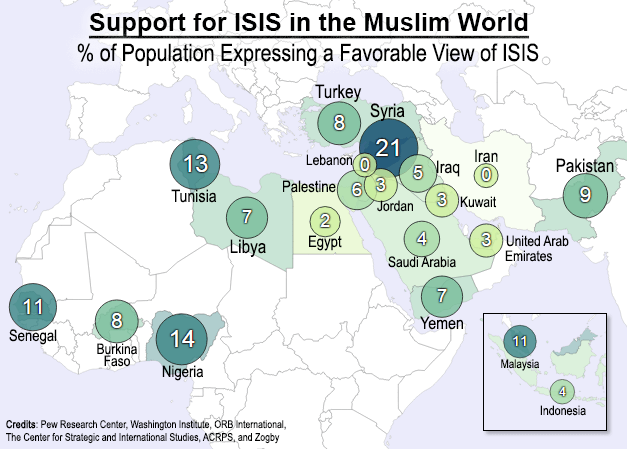
If there are no Muslim moderates, or Muslim moderates are few and far between, why is it that the overwhelming majority of Muslims have a negative view of ISIS?

According to the Pew Research Center, 79% of Indonesians, 84% of Palestinians, 95% of Jordanians, and 100% of Lebanese Muslims repudiate the death-cult that is Daesh. As the Pew Research Center confirms, most Muslims oppose extremism, terrorism, and suicide bombing.

In some cases, Muslims are more moderate than non-Muslims. Take, for instance, the issue of military attacks against civilians. 78% of American Muslims oppose them compared to 58% of American Christians and 52% of American Jews.

As for the stereotype that Muslims are all anti-Israel, think again. According to a Gallup Poll, 81% of Muslim American and 78% of Jewish Americans believe that an independent Palestinian state should co-exist alongside of Israel.

Saying that Radical Islamists and Jihadists are terrorists does not make one an Islamophobe. I do it all the time and I am a committed Muslim.

Putting all Muslims in the same boat, painting them with the same brush, falsifying facts, and trying to convince people that even educated, unveiled, and accent-free Muslim women are extremists is the epitome of Islamophobia.

It is Islamophobic to assert that the Muslim world, as a whole, is currently dominated by bad ideas and bad beliefs.

It is Islamophobic to assert that millions of Muslims fail to denounce terror because they, themselves, are not moderates. They do so all the time. Muslim voices, however, are muffled out by the mainstream media.

It is Islamophobic to assert that the word “moderate,” as we understand it in the Western world, does not apply to Muslims.

It is also Islamophobic to assert that Muslims collectively oppose fundamental rights and freedoms.

Moderate Muslims do not number in the millions. There is over one billion of them. They are the critical mass.

The Muslim world is not a grey zone where you cannot distinguish between friend from foe. It is critical to distinguish between the masses of Muslim human beings from the tiny minority of sub-human terrorists.

The traditional values of Islam are perfectly compatible with the traditional values of the Western world; Judeo-Christian values and Humanitarian values.

The principles of the Prophet influenced the European Renaissance, the Napoleonic Code, the American Constitution, and the Universal Declaration of Human Rights.

The Prophet Muhammad produced the first constitution in the political history of humanity. The Covenants of the Prophet were the first to enshrine modern notions of civic and human rights.

Radical Fake Islam is a deadly disease. It is a cancerous tumor that is attached to the body of Islam. It is a contagious virus that has entered the bloodstream of Islam. It does not belong to the body. It will debilitate, destroy, and kill it. It must be amputated. It must be annihilated by means of antibiotics. The sooner that the cancerous tumor is surgically removed; the sooner that the bloodborne pathogen is neutralized, the better it will be for both Muslims and non-Muslims.

Dr. John Andrew Morrow (al-Ustadh al-Duktur Ilyas Islam) is an Amerindian Muslim leader and a proud member of the Métis Nation. After embracing Islam at the age of 16, he became both a Western academic and a traditional Muslim scholar. He is the author of a large body of scholarly works, the most influential of which is The Covenants of the Prophet Muhammad with the Christians of the World. His websites include www.covenantsoftheprophet.com andwww.johnandrewmorrow.com. His videos and lectures can be found on The Covenants of the Prophet Channel on YouTube: https://www.youtube.com/channel/UCqM3-puvWuKuCEJsDQDZFrA. His Facebook accounts include @johnandrewmorrow and @covenantsoftheprophet. He can be followed on Twitter @drjamorrow.

Related Posts:

mercredi 24 mai 2017
Par John Andrew Morrow
SHAFAQNA – Après chaque nouvelle attaque terroriste en Occident, faussement commise au nom de l’Islam par des hérétiques ou des mercenaires, des politiciens tentent de profiter de la tragédie en faisant de tous les musulmans des boucs émissaires et en diabolisant toute une religion mondiale, alors même que plus de 90% des victimes de Daech sont des musulmans, qu’ils sont en première ligne pour les combattre et que les crimes commis par l’Occident ou Israël, principaux soutiens du takfirisme et du wahhabisme, ne sont (légitimement) pas imputés au christianisme ou au judaïsme. Le Dr John Andrew Morrow présente des faits avérés sur l’Islam et les musulmans.
Traduction : fr.shafaqna.com
Selon le Pew Research Center, 93% du monde islamique est composé de sunnites, chiites et soufis. Ce sont les musulmans orthodoxes. 7% du monde islamique sont composés de Salafistes, Wahhabis et Takfiris. Ce ne sont pas des musulmans orthodoxes. Ce sont des hérétiques. Ce sont les personnes désignées en Occident comme des islamistes, des jihadistes et des islamo-fascistes. En termes statistiques, il n’y a absolument aucun doute que l’écrasante majorité des musulmans sont tout aussi respectueux des lois que les membres de toute autre foi monothéiste. Quiconque prétend autre chose est malhonnête et trompeur…
[Ceux qui stigmatisent les musulmans] invoquent le fait que de nombreux musulmans du Moyen-Orient et de l’Asie du Sud soutiennent la peine de mort pour l’apostasie. Cependant, ils ignorent commodément l’image plus large. 71% de musulmans tunisiens, 73% de musulmans thaïlandais, 78% de musulmans tadjiks, 83% de musulmans turcs, 82% de musulmans indonésiens, 85% de musulmans de Bosnie et de Russie, 89% de musulmans du Kosovo, 92% de musulmans albanais et 96% des musulmans kazakhs s’opposent à la peine de mort pour les personnes qui quittent l’Islam…
Plus de 60% des musulmans soutiennent la démocratie. Si cela semble faible pour certains, c’est parce que les musulmans ont été victimes de fausses démocraties depuis la fin de l’époque coloniale. Si 40% s’opposent à la démocratie, c’est la « démocratie » des dictateurs et des monarques militaires à laquelle ils s’opposent, ainsi que la « démocratie » de l’invasion et de l’occupation occidentales. Interrogés sur la liberté religieuse, 92,6% des musulmans ont affirmé que c’était une bonne chose. Comme le confirme le Pew Research Center, la majorité des musulmans s’opposent à l’extrémisme, au terrorisme et aux attentats suicide…
Dénoncer les islamistes radicaux et les djihadistes n’est pas un acte islamophobe. Je le fais tout le temps et je suis un musulman pratiquant. Mettre tous les musulmans dans le même sac, les peindre grossièrement, falsifier les faits et essayer de convaincre les gens que même les femmes musulmanes éduquées, non voilées et sans accent sont des extrémistes, c’est l’exemple même de l’islamophobie. Il est également islamophobe de prétendre que les musulmans ne se mobilisent pas pour dénoncer la terreur islamiste parce qu’ils ont secrètement une sympathie pour les terroristes. Faux ! Ils le dénoncent tout le temps, par millions. Les voix musulmanes, cependant, sont systématiquement censurées par les médias dominants.
Combien de personnes ont entendu parler du Code d’honneur musulman de l’ISNA (Société Islamique d’Amérique du Nord)? Il dénonce l’extrémisme et la violence.
Combien de personnes ont entendu parler de la Fatwa contre le terrorisme et les attentats-suicides ? Publiée par le Dr Muhammad Tahir al-Qadri en 2010, elle affirme que « le terrorisme est le terrorisme, la violence est la violence, ils n’ont pas leur place dans l’enseignement islamique et aucune justification ne peut être fournie pour eux. » En 2014, il a affirmé que « L’idéologie de Daech revient à de la mécréace pour l’Islam. C’est un anti-Islam, opposé aux enseignements du Prophète de l’islam. »
Combien de personnes ont entendu parler de l’Initiative des Pactes ? Inspirée par Les Pactes du Prophète Muhammad avec les Chrétiens du monde, ce mouvement international de musulmans est impliqué dans la protection des juifs, des chrétiens et des musulmans persécutés et a été à l’avant-garde de la guerre idéologique contre Daech.
Combien de personnes ont entendu parler de la Fatwa de Bin Bayyah ? En septembre 2014, Cheikh Abdallah Bin Bayyah, l’un des savants les plus influents de l’Islam sunnite, a promulgué une longue fatwa condamnant Daech.
Combien de personnes ont entendu parler de la Lettre à Baghdadi ? Sortie en septembre 2014, c’est une réfutation méticuleuse de Daech. Elle a été signée par plus d’une centaine d’éminents spécialistes de l’Islam et dirigée personnellement vers le chef du faux Etat islamique.
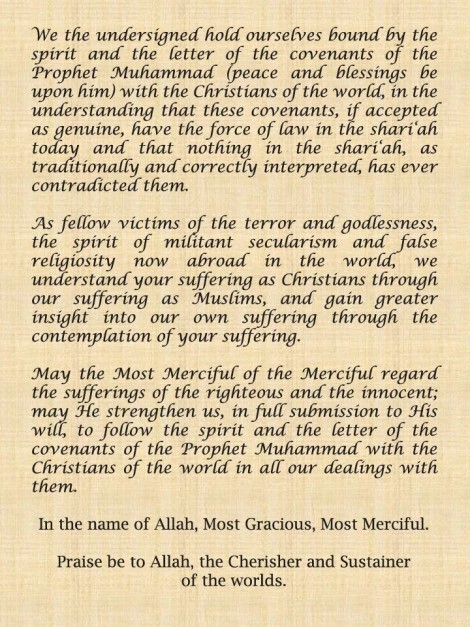
Combien de personnes ont entendu parler du Message d’Amman ? Publié en novembre 2004 et signé par 200 chercheurs islamiques de plus de 50 pays, il appelle à la tolérance dans le monde musulman.
Combien de personnes ont entendu parler de la Déclaration de l’Organisation de coopération islamique ? Publiée en 2014, elle déclare que Daech n’a « rien à voir avec l’Islam » et a commis des crimes « qui ne peuvent être tolérés ».
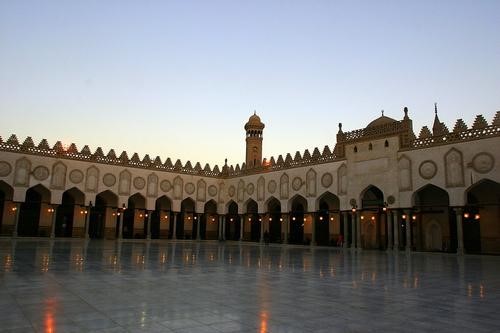
Combien de personnes ont entendu parler de la Fatwa d’al-Azhar ? Émise en 2014, elle affirme que Daech est « un danger pour l’Islam ».
Combien de personnes ont entendu parler de la Déclaration de la Ligue arabe ? Publiée en 2014, elle dénonce les « crimes contre l’humanité » commis par Daech.
Combien de personnes ont entendu parler de la Fatwa qui a été émise par le premier clerc turc, le Mufti Mehmet Gormez ? Émise en 2014, elle affirme que Daech « fait des dégâts considérables» contre l’Islam et les musulmans.
Combien de personnes ont entendu parler des condamnations contre Daech émises par le CAIR (Conseil pour les relations islamo-américaines) ? Depuis 2014, ils ont condamné à maintes reprises Daech comme « non-islamique et moralement répugnant ».
Combien de personnes ont entendu parler de la Déclaration faite par le Conseil musulman de la Grande-Bretagne ? Emise en 2014, elle affirme que « la violence n’a pas sa place dans la religion. »
Combien de personnes ont entendu parler de la Fatwa publiée par le Conseil de jurisprudence de la Société islamique d’Amérique du Nord ? Publiée en 2014 et signée par 126 éminents musulmans, elle affirme que les actions de Daech ne sont en aucun cas représentatives des enseignements de l’Islam.
Combien de personnes ont entendu parler la Fatwa commune sunnite-chiite édictée par 100 Imams britanniques ? Emise en 2014, elle décrit Daech comme un groupe « illégitime » et « cruel ».
Combien de personnes ont entendu parler de la Déclaration publiée par le Conseil des affaires publiques musulmanes ? Publié en 2014, elle condamne Daech et appelle les musulmans à « s’opposer à l’extrémisme ».
Combien de personnes ont entendu parler de Nahdlatul Ulama ? C’est la plus grande organisation islamique au monde, représentant 50 millions de musulmans indonésiens. En 2014, la NU a lancé une campagne mondiale contre l’extrémisme et le wahhabisme.
Combien de personnes ont entendu parler des pensées de Cheikh Muhammad al-Yaqubi sur Daech ? Dans une interview menée en 2014, il a affirmé que « Daech n’a aucune nationalité. Sa nationalité est la terreur, la sauvagerie et la haine. » En outre, il a affirmé que « Baghdadi va tout droit en enfer. »
En 2015, Cheikh al-Yaqubi a publié une conférence intitulée Rejeter Daech : une réfutation de ses fondations religieuses et idéologiques. Dans sa brochure, il déclare que Daech constitue la menace la plus grave que l’Islam ait jamais rencontrée [ce qui est également la position de Sayed Hassan Nasrallah, Sayed Ali Khamenei, Sayed Sistani, etc., qui sont enpremière ligne du combat contre Daech].
Combien de personnes ont entendu parler du djihad qui a été déclaré par le Groupe de Jeunes Musulmans au Royaume-Uni en 2015 ? Ils ont déclaré que des groupes comme Daech n’ont « aucun lien avec l’islam ou la communauté musulmane ».
Combien de personnes ont entendu parler de la Fatwa de masse contre Daech ? Publiée en décembre 2015, elle a été signée par plus de 100 000 clercs musulmans en Inde, au Bangladesh et au-delà, et approuvés par des millions de musulmans.
Combien de personnes ont entendu parler de la Déclaration de Marrakech ? Publiée en 2016 et signée par des centaines de grands dirigeants musulmans, elle exprime leur engagement collectif à l’égard des droits humains, civils, religieux et aux droits des communautés minoritaires dans les pays musulmans.
Last but not least, combien de personnes ont entendu parler de la Déclaration de Grozny qui a excommunié les Salafistes-Takfiris ? Une Fatwa commune émise en Tchétchénie en 2016 par, entre autres, le Grand Cheikh d’Al-Azhar, la plus haute autorité de l’Islam sunnite, a déclaré explicitement que « les Salafistes-Takfirists, Daech (le soi-disant « Etat islamique ») et les groupes extrémistes similaires « n’étaient pas ‘musulmans’ ». [Et la liste est encore longue, et s’étend à toutes les communautés musulmanes d’Orient et d’Occident].
Il est crucial de faire la distinction entre les masses d’êtres humains musulmans et la minuscule minorité de terroristes sub-humains. Les valeurs traditionnelles de l’Islam sont parfaitement compatibles avec les valeurs traditionnelles du monde occidental : valeurs judéo-chrétiennes et valeurs humanitaires. Le Prophète Muhammad a produit la première Constitution dans l’histoire politique de l’humanité. Les Pactes du Prophète ont été les premiers à consacrer les notions modernes de droits civiques et humains. Les principes du Prophète ont influencé la Renaissance européenne, le Code napoléonien, la Constitution américaine et la Déclaration universelle des droits de l’homme.
L’Islam orthodoxe, traditionnel, dominant, civilisationnel et classique n’a pas besoin d’être réformé. Il doit être guéri d’une maladie, d’une innovation toxique, appelée salafisme takfiri, une tumeur cancéreuse attachée au corps de l’Islam. Elle n’appartient pas au corps. Elle veut affaiblir, détruire et tuer le corps. Il faut l’amputer. Plus tôt la tumeur cancéreuse sera enlevée chirurgicalement, mieux ce sera pour les musulmans et les non-musulmans.
Dr John Andrew Morrow, fier musulman, pour l’Initiative des Pactes, mouvement international de protection des victimes de Daech.

May 24, 2017

By Dr. John Andrew Morrow for the Covenants Initiative

Muslims are routinely accused of failing to denounce terrorism. In reality, they are at the forefront of over 300 efforts to oppose extremism, fundamentalism, and violent fanaticism that is committed in the name of Islam by criminals who are outside of its fold.

Although it would be overwhelming to list all these initiatives, the thirty most significant ones have been selected to share with all concerned human beings. Muslims and non-Muslims are encouraged to familiarize themselves with these efforts, to inform others of them, and to support them to the best of their abilities.

  1. ISNA’s Muslim Code of Honor: http://www.isna.net/muslim-code-of-honor
  2. A Common Word Between Us and You: http://www.acommonword.com
  3. Shoulder to Shoulder: http://www.shouldertoshouldercampaign.org/
  4. Dr. Qadri’s Fatwa against Terrorism and Suicide Bombing: http://www.quranandwar.com/FATWA%20on%20Terrorism%20and%20Suicide%20Bombings.pdf
  5. Dr. Qadri’s Fatwa Against ISIS: http://indiatoday.intoday.in/story/isis-is-a-terrorist-state-not-an-islamic-one-tahir-ul-qadri/1/624929.html
  6. The Covenants Initiative: https://covenantsoftheprophet.wordpress.com/2013/08/11/the-covenants-initiative/
  7. The Genocide Initiative: https://www.change.org/p/all-political-players-the-genocide-initiative
  8. Shaykh Bin Bayyah’s Fatwa against ISIS: http://binbayyah.net/english/2014/09/24/fatwa-response-to-isis/
  9. The Letter to Baghdadi: http://www.lettertobaghdadi.com/
  10. The Amman Message: http://ammanmessage.com/
  11. The Statement by the Organization of Islamic Cooperation: http://binbayyah.net/english/2014/09/24/fatwa-response-to-isis/
  12. The Fatwa from Al-Azhar: http://english.alarabiya.net/en/News/middle-east/2015/02/04/Al-Azhar-calls-for-killing-crucifixion-of-ISIS-terrorists-.html
  13. The Statement of the International Union of Muslim Scholars: https://www.middleeastmonitor.com/20140705-prominent-scholars-declare-isis-caliphate-null-and-void/
  14. The Statement from the Arab League: http://newsinfo.inquirer.net/636033/arab-league-confront-isis-now
  15. The Fatwa of Mufti Mehmet Gormez: http://www.reuters.com/article/us-iraq-security-turkey-religion-idUSKBN0FR16120140722
  16. The Statement of CAIR: https://www.cair.com/press-center/press-releases/12551-cair-condemns-isis-violence-and-rejects-calls-to-join-extremists-fighting-abroad.html
  17. The Statement of the Muslim Council of Great Britain: http://www.mcb.org.uk/not-in-our-name-british-muslims-condemn-the-barbarity-of-isis/
  18. The Fatwa of the Fiqh Council of North America: http://fiqhcouncil.org/node/69
  19. The Joint Sunni-Shiite Fatwa by 100 UK Imams: http://wilayah.info/en/sunni-and-shia-british-imams-denounce-isis-together-in-new-video/ https://www.youtube.com/watch?v=2Bd0Y6qWmlA
  20. Association of Muslim Scholars in Iraq: http://www.heyetnet.org/en/index.php/aciklamalar/item/974-statement-no-1007-on-the-expulsion-of-iraqi-christians-from-the-city-of-mosul-by-islamic-state
  21. The Declaration Against Extremism by the Muslim Public Affairs Council: https://www.mpac.org/issues/national-security/mpac-rejects-isis-repugnant-crimes-against-humanity.php
  22. Saudi Arabia’s Council of Senior Scholars: http://af.reuters.com/article/worldNews/idAFKBN0HC0XL20140917?sp=true
  23. The Statements from Nahdlatul Ulama from Indonesia:
    1. http://www.worldreligionnews.com/issues/indonesias-largest-islamic-organization-denounces-isis
    2. http://www.cnn.com/2016/05/10/asia/indonesia-extremism/
    3. htps://www.nytimes.com/2015/11/27/world/asia/indonesia-islam-nahdlatul-ulama.html?_r=0
    4. http://www.huffingtonpost.com/entry/indonesian-muslims-counter-isis_us_565c737ae4b072e9d1c26bda
  24. Shaykh Yaqubi’s Refuting ISIS: http://www.refutingisis.com/
  25. Historic Islamic Edict Fatwa on Joining ISIS/ISIL by the Islamic Supreme Council: http://www.islamicsupremecouncil.com/historic-islamic-edict-fatwa-on-joining-isis-isil/
  26. The Muslim Youth Group’s Jihad Against Extremism: http://www.independent.co.uk/news/uk/home-news/young-british-muslims-declare-own-jihad-against-isis-and-other-terrorists-who-hijack-islam-10146534.html
  27. The Statement by Dr. John Andrew Morrow: http://www.jewishpost.com/news/American-Imam-Issues-Fatwa-Against-ISIS.html
  28. The Mass Fatwa by 100,000 Muslim Clerics from India, Bangladesh, and beyond:
    1. http://www.voanews.com/a/fatwa-endorsed-by-bangladeshi-islamic-scholars-aims-to-curb-terrorism/3384976.html
    2. http://indiatoday.intoday.in/story/more-than-1-lakh-bangladeshi-clerics-sign-anti-terror-fatwa/1/695764.html
  29. The Marrakesh Declaration: http://www.marrakeshdeclaration.org/marrakesh-declaration.html
  30. The Grozny Declaration: http://chechnyaconference.org/material/chechnya-conference-statement-english.pdf

Dr. John Andrew Morrow is an indigenous inhabitant of Turtle Island and a member of the Michif-Otipemisiwak. He professed Islam at the age of 16. He is both a Western academic with a PhD from the University of Toronto and a recognized Muslim scholar. He has authored over thirty scholarly books, the most impactful of which is The Covenants of the Prophet Muhammad with the Christians of the World. His websites include www.covenantsoftheprophet.com and www.johnandrewmorrow.com. His videos and lectures can be found on The Covenants of the Prophet Channel on YouTube: https://www.youtube.com/channel/UCqM3-puvWuKuCEJsDQDZFrA. His Facebook accounts include @johnandrewmorrow and @covenantsoftheprophet. He can be followed on Twitter @drjamorrow.

Introduction

Muhammad ibn ‘Abd Allah was a Prophet. He was a Messenger of God. He was the Seal of the Prophets. This is something agreed upon by all Muslims: La ilaha illa Allah / Muhammadan Rasul Allah: there is no god but Allah and Muhammad is the Messenger of Allah.

Prophethood

Muhammad ibn ‘Abd Allah was a nabi or a prophet, namely, a person sent to preach the Word of God; a person who was following in the footsteps of his prophetic predecessors. He did not preach a new religion; he preached the primordial religion, Islam, submission and surrender to the One and Only God, the Creator and Sustainer of the Universe.

Muhammad ibn ‘Abd Allah was also a rasul or a messenger, namely, a person who was sent with a scripture, a book from God, a revelation, and a code of law. He came forth, not only with ‘aqidah or beliefs but with shari‘ah or law, a comprehensive social, political, and economic system. Islam is a complete way of life.

Unlike the prophets and messengers who preceded him and unlike the founders of other faith traditions, which focus on governing themselves, Muhammad, the Messenger of Allah, also focused on how Muslims should interact with others.

If one reads the Old Testament, and one study the Halakha, one sees that that Jewish Law was concerning primarily with regulating the lives of Jewish people.

If one reads the New Testament, and studies Canon Law, one sees that Christian law was concerned primarily with regulating the lives of Christian people. There is little in the Judeo-Christian tradition regarding the rights of non-Jews and non-Christians. There is little with regards to the manner we should treat different faith communities.

For many religions, both Eastern and Western, it was pretty much: “Follow my way or I will send you on the highway to Hell.” Although the belief system and code of conduct of believers was clearly delineated, the rights of unbelievers were often reduced to the right to die. In many cases, it boiled down to “Convert the unbelievers or kill them all.”

Pluralism

Islam, however, came to the scene with an entirely novel and unique approach: pluralism. Unlike many other religions that insisted that salvation was for them and them alone, Islam insisted that salvation was within the reach of all righteous monotheists. So long as one believed in God, and one did good deeds and avoided evil deeds, one had hope in the mercy of Almighty God. As Almighty Allah, says in the Holy Qur’an:

Surely those who believe, and those who are Jews, and the Christians, and the Sabians, whoever believes in Allah and the Last day and does good, they shall have their reward from their Lord, and there is no fear for them, nor shall they grieve. (2:63)

As Mustafa Akyol, the author of The Islamic Jesus, has observed:

The fact that the Qur’an promised salvation to [the Sabians], along with Jews and Christians, reflects a theological liberality in early Islam that most contemporary Muslims would have a hard time to even consider. (68)

I have studied Islam for over three decades. I too was taught that only Muslims were believers and that only Muslims went to Heaven. I was taught that Christians were mushrikin or polytheists. I was taught that the People of the Book were kuffar or infidels who were destined to eternal damnation in Hell. I studied all the so-called Muslim authorities who misrepresented and misinterpreted the Qur’an to suit their intolerant purposes.

I read all the so-called “authentic” traditions that extremists use to justify denying non-Muslims basic civil and human rights. I read all the so-called authoritative commentaries of the Qur’an that present an intolerant image of Islam. I can assert, openly, and unabashedly, that the extremist, fundamentalist, exclusivist, absolutist, fascist and supremacist interpretation of Islam is false. It represents a re-invention of Islam. It is not the Islam of the Rightly-Guided Caliphs. It is not the Islam of the Prophet Muhammad. And it most certainly is not the Islam of the Qur’an and the Islam of Almighty Allah.

Political Responsibility

When the Messenger of Allah established himself in Madinah, he consulted with Jews, Muslims, and polytheists, and created a constitution, the first of its kind in the political history of humanity. Known as the Covenant of Madinah, it placed all citizens on equal footing with equal rights and obligations. The citizens of the city-state of Madinah consisted of Jews and Arab non-Muslims. They numbered in the tens of thousands. Muslims, however were a minority during the early days of Muhammad’s rule: they numbered in the hundreds. Nonetheless, the Prophet proclaimed that they were a ummah wahidah, a single community, a constitutional confederation.

The term mu’minin or believers is used almost a thousand times in the Qur’an. As Mustafa Akyol recognizes, the term “was a broad umbrella that could incorporate all monotheists” (68). In the Constitution of Madinah and in the Covenants of the Prophet, the Messenger of Allah described the People of the Book as mu’minin or believers. And this makes perfect logical sense: anyone who believes in God is a believer. When the Messenger of Allah referred to his followers, those who embraced Islam, he used the term muslimin or Muslims. The Prophet spearheaded a movement of believers and created a Confederation of Believers. The rightly-guided Caliphs used the title Amir al-Mu’minin, Leader of the Believers, not Amir al-Muslimin, Leader of the Muslims. They were the leaders of all the citizens of the Ummah.

As Mustafa Akyol explains, “The existence of different religious traditions on earth is not an aberration but, quite the contrary the very will of God” (102). As we read in the Holy Qur’an,

And we have sent down the Book to you [Muhammad] with truth, confirming and conserving the previous Books. So judge between them by what God has sent down and do not follow their whims and desires deviating from the Truth that has come to you.

We have appointed a law and a practice for every one of you. Had God willed, He would have made you a single community, but He wanted to test you regarding what has come to you. So compete with each other in doing good. And every one of you will return to God and He will inform you regarding the things about which you differed. (5:48)

This is pluralism plain and simple, a condition or system in which various groups, principles, sources of authority or religious traditions co-exist in respect and tolerance. It is pluralism as defined by Diana L. Eck: energetic engagement with diversity; active seeking of understanding across lines of difference; encounter of commitments; and the language of dialogue.

One day, when the Prophet Muhammad was in Madinah, a delegation of Christians visited him from Najran. They debated and discussed religious matters. They agreed on some issues. They disagreed on other issues. When it came time for the Christians to perform their prayers, they excused themselves to leave the mosque. The Prophet Muhammad insisted that they pray in his mosque as it was a place of prayer and a house of God. And so the Christians prayed and celebrated mass in the mosque of the Prophet. This event is meticulously documented in Muslim sources. Not only is it authentic, it is exemplary. It is the very embodiment of Islamic ethics. Compare that to the actions of ISIS.

There are two visions of Islam that confront us today: an Islam of peace, mercy, tolerance, love, equality, and justice; and an Islam of war, cruelty, intolerance, hatred, inequality, and injustice; an Islam of terrorism, bloodshed, violence, misogyny, and bigotry. Forgive me if I have enough sense of decency and humanity to side with the former, True Islam, and repudiate all those who side with the latter which is nothing less than Anti-Islam. Muslims, true Muslims, must agree to disagree, not only with non-Muslims, but with each other. Had Allah willed, He would have made us all the same. He did not decree uniformity by means of barbarity, like ISIS wants to impose, but diversity and plurality under the wings of mercy. As Almighty Allah says in the Holy Qur’an:

O humankind, indeed We have created you from male and female and made you peoples and tribes that you may know one another. Indeed, the most noble of you in the sight of Allah is the most righteous of you. Indeed, Allah is Knowing and Acquainted. (49:13)

The Qur’an abolishes sexism. The Qur’an abolishes racism. The Qur’an abolishes absolutism. It calls upon different religious traditions to “compete with each other in righteousness” (5:48). It calls upon different religious traditions to defer their differences to the ultimate judgment of God. It is what is known as irja or “postponement;” namely, deferring religious differences to the afterlife.

The Prophet, peace and blessings be upon him, never converted people by force. As Almighty Allah says in the Holy Qur’an, “There is no compulsion in religion” (2:256). Consequently, the Messenger of Allah invited people to Islam. If they accepted Islam, alhamdulillah, praise be to Allah. If they preferred to keep their religion, masha’ Allah, it was the will of Allah. Perhaps they would come into Islam in the future, insha’ Allah, if it is the will of Allah. The Prophet was perfectly clear on the subject. As he wrote in the Treaty with the Kings of Himyar, cited in the Sirah of Ibn Ishaq:

If a Jew or a Christian becomes a Muslim, he is a believer with his rights and obligations. He who holds fast to his religion, Jew or Christian, is not to be turned from it. (643)

As Abu al-Fath al-Samiri, wrote in the Continuation of his chronicle,

The Prophet of Islam did not cause anyone distress throughout his life. He would present his belief before the people, accepting anyone who came to him, [yet] not compelling one who did not.

According to this 14th century Samaritan scholar, “Muhammad never mistreated any of the followers of the Law.” He also related a tradition transmitted by Samaritan elders that stated that: “Muhammad was a good and mighty person because he made a treaty of friendship with the Hebrew People.”

If the People of the Book did not wish to embrace Islam, Almighty Allah called upon them to follow their scripture firmly. As we read in the Holy Qur’an: “So let the followers of the Gospel judge according to what God has sent down in it” (5:47). This is exactly what the Messenger of Allah did. He judged Jews on basis of the Torah; Christians on the basis of the Gospel; and Muslims on the basis of the Qur’an. And that is precisely what the Rightly-Guided Caliphs did. As Imam ‘Ali, may Allah be pleased with him, said when he assumed the Caliphate:

Question me before you lose me. Question me, for I have the knowledge of those who came earlier and those who will come later. If the cushion (on which a judge sits) was folded for me (to sit on), I could give judgements to the people of the Torah by their Torah, to the people of the Gospels by their Gospels, to the people of Psalms by their Psalms and to the people of the Furqan (i.e. Qur’an) by their Furqan, so that each one of these books will be fulfilled and will declare, “O Lord, indeed ‘Ali has given judgement according to Your decree.

Conclusions

This is Islam, true Islam, the Islam of Allah, the Islam of the Prophet, and the Islam of all true Muslims. It is a religion that soothes the soul. It is a religion that satisfies the intellect with certainty. It is a religion based on ethics and morality. It is a religion of piety and righteousness. It is a religion that provides people with rights as opposed to depriving people of rights. It is a religion of personal growth and development; a religion of social justice.

Dr. John Andrew Morrow is an Amerindian Muslim leader and a proud member of the Métis Nation. After embracing Islam at the age of 16, he became both a Western academic and a traditional Muslim scholar. He is the author of a large body of scholarly works, the most influential of which is The Covenants of the Prophet Muhammad with the Christians of the World. His websites include covenantsoftheprophet.com and johnandrewmorrow.com. His videos and lectures can be found on The Covenants of the Prophet Channel on YouTube. His Facebook accounts include @johnandrewmorrow and @covenantsoftheprophet. He can be followed on Twitter @drjamorrow.

The Muslim Post

By Charles Upton

In early May of 2017, the Library of Congress in Washington DC released digital copies of the Covenants of the Prophet. The precious documents were among the 1,687 manuscripts that were microfilmed at the Eastern Orthodox Monastery of St. Catherine’s on Mount Sinai in 1949. Part of the LOC’s collection for over nearly seventy years, the Covenants of the Prophet were only previously available to researchers who requested to view them in person.

When Dr. John Andrew Morrow visited the Library of Congress in November of 2014 to study and make digital copies of the Covenants of the Prophet, Margaret Kieckhefer, the Senior Information and Reference Specialist, was stunned: “You are the only scholar who has consulted the Covenants of the Prophet. All the other scholars who come here are only interested in the Christian manuscripts.”

For years, the Covenants of the Prophet were the personal treasure trove of Professor Morrow. As far as other scholars were concerned, the Muhammadan Covenants could only be found at St. Catherine’s Monastery in Egypt. “Considering that many Covenants of the Prophet were destroyed by fanatics and extremists in the past, and that the terrorists of our times are determined to destroy them, I was relieved to know that copies of them were safely stored in the Library of Congress,” explained Morrow.

Reaction to the release of the Covenants of the Prophet has been mixed. As Dr. Morrow expressed, “I am both sad and glad that these invaluable documents have been placed online under public domain. In the past, I had a monopoly over the manuscripts. This allowed me control over content. Anyone who wished to work in the field had to work with me directly or indirectly. Now, the field is wide open to both friends and foes alike. I am glad, however, that other academics will have access to these primary sources and I hope that they will stimulate scholarship for centuries to come.”

Rachida Bejja, a supporter of the Covenants Initiative, viewed the public dissemination of the Covenants of the Prophet as positive: “Prior to the publication of The Covenants of the Prophet Muhammad with the Christians of the World, there was virtually no knowledge of these documents and even less interest. I am convinced that the Library of Congress published the Covenants of the Prophet online in response to the popularity of Professor Morrow’s ground-breaking book.”

Héctor Horacio Manzolillo, a political commentator and analyst, was far more cynical regarding the public release of the Covenants of the Prophet. “Dr. Morrow is a pioneer in this field. He published The Covenants of the Prophet Muhammad with the Christians of the World in 2013. In 2017, he was set to publish Six Covenants of the Prophet Muhammad with the Christian Communities of His Time in over a dozen languages along with the 2-volume Islam and the People of the BookCritical Studies on the Covenants of the Prophet. As was well-publicized, he was planning to publish the collection of Muhammadan Covenants he had gathered from Mount Sinai and other archives. That project has been scuttled by the Library of Congress. Their timing is certainly suspicious. It is as if they stabbed Dr. Morrow in the back. If they had the Covenants of the Prophet since 1950, why are they just making them available to the public at this very moment?”

In the mind of Manzolillo, the reason behind the release is clear: “The Covenants of the Prophet are an inconvenient truth. They were hidden for centuries. It was thanks to the work of Dr. Morrow that they were resurrected and made relevant. Since the enemies of truth cannot silence Morrow’s voice, they want to drown it out by opening the floodgates; namely, by financing scholars-for-dollars to refute his findings and marginalize his scholarship. The Covenants of the Prophet present a previously ignored societal model that poses a threat to existing power structures. By championing the Muhammadan Covenants, Morrow has made enemies, not only of non-Muslims but of Muslims as well. Whether they are Sunnis or Shiites, the states they have created are inconsistent with the teachings of the Prophet. They tried to ignore Morrow’s findings but they failed. They tried to co-opt Morrow’s findings but he stood firm. Now they seek dilute his findings and re-direct research to castrate the Covenants of the Prophet, make them apolitical, and transform them into ‘historical curiosities’ without practical applications.”

Whether one is positive or negative when it comes to the decision of the Library of Congress to publicly release the Covenants of the Prophet from the Monastery of Saint Catherine at Mount Sinai, the scholarly foundations established by Dr. John Andrew Morrow will remain firmly entrenched. His academic accomplishments have inspired scores of scholars, including the likes of Abdurrahman Abou al-Majd, Eduardo Wassim Abou Ltaif, Zafar Bangash, Kevin Barrett, Bouchra Belgaid, Craig Considine, Mohamed Elkouche, Rosinda Etchegoyen, Naglaa Hassan, Evangelos Katafylis, Qasim Rashid, Reza Shah-Kazemi, Muhammad Sultan-Shah, Walaa Nasrallah, and Ahmed El-Wakil, among many others who are following in his scholarly footsteps.

As Héctor Manzolillo explained, “Considering the socio-political implications of the Covenants of the Prophet, this scholarly interest is precisely what the powers-that-be wanted to prevent. They have used every means possible to convince people in Higher Education and in high-ranking political positions that the Muhammadan Covenants were forged by monks to protect their lives and to obtain other benefits from Muslim rulers. When the Covenants of the Prophet Muhammad with the Christians of the World was published in 2013, articles and ‘scholarly’ studies surfaced alleging that the treaties in question were false and, indirectly, that Morrow was a liar because he based his findings upon them. Nonetheless, the sun continues to spread its light: the importance and veracity of the Covenants of the Prophet continues to spread in all directions: north, south, east and west. Since the truth of the treaties continues to spread, it seems that a new tactic has been developed to negate their importance and impact, particularly in the field of international politics, since the Covenants demonstrate, once and for all, that all the terrorism that is attributed to Muslims and which is devastating entire regions of the planet is un-Islamic. It has nothing to do with Islam. In fact, it is the invention of the enemies of Islam.”

When asked to help guide students and scholars through the massive collection of manuscripts, Dr. Morrow was as gregarious as ever: “Researchers should be pointed to the main page of the collection: (https://www.loc.gov/collections/manuscripts-in-st-catherines-monastery-mount-sinai/about-this-collection). The reel titled Arabic Firmans 1-48. Covenants of the Prophet and Decrees(https://www.loc.gov/item/00279389013-ms) contains five copies of the Covenant of the Prophet in Arabic. The first three date from 1737-1738, 1778, and 1800-1801, while the final two are undated. Scroll 77: Arabic Firmans 961, Addendum, contains a copy of the Covenant of the Prophet in Arabic (https://www.loc.gov/item/00279389153-ms). Microfilm Turkish Scrolls, Reel 1681, however, contains a much larger collection. It features 43 copies of the Covenant of the Prophet in Ottoman Turkish. The documents in the reel date from the 16th century to the 20th century. They can be accessed via the following link:https://www.loc.gov/resource/amedmonastery.00279388975-ms/?sp=1&st=gallery. The reel titled Arabic Manuscripts 695 contains two copies of the Covenant of the Prophet in Arabic, copied in 1683-84. Finally, Arabic Manuscripts 696 contains a Covenant of the Prophet, in Arabic and Turkish, that was copied in 1561 (https://www.loc.gov/item/00279388963-ms).”

As Dr. Morrow observed, the Covenants of the Prophet from St. Catherine’s Monastery are not the only treasures in its library’s ancient collection. “There are thousands of decrees and edicts from Fatimid Caliphs and Ottoman Sultans, along with Muslim jurists from the major schools of jurisprudence, that require meticulous study. Many of them explicitly confirm the rights and freedoms that the Prophet Muhammad granted to the monks of Mount Sinai.” Asked if he had any closing words for this article, Professor Morrow shook his head and said: “The Library of Congress, for good or bad, has released some of its riches. I pray they will prove profitable to investors in the hereafter instead of being squandered by pirates in search of worldly pleasure.”

Charles Upton was born in 1948. His books include Day and Night on the Sufi PathVirtues of the ProphetReflections of TasawwufThe System of Antichrist, and, with Dr. John Andrew Morrow, The Words of Allah to the Prophet Muhammad: Forty Sacred Sayings. He is also the conceiver of the Covenants Initiative, an international movement of Muslims to protect persecuted Christians, based on Dr. Morrow’s book The Covenants of the Prophet Muhammad with the Christians of the World. In 1988, he embraced Islam. Since that time, under two shaykhs, he has followed the Sufi path.

By the Covenant Initiative

SHAFAQNA – 1) MUSLIMS ARE HUMAN BEINGS. 1.6 billion people profess the Islamic faith. 1 out of every 5 people on the planet is a Muslim.

2) MUSLIMS ARE DIVERSE. The Muslim community is as diverse as the Christian community. There are Muslims from every imaginable race, nationality, language, and culture.

3) MUSLIMS, LIKE ALL HUMAN BEINGS, HAVE SHORTCOMINGS. Like Jews, Christians, Buddhists, and Hindus, Muslims have virtues and vices. This is a fundamental part of the human condition.

4) MOST MUSLIMS PRACTICE TRADITIONAL, CLASSICAL OR CIVILIZATIONAL ISLAM. The mainstream Muslim majority practices moderate forms of Islam. They are Sunnis, Shiites, and Sufis.

5) TRUE ISLAM REJECTS EXTREMISM. Both the Qur’an and the Prophet Muhammad explicitly condemn religious extremism

6) TERRORISTS ARE A MINORITY. According to the FBI, 0.001% of so-called Muslims are terrorists.

7) EXTREMISTS ARE A MINORITY. According to the FBI, 7% of so-called Muslims support “Radical Islam.” According to the Pew Forum, the overwhelming majority of Muslims oppose ISIS and other terrorist groups.

8) RADICAL ISLAM IS NOT ISLAM. Extremists and terrorists all follow the Salafi / Wahhabi / Takfiri ideology, a radical re-interpretation of “Islam” that surfaced in Saudi Arabia less than two centuries ago.

9) MUSLIMS ARE THE GREATEST VICTIMS OF TERRORISM. Although they target Christians and Yazidis, the greatest victims of so-called “Radical Islam” are Muslims, particularly Shiites, Sufis, and traditional Sunnis. They represent 95% of the victims of terrorism.

10) MOST MUSLIMS ARE LOYAL, LAW-ABIDING, CITIZENS. Most Muslims are concerned primarily with providing for their families and their future. They are our greatest allies against the extremists and terrorists.

11) MANY MUSLIMS ARE ACTIVELY (NOT JUST PASSIVELY) OPPOSING THE TERRORISTS. There are literally hundreds of declarations, fatwas and ongoing campaigns by Muslims to combat terrorism, throughout the Muslim world and in the United States. One anti-ISIS edict was signed by 100,000 Muslim clerics. Another was issued by an Indonesian organization that represents over 50 million Muslims.

12) THE SALAFI-WAHHABI-TAKFIRIS HAVE BEEN EXCOMMUNICATED. In August of 2016, in Grozny, Chechnya, a group fatwa was issued by the Grand Shaykh of al-Azhar University, the highest authority in Sunni Islam, and several Grand Muftis (also seconded by the Russian Council of Muftis), declaring that the “Salafi / Takfirists… Daesh” and “other extremists” are “not Muslim.”

Conceived by Charles Upon (Sidi Akram), the Covenants Initiative was inspired by The Covenants of the Prophet Muhammad with the Christians of the World by Dr. John Andrew Morrow (Sidi Ilyas Islam). Initially established as an international Muslim movement to protect persecuted Christians, the Covenants Initiative expanded its mandate to protect all  victims of Takfiri terrorism, be they Ahl al-Kitab or Ahl al-Qiblah. The central website of the Covenants Initiative is www.covenantsoftheprophet.com. It also operates the Covenants of the Prophet Channel on YouTube: https://www.youtube.com/channel/UCqM3-puvWuKuCEJsDQDZFrA. Its Facebook page is @covenantsoftheprophet

By Dr. John Andrew Morrow

(al-Ustadh al-Duktur Ilyas ‘Abd al-‘Alim Islam)

Why don’t Muslims speak out against terrorism? It is as much a question as it is a statement. It implies that Muslims do not denounce terrorism because they implicitly support it. This is a logical fallacy. According to the New America Foundation, white, right-wing, so-called Christian extremists have killed more than twice as many Americans on US soil than so-called Muslim Jihadists. I have never heard Caucasian, Christian, Americans speak out against white supremacist terrorism. I don’t expect them to.

Asking Muslims if they support ISIS is as idiotic as asking white Christians if they support the Crusades, the Trans-Atlantic Slave Trade, the Genocide of Native Americans under the name of Christ as Manifest Destiny, the Genocide of the Aboriginal inhabitants of Australia, the Spanish Inquisition, Western colonialism and imperialism, the Salem Witch Trials, segregation, Jim Crow, the lynching of over 5000 African Americans by “good God-fearing Christian,” the Biblically-justified apartheid in South Africa, the KKK and other white Christian supremacists, the Serbian Orthodox Christians who attempted to exterminate the Muslims and Catholics in the former Yugoslavia, the Lord’s Resistance Army in Uganda that has butchered 100,000 people in the name of Christ, or the Christian militias in the Central African Republic that are exterminating and cannibalizing Muslims. I know full-well that no true Christian would support such inhumanity.

Although some Christians are ill-intentioned, most are simply ill-informed. In fact, according to a Brookings Poll, 40% of Americans believe that most Muslims oppose ISIS; 14% think most Muslims support ISIS, and 44% believe Muslims are evenly balanced on the issue.

Support for ISIS in the Muslim World – Perceptions vs Reality

The fact of the matter is that Muslims speak out. Muslims scream and shout. As a minority that makes up merely 1% of the US population, it is hard for Muslims to get heard.

How many people have heard of ISNA’s Muslim Code of Honor? It denounces extremism and violence.

How many people have heard of the Fatwa against Terrorism and Suicide Bombing? Issued by Dr. Muhammad Tahir al-Qadri in 2010, it states that “Terrorism is terrorism, violence is violence and it has no place in Islamic teaching and no justification can be provided for it.” In 2014, he asserted that: “The ISIS ideology is disbelief in Islam. It is anti-Islam; against the teachings of the prophet of Islam.”

How many people have heard of the Covenants Initiative? Inspired by The Covenants of the Prophet Muhammad with the Christians of the World, this international movement of Muslims is committed to protecting persecuted Jews, Christians and Muslims, and has been at the forefront of the ideological war against ISIS.

How many people have heard of Bin Bayyah’s fatwa? In September of 2014, Shaykh Abdallah Bin Bayyah, one of the most influential scholars in Sunni Islam, passed a lengthy fatwa condemning ISIS.

How many people have heard of the Letter to Baghdadi? Released in September of 2014, is a meticulously detailed refutation of ISIS. It was signed by over one hundred of Islam’s leading scholars and personally directed to the leader of the fake Islamic State.

How many people have heard of the Amman Message? Issued in November 2014, and signed by 200 Islamic scholars from over 50 countries, it calls for tolerance in the Muslim world.

How many people have heard the statement from the Organization of Islamic Cooperation? Released in 2014, it declares that the Islamic State has “nothing to do with Islam” and has committed crimes “that cannot be tolerated.”

How many people have heard of the fatwa from al-Azhar? Issued in 2014, it states that ISIS is “a danger to Islam.” 

How many people have heard of the Statement from the Arab League? Released in 2014, it denounces the “crimes against humanity” carried out by ISIS.

How many people have heard of the fatwa that was passed by Turkey’s top cleric, Mufti Mehmet Gormez? Issued in 2014, it states that ISIS is “hugely damaging” to Islam and Muslims.

How many people have heard of the condemnations made against ISIS by CAIR? Since 2014, they have repeatedly condemned ISIS as “Un-Islamic and morally repugnant.”

How many people have heard of the declaration made by the Muslim Council of Great Britain? Released in 2014, it affirms that “violence has no place in religion.”

How many people have heard of the fatwa published by the Fiqh Council of the Islamic Society of North America? Issued in 2014, and signed by 126 leading Muslim scholars, it asserts that the actions of ISIS are in no way representative of the teachings of Islam.

How many people have heard of the Joint Sunni-Shiite Fatwa issued by 100 U.K. Imams? Released in 2014, it describes ISIS as an “illegitimate” and “vicious group.”

How many people have heard of the statement issued by the Muslim Public Affairs Council? Published in 2014, it condemns ISIS and calls upon Muslim to “stand against extremism.”

How many people have heard of Nahdlatul Ulama? It is the largest Islamic organization in the world, representing 50 million Indonesian Muslims. In 2014, the NU launched a global campaign against extremism and Wahhabism.

How many people have heard of Shaykh Muhammad al-Yaqubi thoughts on ISIS? In an interview conducted in 2014, he asserted that “ISIS has no nationality. Its nationality is terror, savagery, and hatred.” Furthermore, he asserted that “Baghdadi is going to hell.”

In 2015, Shaykh al-Yaqubi published a lecture titled Refuting ISIS: A Rebuttal of its Religious and Ideological Foundations? In his booklet, he states that ISIS constitutes the most serious threat that Islam has ever faced.

How many people have heard of the jihad that was declared by the Muslim Youth Group in the UK in 2015? They declared that groups like ISIS have “no link with Islam or the Muslim community.”

How many people have heard of the mass fatwa against ISIS? Issued in December of 2015, it has been signed by over 100,000 Muslim clerics from India, Bangladesh, and beyond, and endorsed by millions of Muslims.

How many people have heard of the Marrakesh Declaration? Issued in 2016, and signed by hundreds of major Muslim leaders, it expresses their collective commitment to the cause of human, civil, religious, and minority rights in Muslim countries.

Last but not least, how many people have heard of the Grozny Declaration which excommunicated the Salafi-Takfiris?  A group fatwa issued in Chechnya in 2016 by, among others, the Grand Shaykh of Al-Azhar, the Grand Shaykh of Al-Azhar, the highest authority in Sunni Islam, explicitly declared that “Salafi-Takfirists, Daesh (the so-called ‘Islamic State’) and similar extremist groups” were “not Muslim”.

I can assert with confidence, dismay, and despair, that 99% of non-Muslims have never heard of these efforts. And though millions of Muslims have participated in them, countless millions more have never heard of them. This ignorance is a scandal.

The Pew Research Center, the Washington Institute, ORB International, the Center for Strategic and International Studies, the Arab Center for Research and Policy Studies, and Zogby all confirm that the overwhelming majority of Muslims are opposed to ISIS.

Support for ISIS in the Muslim World)

I call upon all Muslims who oppose to ISIS, particularly those with sufficient resources to influence the mass media, to dedicate themselves to the publication of these and all other Muslim struggles against Daesh and their co-conspirators to the four corners of the earth. I also call upon our non-Muslim brothers and sisters to share this information with their family, friends, and communities. Millions upon millions have spoken out. It is up to all of us to spread the word.

Dr. John Andrew Morrow is an Amerindian Muslim leader and a proud member of the Métis Nation. After embracing Islam at the age of 16, he became both a Western academic and a traditional Muslim scholar. He is the author of a large body of scholarly works, the most influential of which is The Covenants of the Prophet Muhammad with the Christians of the World.

His websites include www.covenantsoftheprophet.com and www.johnandrewmorrow.com.

His videos and lectures can be found on The Covenants of the Prophet Channel on YouTube. His Facebook accounts include @johnandrewmorrow and @covenantsoftheprophet. He can be followed on Twitter @drjamorrow.

BY: JOHN ANDREW MORROW   SOURCE: ISLAMICITY MAY 16, 2017 NO COMMENTS

Introduction

What good is religion if it is confined to private space? What good is religion if it fails to guide us in public life? We should not cast off our convictions, muzzle our morals, put aside our principles, and eject our ethics when we exit our homes. Almighty God, glorified and exalted be He, the Prophets, and the Messengers, peace and blessings be upon them, provided us with enduring values that are applicable at all times and all places. The Ten Commandments cannot be compromised. The Noble Eightfold Path cannot be compromised. The Golden Rule cannot be compromised. The Seven Grandfather Teachings cannot be compromised: humility, bravery, honesty, wisdom, truth, respect, and love, values that are becoming increasingly difficult for indigenous people to embody due to the soulless nature of secular society. So, woe to those who seek to bend and break universal moral values. They have no sense of the sacred.

The Qur’an and the Sunnah

The Prophet Muhammad provided us with guidance in matters of moral law, religious law, personal law, civil law, criminal law, environmental law, and international law. There are over 100 major fields of law: all of which have been addressed by the Hermit of Hira, Muhammad ibn ‘Abd Allah.

Most Muslims read the Qur’an. And while it is wonderful to be able to read it in Arabic, Muslims should also make sure to study its meaning in a language they understand. When in doubt regarding its interpretation, Muslims consult the full-range of traditional commentaries of the Qur’an to see the full spectrum of readings. They should not rely on a single source. Most Muslims are familiar with Hadith literature. This is positive but perilous. Muslims should be extremely careful as to what they read. They should seek the guidance of traditional teachers. They should rely on reason and maintain moderation. They should focus on the spirit and not the letter.

If most Muslims read the Qur’an and some Muslims read the Hadith, few Muslims, however, have read, much less heard of, the letters, treaties, and covenants of the Prophet. The Messenger of Allah wrote (or dictated, as some prefer), hundreds upon hundreds of letters. This is a historical fact. It is indisputable. These documents are found in books of prophetic traditions, books of Qur’anic commentary, books of jurisprudence, and books of history. They form a fundamental part of our Islamic tradition and heritage. As Agapius of Hierapolis, a 10th century Christian author, acknowledged:

Their leader was a man called Muhammad, the son of ‘Abd Allah… He became their chief and king… Christians from the Arabs and others came to him and he gave them a guarantee of safety and wrote documents for them… All the people in opposition to him did likewise, I mean the Jews, the Zoroastrians, the Sabians, and others; they paid allegiance to him and took from him a guarantee of safety on the condition that they would pay him the poll-tax and the land-tax.

Ancient Muslim, Christian, Jewish, Samaritan, and Zoroastrian sources all confirm that the Prophet protected the lives, property, and places of worship of the People of the Book. Churches, monasteries, synagogues, and fire-temples, were all subject to protection.

The Letters, Treaties, and Covenants of the Prophet

If people wish to truly understand the Prophet Muhammad as a religious leader, as a diplomat, as a politician, and as a military strategist, they must absolutely study the letters, treaties, and covenants of the Prophet Muhammad and his extensive correspondence with Jews, Samaritans, Christians, and Zoroastrians.

Those who read Arabic should study Majmuʻah al-wathaʼiq al-siyasiyyah li al-ʻahd al-nabawi wa al-khilafah al-rashidah by Muhammad Hamidullah. Those who read Arabic should study Makatib al-Rasul by ‘Ali Ahmadi Minyanji. Those who read English should study Power Manifestations of the Sirah: Examining the Letters and Treaties of the Messenger of Allah by Zafar Bangash.

The most comprehensive source in the English language, however, is The Covenants of the Prophet Muhammad with the Christians of the World. It is a work that provides an authoritative analysis of prophetic pluralism. After that, I would point readers to Islam and the People of the Book: Critical Studies on the Covenants of the Prophet, a forthcoming work that should be printed at some point in 2017.

Although I cannot possibly cite hundreds of letters from the extensive and impressive correspondence of the Prophet Muhammad, I will limit myself to reading the Master Template that he used when granting covenants of protection to the People of the Book as reconstructed and translated by Ahmed El-Wakil.

The Master Template of the Muhammadan Covenant with the Christians

In the name of Allah, the Most Gracious, the Most Merciful.

This is a writ that Muhammad ibn ‘Abdullah ibn ‘Abd al-Muttalib the Messenger of Allah has written to all Christians and to all the nations within which they reside to protect and to safeguard them because they are Allah’s trust among His Creation, so that there be evidence in their favor and for people to no longer have an excuse in front of Allah after the coming of the messengers. And Allah is All-Mighty and All-Wise.

He wrote it for the people of his creed and to all those who profess the Christian religion — in the Eastern lands and in the West, near and far, be they Arabs or non-Arabs, known or unknown — a writ which constitutes an authoritative covenant, a definitive decree and an established sunnah so that justice may prevail and for it to stand as an inviolable pact of protection.

He who observes it holds to the religion of Islam and is worthy of it. As for he who violates it and jeopardizes the covenant by opposing and transgressing what the Messenger of Allah has commanded therein, he has broken the covenant of Allah, denied His oath, and forsaken his protection thereby making himself subject to the divine curse, regardless of whether he be a Sultan or any other person among the Believers and the Muslims.

I have committed myself to granting the covenants and the pledges which have been requested of me and from all those who follow my creed among the Muslims. I give the Christians the covenant of Allah and His pledge and place them under the safeguard of His prophets, His chosen ones and His saints from among the Believers and the Muslims so that it be binding among the first and the last of them.

My protection and pledge is the most solid that Allah has taken from a prophet who has been sent or from an angel who is stationed near [the divine throne], thereby rendering mandatory the obedience, obligations and adherence to the covenant of Allah.

I protect their land with all my power, my horses, my men, my weapons, my strength and my followers among the Muslims from every region where the enemy lies, whether they be close by or far away, and regardless of whether the Muslims are at peace or at war.

I protect their surrounding areas and grant security to their churches, convents, houses of worship, the places of their monks and pilgrims, wherever they may be found, be they in the mountains or the valleys, the caves or the inhabited regions, the plains, the desert or in buildings, that I should safeguard them, their religion and creed wherever they may be found in the sea or on land, in the East or West in the same way that I protect myself, my entourage, and the people of my creed from among the Believers and the Muslims.

I place them under my protection and I give them my pledge and my security at every moment. I defend them from every harm, mischief and retribution. I am behind them, protecting them from every enemy who wishes us harm. I myself protect them by means of my helpers, my followers and the members of my creed because they are under my responsibility and my protected people whom I govern. I must therefore care for them and protect them of all harm so that it does not reach them unless it first reaches me and my Companions who with me defend the integrity of Islam.

I remove from them all mischief that people of the covenant have to bear of supplies which they give as loaned goods and as land taxes [kharaj] except what they voluntarily consent to and that they should neither be forced nor compelled in this matter.

It is not permitted to remove a bishop from his bishopric, a monk from his monastic life, a Christian from his Christianity, an ascetic from his hermitage, or a pilgrim from his pilgrimage. Nor is it permitted to destroy any part of their churches or their convents or to take parts of their buildings to construct mosques or homes for the Muslims. Whoever does such a thing will have violated the covenant of Allah, opposed His messenger and betrayed the protection granted to him by Allah.

It is not permitted to impose the jizyah or any kind of land tax [kharaj] on monks, bishops and those worshippers who by devotion wear woolen clothing or live alone in the mountains or in other regions secluded from human habitation.

The jizyah for those Christians who have not consecrated their lives to divine worship and who are neither monks nor pilgrims will either be at a rate of 4 dirhams per year or the provision of a garment to support the Muslims and to strengthen the Treasury. If the garment is too difficult for them then it will not be binding upon them unless they willingly consent.

The jizyah will not surpass more than twelve dirhams per year for landowners and proprietors of estates and large businesses at sea and at deep-sea — who exploit mines for precious stones, gold and silver — including those who are wealthy and powerful among those who have professed Christianity so long as they are inhabitants and residents of the land.

The traveler who is not a resident in the land and he who is a foreigner will not have to pay the land-tax [kharaj] or the jizyah except he who has inherited land over which the Sultan has a monetary right. He must pay the money as others do without there being any excesses and he should not be made to bear what is beyond his strength or means in the cultivation, development and harvest of the land. He should also not be taxed excessively and above the limit that has been set for landowners who are inhabitants of the land.

The people under our protection will not be obliged to go to war with the Muslims to face their enemies and to combat them. The reason for this is that they have been given our protection so that they be discharged of this obligation and it is therefore the Muslims who will be responsible for their safety and protection. The Christians will not be obliged to equip the Muslims for any of their wars against their enemies by means of weapons and horses unless they freely contribute of their own volition. Whoever does so will be the object of praise, reward, and gratitude, and his help will not be forgotten.

No one who follows the Christian creed will be forced to enter into Islam — and dispute not with them except with means that are better (Q29:46). They must be covered by the wing of mercy and all mischief and harm that could reach them, wherever they may find themselves and wherever they may be, must be repelled.

If a Christian were to commit a crime or an offense, Muslims must stand by his side, help him and support him. They must safeguard him and pay the penalty for his offense. They should encourage reconciliation between him and the victim to either help or save him.

The Muslims must not abandon the Christians and leave them without help and assistance since I have given them the covenant of Allah to ensure that they have the same rights and obligations as the Muslims. Furthermore, the Muslims have an obligation toward them with respect to the covenant, guaranteeing them the right of protection and safeguarding everything that is sacrosanct. They also have accepted that every mischief be removed from them and that they be bound to the Muslims so that they and the Muslims become partners with one another in the mutual rights and obligations that they share.

Christians must not be subject to suffer abuse in matters pertaining to marriages, except for what they themselves agree. Christian families should not be compelled to marry their girls to Muslims and they should not be subject to any maltreatment if they decline a suitor or refuse a marriage proposal. Such marriages should only take place if they desire them and with their approval and consent.

If a Muslim takes a Christian woman as a wife, he must respect her Christian beliefs. He must support her religious aspirations so that she may receive religious instruction from her [clerical] superiors and he must allow her to fulfill her religious obligations. He must not ever prevent her of this. He must also not force her to act contrary to her religion or abuse her so that she abandons it. If he does this, and forces her, then he has broken the covenant of Allah and violated the pledge [given to the Christians] by the Messenger of Allah, and in the sight of Allah he is among the liars.

The Christians hold the right to request assistance from the Muslims to help them repair their convents, monasteries or for any other matter pertaining to their religious affairs. The Muslims must help them without the aim of receiving any compensation: they should aim to restore that religion out of faithfulness to the covenant of the Messenger of Allah and as a gift and donation to them from Allah and His messenger.

In matters of war between them and their enemies, the Muslims must not employ any Christian as a messenger, guide, helper, informant, or for any other duty of war. Whoever obliges one of them to do such a thing will have committed an injustice, disobeyed the Messenger of Allah and become free of his protection. The Muslims must uphold the stipulations which Muhammad ibn ‘Abdullah ibn ‘Abd al-Muttalib, the Messenger of Allah, has issued in favor of those who follow the Christian creed.

He has also placed conditions in their religion concerning their pact of protection which they must abide by as part of the covenant which they have contracted with him. Among other things, none of them are to support an enemy of war against the Muslims, either openly or covertly. They are not to shelter them in their homes from which they could await the moment to launch an attack. These enemies [of the Muslims] should never be allowed to halt in their regions, their villages, their places of worship, or in any other place belonging to their co-religionists. They must not provide any assistance to them by furnishing them with weapons, horses, men or other logistical support. They must not allow them to deposit any of their wealth or exchange any correspondences with them. They are not to host them as guests except that it should be in a monastery where they are seeking refuge and protection for their livelihoods and their religion.

The Christians must host the Muslims along with their mounts for three days and three nights when they halt among them. They must offer them wherever they may be located or stationed the same food that they consume. They are not obliged to do any more, for in fulfilling this obligation they have removed all harm and mischief that may reach the Muslims.

If one of the Muslims needs to hide in one of their homes or in one of their places of worship they must grant him hospitality, help him and stand by his side so long as the Muslim remains in hiding. They must conceal him from the enemy, not disclose his location and accommodate for all of his needs.

Whoever contravenes any of these conditions or transgresses them by altering them has freed himself of the protection of Allah and that of His messenger. The Christians possess the covenants and the pledges which I took from their priests, monks and from other Christians from among the People of the Book. It is the most solid trust that Allah and His prophet have placed on the community so that they may abide by what the Prophet himself has decreed upon them and upon all of the Muslims, to ensure their protection and as benevolence to them until the Hour arrives and the world comes to an end.  Whoever is unjust after this toward a protected person by breaking and rejecting the covenant, I will be his enemy on the Day of Judgment among all the Muslims.

Conclusions

What more could I possibly say? What on earth could I possibly add to the words of the Prophet, peace and blessings be upon him. I am unworthy. His wisdom leave me completely and utterly speechless. Peace be upon the Prophet of Allah. Peace be upon the Messenger of Allah. And peace be upon all the followers of righteous guidance.

Dr. John Andrew Morrow is an Amerindian Muslim leader and a proud member of the Métis Nation. After embracing Islam at the age of 16, he became both a Western academic and a traditional Muslim scholar. He is the author of a large body of scholarly works, the most influential of which is The Covenants of the Prophet Muhammad with the Christians of the World. His websites include http://www.covenantsoftheprophet.com and http://www.johnandrewmorrow.com. His videos and lectures can be found on The Covenants of the Prophet Channel on YouTube: https://www.youtube.com/channel/UCqM3-puvWuKuCEJsDQDZFrA . His Facebook accounts include @johnandrewmorrow and @covenantsoftheprophet. He can be followed on Twitter @drjamorrow.

03.04.2017

Geopolitica

The last critic to confront The Covenants of the Prophet Muhammad with the Christians of the World prior to the publication of Islam and the People of the Book is Carlos Martínez Carrasco who published a review of the Spanish version of the former, El minarete y el campanario: los pactos del Profeta Muhammad con los cristianos del mundo in Miscelánea de estudios árabes y hebraicos (Vol. 66: 348-351) in 2017.

Rather than address questions of content as called upon by any reputable reviewer, Martínez Carrasco commenced with a personal attack, calling into questions my credentials, stating that it has never been more important to know an author prior to getting to know his work. He alleges that the Spanish translation of The Covenants of the Prophet Muhammad with the Christians of the World “”is not an academic study with a methodology that is in accordance with the field of studies to which it corresponds.”

Martínez Carrasco claims that a review of my CV demonstrates that my academic training is distant from the field of Arabic and Islamic Studies. He observes, rightfully so, that I am a Professor of Foreign Languages, an expert in the Spanish language and Hispanic Studies, and that I completed a doctoral dissertation on The Indigenous Presence in Rubén Darío and Ernesto Cardenal (2000). He also claims that my interest in a field that is so different from my professional area of expertise is a result of my conversion to Islam at the age of 16, a personal journey that led me to complete studies in the Islamic Tradition both inside and outside of academia.

To Martínez Carrasco I say what Imam ‘Ali said to the Kharijites: “There is both truth and falsehood in what you say.” It is true that I completed a Bachelor’s degree in Spanish and French Language and Literature, along with an M.A. and a Ph.D. in Spanish American Literature. I have always been open about my academic accomplishments.

If I completed undergraduate and graduate majors in the Department of Spanish at the University of Toronto there was a reason: it was the only place where I could specialize in the three fields that fascinated me the most: Hispanic Studies, Native Studies, and Islamic Studies.

As a Hispanist, I studied the Spanish language and linguistics. I took courses in the history of Spanish, becoming perfectly well-versed in the Arabic influence on the Spanish language. As part of my academic training, I studied Spanish culture, history, and civilization, including the nearly 800 years of Arabic Muslim rule in al-Andalus. Consequently, I am perfectly well-versed in the history of Islamic Spain.

I obviously studied Spanish literature, including the influence it received from Arabic and Islamic literature. It is called Comparative Literature. It is what scholars like Luce López-Baralt do. One cannot compare two literary traditions unless one is an expert in both. Consequently, not only am I perfectly well-versed in Spanish literature, I am perfectly well-versed in Arabic literature. Hence, I am both a Hispanist and an Arabist.

I was introduced to Morisco literature by the distinguished Dr. Ottmar Hegyi when I was an undergraduate student. It was he who encouraged me to enter graduate school and complete a thesis on Aljamiado literature. I spent over a decade researching the topic in preparation for my dissertation; however, my mentor, Professor Hegyi, retired prior to its completion. That work, Shi’ism in the Maghreb and al-Andalus, is set to be published in the near future. It is a work that was researched and written while I was a graduate student at the University of Toronto.

Since the retirement of my mentor, an eminence in Aljamiado-Morisco literature and the influence of Islam on Spanish literature, left me without a thesis director, I decided to complete a thesis on The Islamic Presence and Influence in Pre-Columbian America, a work that bridged Hispanic and Islamic Studies. I completed all the research required and wrote a significant portion of my thesis only to learn that a sector of scholars did not consider it “politically correct.” They dogmatically embraced the notion that there was no contact with the Americas prior to Columbus. My work, in their view, was historical revisionism. I am sure they had anxiety attacks when it was established that the Norse had been traveling to these lands as early as the 10th century. Lance aux Meadows must have been a nightmare for them. Although I believe that some Muslims and Black Nationalists grossly exaggerate claims of African and Arab contact with the Americas, I have little doubt that some Arabs and Africans crossed the Atlantic prior to Columbus.

Rather than research myself out of existence, I decided to select a topic that was acceptable to all faculty members in the Department: The Indigenous Presence in Rubén Darío and Ernesto Cardenal. This subject bridged two interests: the Hispanic world and the indigenous world. And while the Islamic connection may not appear evident to outsiders, it should be noted that the work of Ernesto Cardenal is also influenced by Sufism and Political Islam. The fact that I specialized in the work of Ernesto Cardenal explains my authorship of Religion and Revolution: Spiritual and Political Islam in Ernesto Cardenal, a work that could only be completed by a person who is a specialist in both Hispanic literature and Islamic literature.

Martínez Carrasco might argue that I have no formal academic training in the field of Religious or Islamic Studies. This is false. I took courses in Religious Studies, Islamic Studies, and Philosophy at the University of Toronto. In fact, one of my professors was Dr. Solomon Alexander Nigossian, an Armenian Christian from Egypt who taught in the Department of Religion at the University of Toronto for decades. An accomplished academic, Nigosian authored many works on Islam. It was he who taught me the methodology employed in the field of Religious and Islamic Studies.

Martínez Carrasco also fails to mention that I completed post-doctoral studies in Arabic at various language institutes in the United States and Morocco. He fails to mention that I was never solely a Spanish Professor. I was a Professor of Spanish, French, and Arabic. In fact, I designed the entire Arabic major for a state university, including all the course offerings. What is more, I was hired by the University of Virginia to teach Religious Studies. I taught a course on Ibn Battutah as well as a course on Islam for its Semester at Sea program. Finally, all of my courses on Spanish Civilization and Culture included a component on the history of al-Andalus.

Although Martínez Carrasco treats it as irrelevant, I also completed the full cycle of traditional Islamic Studies both independently and at the hand of Muslim scholars from the Sunni, Shi’ite, and Sufi persuasions. I am widely recognized as an ustadh [professor of Islam], a shaykh [a Muslim religious leader], an ‘alim [religious scholar of Islam], and a hakim [Islamic herbalist]. These are not titles that I arrogantly assumed. They are titles that were granted to me by my peers.

Imam Ilyas Fawzy from al-Qarawiyyin University stated that “Your knowledge of Islam is profound.” Al-Shaykh al-Habib ‘Ali al-Jifri said that “Doctor John is very strong in Islamic Studies.” I am called upon to peer-review the works of Muslim jurists. Religious Authorities refer to me as a Religious Authority. This should suffice as proof of my qualifications. It is not necessary for me to list any more words of praise from fellow scholars and colleagues. Martínez Carrasco, however, would argue that the people I cite are clerics, as opposed to academics, as if priests, rabbis, and muftis were not reputable scholars.

I am far from being unique in combining both Hispanic and Islamic Studies. Other scholars who have done the same include Ottmar Hegyi, Luce López-Baralt, María Rosa Menocal, J.T. Cutillas-Ferrer, Maria Luisa Lugo Acevedo, Francisco Marcos Marín, T.B. Irving, L.P. Harvey, Gerald Albert Wiegers, A.G. Chejne, Vincent Barletta, Karima Bouras and the scores of scholars who specialize in Islamic Spain and Aljamiado-Morisco literature. I am an aljamiadista. That makes me a Hispanist, Islamologist, and an Arabist.

As Martínez Carrasco repeats, however, “I do not consider The Covenants of the Prophet… to be a study that is rooted in scientific criteria but rather a religious apology shrouded in pseudo-historical rhetoric.” In other words, the fact that I am a Muslim automatically excludes me from being an objective academic grounded in a scientific methodology. This is bigotry plain and simple. It is a discriminatory decree issued from a podium of prejudice. If being a Muslim disqualifies me from writing objectively about Islam, being a non-Muslim disqualifies Martínez Carrasco from writing about Islam. He subjectivity and hostility toward Islam is manifest.

After briefly describing the content of the book, Martínez Carrasco asserts that “From the first pages of the book, it is obvious that J.A. Morrow’s objective in The Covenants of the Prophet… is to whitewash the image of Muslims and defend them from those who accuse them of being extremists.”

Martínez Carrasco claims that The Covenants of the Prophet is a response to those who accuse Muhammad of being a bloody murderer who spread Islam by the sword. For this reason, claims the Spanish critic, I focus exclusively on the Covenants with the Christians while I am much more critical of the Jews. Apparently, this is because I live in “an eminently Christian environment.”

I am not an apologist. I do not have an agenda. I am an academic. I study sources and I let the sources speak for themselves. I have written and spoken about the gestation of The Covenants of the Prophet Muhammad with the Christians of the World. Martínez Carrasco should have done some research prior to make such specious allegations. Although he went out of his way to check my background and judged my book on the basis of it, he failed to find out that I am as interested in the Covenants of the Prophet with the Jews, Samaritans, and Zoroastrians as I am in the Covenants with the Christians.

Martínez Carrasco complains that “the entire book revolves around the idea of Islam as a religion of peace that embraces and supersedes the previous monotheisms.” It is for this reason, argues Martínez Carrasco, that both Héctor Horacio Manzolillo and I draw attention to the need for an interreligious understanding in face of new challenges, such as the eco-genocide that is faced by the planet. In other words, Manzolillo and I are really Islamic dominionists. As Martínez Carrasco writes,

Despite this desire to go beyond religious differences between Christians, Jews, and Muslims, the pages devoted to analysis occult a rather dangerous message which should be drawn to attention. Perhaps it is worthwhile to remember that we are dealing with a work written by a convert to Islam. The work contains an underground ideological current that blames all evils on the materialism of Western civilization while, at the same time, contrasts the spirituality of the Arab world which is treated (erroneously) as a homogeneous block. This idea makes Morrow, unwittingly and unconsciously, a hostage to a colonialist vision that makes the Arabs an ahistorical people, oblivious to the changes experienced in the world over the centuries, which keeps them in a state of ‘innocence.’

I have never seen such a twisted interpretation in all my life. Since when do I confound Arabs with Muslims? I make that distinction very clear. I am the very last person to idealize Arabs and Muslims. I absolutely accept the Prophet Muhammad. I respect other authorities of Classical Islam. And I bash anyone and everyone who fails to adhere to primordial ethical principles.

What kind of person considers the Covenants of the Prophet with the People of the Book to be dangerous? On the contrary, I contend that those who oppose them are particularly perilous. And while I blame the West for its sins and shortcomings, I am also the first to sing its praises. And the same goes for the East, the North, and the South, I say it like it is. I give praise when praise is due and I criticize when I am compelled to do so. It is my duty as a responsible scholar and academic.

Martínez Carrasco alleges that Manzolillo’s criticism of democracy as some sort of panacea is an indication of the general tone of the work. How a comment made by the translator in the commendatory preface can apply to the work itself is incomprehensible. This is far from being a major or even minor theme in the study. Apparently, it offended the critic enough to him to ask readers to “come of their own conclusions.” In other words, Morrow and Manzolillo are opposed to democracy. The comments of the critic reek to high heaven.

If Martínez Carrasco had conducted proper research, he would know full well that Manzolillo and I strongly support participative and representative democracy and oppose all forms of dictatorship and despotism. Simply because we criticize the pseudo-democracy of the ancient Greeks and Romans and the corporatocracy that is falsely presented as democracy today does make us anarchist or totalitarian in political inclination.

Manzolillo’s comments certainly struck a chord for they remain a bone in Martínez Carrasco’s throat. He claims that the background of the book consists of a comparison between Western, liberal, parliamentary democracies and Islam as a political-religious entity. In the words of the critic,

J.A. Morrow argues that Greco-Roman democracy was based on slavery and was profoundly unequal while Islam, from its onset, was opposed to slavery, provided equality to all, believers and unbelievers, regardless of age and gender, which immediately makes Islam, according to the author, superior to democracies. Perhaps he forgets that that the traffic of slaves persists to this day in the Islamic world although actual figures are unknown. Morrow perhaps also forgets that he can write books like this one due to the rights that are granted to him by such a pernicious system as democracy.

There is no doubt in my mind that the vision of Islam promulgated by the Prophet Muhammad is far superior to the so-called democracies of the Greeks and Romans. In fact, when given a choice between early Islamic rule and Byzantine rule, most of the Jews, Samaritans, and Christians of the Middle East, North Africa, and the Iberian Peninsula opted for Islamic rule despite the fact that few if any Muslim rulers lived up to the standards set forth by the Messenger of Allah. Still, even with its shortcomings, the system of government implemented in Muslim lands granted rights, freedoms, and protections that only surfaced in the Western world in the 20th century.

If Martínez Carrasco had any sense of honesty, he would distinguish between the teachings of Islam preached by the Prophet and the un-Islamic practices of pseudo-Muslims. The Prophet Muhammad never owned slaves. He never encouraged his Companions to own slaves. He said that slave traders were the worst of human beings. He promoted and even mandated the liberation of slaves. Both he and his Companions freed tens of thousands of slaves. Based on a survey of early sources, it is estimated that they liberated 39,000 enslaved human beings.

Rather than bash Islam for the fact that some barbarians in places like Sudan, Chad, and Mali, engage in slavery, how about taking a long hard look in his own mirror, the West, where women and children are enslaved in staggering numbers. In the United States, over 100,000 girls are sold into sexual slavery every year. The numbers in Europe are comparable. ISIS sex slaves get plenty of media attention; however, they pale in comparison to the number of sex slaves in modern, Western, democracies. While an institution like slavery in parts of Black Africa that has not changed substantially since medieval times is one thing, it is another thing altogether for there to be sex slaves in Western Europe and the United States, the self-professed bastions of democracy and human rights, regardless of the fact that both forms of slavery, both Eastern and Western, are absolutely reprehensible.

Martínez Carrasco claims that “with such premises as a starting point, it is legitimate to believe that we are not dealing with a scientific study of historical facts based on textual evidence. On the contrary, what Morrow articulates is a clearly religious discourse that does not seek to establish a more or less rigorous understanding of the past, but rather a theological Truth, with everything that it implies.”

Martínez Carrasco insists that the theological discourse of The Covenants of the Prophet Muhammad with the Christians of the World is evident in the incorrect use – out of ignorance – of historical terminology which is continually interpreted in a religious light. The critic alleges that my approach to Islamic sources is almost always acritical and that any hypothesis that questions the Islamic Canon is quickly dismissed as being the product of “spiritually insecure scholars.”

Although I do not have a degree in history, I was trained in historical methodology. I know full well how to handle sources. Hundreds of academics, including historians, have praised and endorsed The Covenants of the Prophet Muhammad with the Christians of the World. Of course, such facts are ignored by certain cave-dwelling Spaniards. And in case Carrasco did not capiche, the Muhammadan Covenants do not form a part of the Islamic Canon. They were ignored. They were suppressed. They were extirpated. And they are now being revived. If the critic bothered to read the book in its entirety, rather than focus on a few words by the translator, he would know that I do not defend the status quo. On the contrary, I argue that the Covenants of the Prophet were concealed by so-called Muslim leaders who wanted freedom of action without having to truly take prophetic principles into consideration. In fact, I am relentless in my criticism of literalism, fundamentalism, and extremism.

Martínez Carrasco claims that I yearn for “the ‘golden age’ represented by the prophetic period during which Muhammad ruled; a Muhammad who is presented as a man of peace, an anti-colonialist, but who is simultaneously presented as a great military strategist.’”

Neither Manzolillo nor I yearn for a “golden age” of Islam. We are not Salafis who dream of an imaginary, legendary, and mythical Muslim utopia rooted in the 7th century. We value positive aspects. We criticize negative aspects. We realize that nothing is perfect. Since we live in the present, and plan for the future, we do not live in the past. We do, however, study the past in order to inform our understanding, to avoid previous mistakes, and to adopt strategies that will prove to be successful. We seek not to imitate. We seek not to replicate. We seek to derive principles and to apply them.

As for Muhammad, the man was well-rounded. He was a mystic but a man of the people. He was unlettered but erudite. He was powerful but humble. He could convey concepts to both formally trained scholars and to simple shepherds. He was caring and compassionate but he could be ferocious in battle. War and peace go hand in hand. If you want peace, you better prepare for war. This is reality. The Prophet Muhammad himself said, “I smile and I fight.” He came with the Word and the Sword but it was the sword of social justice.

Continuing with the same preposterous claim, Martínez Carrasco warns that “The discourse is masked by an alleged equidistance between the ‘black legend’ and the ‘pink legend.’ But what it really offers is an updated version of the second adorned with an argument that does not hold up to a critical analysis, such as the claim that it was Muhammad who elaborated the dogma of the Immaculate Conception.”

Unless one is familiar with Hispanic history, the reference to the “black legend” and the “pink legend” will be lost to most readers. In the Hispanic context, the “black legend” refers to the claims that the Spaniards committed genocide against the indigenous inhabitants of the Americas. In the Muslim context, the “black legend” mentioned by Martínez Carrasco would be the demonization of Islam and Muslims that was common throughout European history whereas the “pink legend” is the presentation of Islam, particularly in the Iberian Peninsula, which is depicted as some sort of “Golden Age.”

In the mind of the critic, The Covenants of the Prophet Muhammad with the Christians of the World is simply a repackaged version of the “pink” or “rosy legend” that does not stand up to critical analysis. Once again, if the critic actually read or actually understood what he read, he would know that I praise the principles and protections that the Prophet provided in his Covenants with the Jews and Christians. I am impressed with those promises and privileges. I am only impressed with Muslim leaders inasmuch as they abided by them. In short, they are the litmus test that I use when assessing the Islamicity of so-called Islamic rulers.

As for Martínez Carrasco’s claim that I asserted that it was Muhammad who elaborated the dogma of the Immaculate Conception, I will allow my book to speak for itself. It reads: “While most Muslims and Christians are ignorant of the possibility, it appears that the first person to formulate the doctrine of the Immaculate Conception was Muhammad himself, a fact conceded by both Catholic and Protestant theologians (Grassi 74). Some assert that the Prophet learned such doctrines from the Eastern Christians, but ignore the strong evidence that the Christians might in face have learned it from him” (13).

However, as any intelligent reader observes, it is not I who is making the claim, it is M. Grassi (Alfio) in his Charte Turque ou Organisation religieuse, civile et militaire de l’empire ottoman which was published in Paris in 1826. As for myself, I simply state that there is strong evidence to support this claim. The comment in question, which is completely peripheral to the study as a whole, completely and totally sidelined the critic who actually misrepresented that I wrote. Dumb or duplicitous? To quote Carrasco, I will let readers “come to their own conclusions.”

To conclude his Islamophobic review, Martínez Carrasco writes that: “The Covenants of the Prophet… should be placed on the opposite end of the spectrum of revisionists works that overemphasize the negative aspects of Islam. It pursues a legitimate objective, but it does so at the cost of falsifying the past, which does not lead to a better understanding of Islamic reality, but to its conversion into a sort of ‘lost paradise,’ a utopia hardly achievable, which reminds us of the poor capacity of Muslims to adopt to change, always hanging on to a past that paralyzes them.”

Although I disagree with virtually everything that Martínez Carrasco has to say, I proudly agree that The Covenants of the Prophet Muhammad with the Christians of the World is far removed from revisionist works, namely, the works of academic termites, both Muslim and non-Muslim, who are determined to destroy the foundations of Islam. Far from “falsifying the past,” however, I shed a shining light on the past; I revive the past; and I revindicate the past. I present Islam as it truly was, as it truly is, and as it should always truly be. This may not be the “Islam” of the Saudis, the Salafis, the fundamentalists, the extremists, the literalists, the absolutists or the “Islam” of the liberals, the feminists, and the reformists. It is, however, the Islam of the Prophet: no ifs, ands, or buts.

As for the gross overgeneralization that Muslims, as whole, are incapable of adapting to change and Modernity, such stereotypes are unbefitting of a scholar of any rank or repute. Muslims face many challenges. They have struggled through colonialism and imperialism. They suffer from foreign intervention in their domestic affairs. They suffer from the soul-suffocating stench of Western debauchery, materialism, hedonism, and nihilism. And yet they survive and they thrive and they are filled with aspirations. As “backwards” as many Muslims may be, and despite of their moral shortcomings, I am proud that they represent the only major group that refuses to submit to militant secularism while other populations kneel eagerly, anxiously, and precipitously at the feet of Mammon.

Martínez Carrasco’s weakest point is that he focused his critique on the intentions of the author and the translator. This explains why he focused disproportionately on the prologue. Beside mentioning the chapters of the book and the topics they address, he does not provide any critique or any commentary — either in favor or against — of the book’s actual content. Instead of reviewing the book, he judges the intentions for which it was written. In other words, he does not care about the work. He does not care about evidence. Rather, he is only interested in denigrating the book based on the supposed intentions of Manzolillo and the fact that Morrow converted to Islam at the age of 16. Furthermore, by acting in such a fashion, it is Martínez Carrasco who shows his true intentions.

And since Carlos Martínez Carrasco commenced his book review by questioning my credentials, it is only fitting that I conclude my rebuttal with a critique of his credentials or, shall we say, the lack thereof. Mr. Carrasco is a “Licenciado en historia por la Universidad de Granada.” In other words, he holds a bachelor’s degree in history from the University of Granada. He does not have an M.A. He does not have a doctoral degree. He does not have a terminal degree. Mr. Carrasco is an “investigador del Centro de Estudios Bizantinos, Neogriegos y Chipriotas.” In other words, he is a researcher in the field of Byzantine, Neo-Greek and Cyprian Studies. He has no formal academic training in Religious Studies, Arabic Studies, or Islamic Studies. Mr. Carrasco is not an Assistant Professor. He is not an Associate Professor. And he is most certainly not a Full Professor. He is simply an Adjunct in the Department of Medieval History at the University of Granada. In terms of his academic achievements, he is the author of ten papers, two book reviews, and one lecture. He also wrote a novel.

If Carlos Martínez Carrasco wishes to critique my work, let him complete a M.A. and Ph.D. in Religious Studies, Arabic Studies or Islamic Studies. In fact, any terminal degree in a related field in the Humanities would do. And since I am also a shaykh and an imam, on top of being an academic, let Mr. Carrasco also become Father Carrasco, a Catholic priest or, if he prefers, a rabbi. That way, if he cannot critique my work as an academic, at least he can critique it as a cleric. And while he is at it, let him rise up in the academic ranks, becoming an Assistant Professor, an Associate Professor and then, a Full Professor or, as the rank is known in Spain, Profesor Titular. Let him also publish one hundred academic articles, presents dozens of scholarly papers and conference, and publish dozens of peer-reviewed books. Then, and only then, would Carlos Martínez Carrasco be my peer and be qualified to peer-review my books. And Allah is Just, All-Hearing, and All-Seeing.

Restoring the Balance
John Andrew Morrow
Cambridge Scholars Publishing
http://www.cambridgescholars.com
9781443890144, $81.95, HC, 235pp, http://www.amazon.com

“Restoring the Balance: Using the Qur’an and the Sunnah to Guide a Return to the Prophet’s Islam” by independent scholar John Andrew Morrow is a penetrating reflection upon the reality of Islam in the modern world. Addressing a myriad of pressing issues that impact Muslims in the East, West, North, and South, it tackles topics that are both difficult and troubling, threading its way through a mine-field of religious, cultural, and ideological issues with courage, balance, caution, and concern. In a world of extremes, which pits religious fundamentalists against radical reformists, “Restoring The Balance” calls upon Muslims to maintain the middle ground, using the Qur’an and the Sunnah to guide to a return of the Prophet’s Islam. Impressively well written, organized and presented, “Restoring The Balance” is additionally enhanced with the include of four appendices: The Covenants Initiative; The Genocide Initiative; Edict against ISIS; What Should Muslims Say to Donald Trump? An invaluable and much needed contribution to our national dialogue and our near term future under a Trump administration, “Restoring The Balance” is a critically important and unreservedly recommended addition to community and academic library collections in general, and Islamic Studies supplemental reading lists in particular.

Mid-West Review of Books Vol. 26. Number 12 (December 2016).

http://www.midwestbookreview.com/ibw/dec_16.htm