Category: Uncategorized

By Hanan al-Harbi

On July 7, 2017, John Rossomondo published an article titled “Paranoid Terrorist Apologism Dominates ISNA Convention in Chicago.” As if the title did not speak for itself, this propaganda piece was printed in IPT News, the mouthpiece of the Investigative Project on Terrorism, a so-called “research group” founded by Steven Emerson, a man widely denounced as being a dishonest bigot. The Southern Poverty Law Center has this to say about him:

Steve Emerson is a self-described “expert on terrorism” who has claimed that the Obama administration “extensively collaborates” with the Muslim Brotherhood; asserted that Europe is riddled with “no-go zones” and is “finished” because of Muslim immigration; and stated that 480 million to 640 million Muslims “support the notion that it’s okay to bomb the World Trade Center,” among other things. A reviewer for The New York Times Book Review said a 1991 book he co-authored on terrorism was marred by “a pervasive anti-Arab and anti-Palestinian bias.” Despite this sorry record, Emerson, a former journalist who started the Investigative Project on Terrorism in 1995, has been repeatedly interviewed on Fox News, testified on several occasions to Congress, and been cited by government officials as an authority. But Emerson’s reputation took a huge hit in January 2015, when he claimed that Birmingham, England, was a “no-go zone” for non-Muslims and that in parts of London “Muslim religious police … actually beat and actually wound seriously anyone” not wearing “religious Muslim attire.” British Prime Minister David Cameron responded by calling Emerson “clearly a complete idiot,” and Ofcom, which regulates the British media, said the comments were “materially misleading.” In 1997, Emerson was accused of giving The Associated Press documents he claimed were from the FBI but were really written by him. The Tennessean reported in October 2010 that in 2008, Emerson’s nonprofit Investigative Project on Terrorism “paid $3,390,000 to [Emerson’s for-profit firm] SAE Productions for ‘management services.’ Emerson is SAE’s sole officer.” The paper quoted Ken Berger, president of Charity Navigator, saying, “Basically, you have a nonprofit acting as a front organization, and all that money going to a for-profit,” he said. “It’s wrong. This is off the charts.”

As for John Rossomando, who holds the title of “Senior Analyst” at the Investigative Project on Terrorism, his publications have all the hallmarks of hate speech. After bashing the 54th Annual ISNA Conference and some of its other speakers, Rossomando, makes the following groundless assertion:

Another ISNA speaker, John Morrow, who teaches at Ivy Tech Community College in Indiana and directs the Covenants of the Prophet Foundation, launched into conspiratorial rhetoric accusing the U.S. of using the CIA to support jihadi groups with the intent of spreading anti-Muslim hatred.

“How do you ensure that the public continues to support the War on Terror, which is really a war on Islam and Muslims?” Morrow asked. “By means of terrorist attacks, by means of false flag operations, that way the eternal endless war of the globalist totalitarian fascists continues unabated to the pleasure of big brother, or as we know him in Islam, the one-eyed liar. The philosophy is clear. Keep the focus on fear.”

To start with, Dr. Morrow retired from his position as a Full Professor at Ivy Tech over one year ago. If Rossomando were a real journalist who adhered to professional standards, he would verify his sources prior to publishing information that is both false and misleading.

Dr. Morrow did not engage in “conspiratorial rhetoric.” On the contrary, he engaged in fact-based rhetoric. It is a confirmed fact that the CIA has supported terrorists and authoritarian regimes all around the world to advance its geo-political agenda. Has Rossomando heard of the Contras in Nicaragua, the Cuban exiles, the Salvadorean death squads, the Mujahidin and al-Qaeda in Afghanistan, and the various terrorist outfits operating in Iraq and Syria?

According to Rossomando, “This is the same narrative that ISIS jihadist recruiters use to lure disaffected Muslims into becoming terrorists.” No, it is not. Anyone who makes such allegations does not even have a Wikipedia-level knowledge of the subject at hand. So, good look to him when it comes to “Seeking a position as an open-source intelligence analyst,” as he advertised on his LinkedIn page. He is clearly unqualified to even comment on the Comics.

Unlike Rossomando, Dr. Morrow has been consulted by dozens upon dozens of governments around the world, including, the Obama administration, and, believe or not, the Trump administration. Regardless of their ideological inclination, and although Morrow does not mince his words, they value the depth of his knowledge, his non-partisan position, and his brutal honesty.

If Rossomando were a bona fide reporter, he would research his subject. As even a cursory investigation confirms, Morrow has been at the forefront of the war on Takfirism, described incorrectly by Islamophobes as “Radical Islam.” As the leader of the Covenants Initiative, a Muslim movement devoted to protecting the People of the Book, Morrow is a virulent critic of extremism and terrorism. His seminal study, The Covenants of the Prophet Muhammad with the Christians of the World, was one of the factors that contributed to the Marrakech Declaration which reaffirms the rights of non-Muslim minorities in Muslim-majority nations.

Along with numerous other interfaith partners, Morrow helped get the Fortenberry Resolution passed in the House of Congress, thanks to which the actions of ISIS have been officially described as war crimes, crimes against humanity, and genocide. He has also worked incessantly to unite people of all stripes in a common struggle against all forms of intolerance and fanaticism.

Morrow is as far removed from terrorism as John Rossomondo, Steven Emerson, Joseph Farah, and Meira Svirsky are from intellectual honesty. Who, then, are the real “paranoid terrorist apologists?” I would venture to say that the title perfectly applies to Islamophobes who espouse grandiose and delusional anti-Muslim conspiracy theories for the same reasons that Hitler demonized Jews and the Serbs dehumanized Bosnians. As Bob Marley said, “If the hat fits, let them wear it.”

Considering that Morrow issued a religious statement excommunicating ISIS from the Muslim faith, it cannot be logically claimed that his rhetoric helps to recruit them. The same, however, cannot be said of Islamophobic fascists. The racist, paranoid, and hate-filled rhetoric of the extreme right is the fuel that fires violence against innocent and defenseless men, women, and children whose sole sin is that they are Muslim or happen to look Muslim. And since Muslims come from every race, ethnicity, and nationality all human beings can fall victim to the blind rage of intellectually-impaired racists.

Appealing to the humanity of 21st century hatemongers, the illegitimate offspring of the German SS, the Spanish Falange, the Italian Fascists, the Serbian Chetniks, the Zionist Stern Gang, and the American KKK, is in vain. For the modern-day Goebbels who work for the Ministry of Public Enlightenment and Propaganda, producing fake news and promoting conspiracy theories, the only good Muslim is a dead Muslim. As proud and patriotic people of faith, we have no choice but to fight the enemies of religious freedom in defense of our democratic values.

For those who really want a sense of what Dr. Morrow said at ISNA, the complete transcript of his speech, and the video of the entire session, is available on the Muslim Post: http://www.themuslimpost.com/the-role-of-faith-in-a-culture-of-fear-in-america/

Hanan al-Harbi is a Dutch-Syrian journalist. She is a graduate of the University of Iceland, in Reykjavík, where she studied Political Science She writes for Veterans Today, the Muslim Post, and many other publications. 

The Muslim Vibe (August 9, 2017)

This is the first in a two-part series on the experiences of Dr. John Andrew Morrow (Imam Ilyas Islam) on his journey towards finding himself, his roots and becoming both Métis and Muslim. The Métis are people of mixed European and Indigenous ancestry, and one of the three recognized Aboriginal peoples in Canada; the use of the term Métis is complex and contentious and has different historical and contemporary meanings. For more, click here


I was born John Andrew Morrow in Montréal, Québec, Canada. Although both of my parents were Francophone Quebeckers, and French was my maternal language, my English (or rather Irish) name was the cause of some confusion to both myself and others. My mother was Francophone from both sides and my father was Francophone from one side and Anglophone/Francophone from the other. I was clearly French Canadian as opposed to English Canadian. So while much was clear, much, however, remained veiled.

During the time of my grandparents, we were simply Canadians, a term used to distinguish us from the English invaders and colonizers. During the time of my parents, we moved from being Canadians to hyphenated French-Canadians. During my time, we moved from being French Canadians to being Québécois. Our identity was becoming increasingly narrow as we became increasingly minoritized and marginalized in the new multicultural Canadian mosaic.

Although my maternal family was clear that they were French, French Canadian, and Québécois, my paternal family was more ambiguous. My paternal grandfather was a Quebecker of Irish ancestry. His family had been in la Belle Province for generations. He spoke fluent French and became renowned as an expert woodsman and fisherman. My paternal grandmother spoke English as a second language – she only learned it after marrying my grandfather. I never heard her describe herself as French, French Canadian or Québécois. Her origins were obscure. She never spoke about her parents, her family, and her past. We assumed she was hiding some painful family secrets. As my father said when I asked him about our origins:

“Whatever we are, be proud of it.”

As much as my name was Irish, I knew that I was only Irish by direct paternal ancestry; not by language, culture, or identity. At the same time, I knew, deep-down, that we were not entirely French Canadian either.

My maternal grandfather, who spoke nothing but joual, a 16th-century French dialect, peppered his colorful language with indigenous words: “Grand Manitou”, something he would cry out when he was shocked, surprised, or excited. My maternal grandfather used to invoke the Great Spirit. When I asked my maternal grandmother about our ancestry, she mentioned that we descended from the coureurs des bois, the runners of the woods; they were the trappers, traders, and voyageurs who traveled North America from North to South and East to West and were mostly Métis. They were of mixed ancestry: part French and part First Nations. They typically spoke Métis French along with half a dozen indigenous languages. Among themselves, they spoke a language of their own, a mixed language, known as Michif.

“Do we have any Chinese in our family?” I once asked my mother when I was a child. “Not that I know of,” responded my mother. “Why do you ask?” “Well, we have many family members with Oriental eyes,” I pointed out referring to the epicanthic eye-folds that I noted on my cousins and maternal grandmother. I also noted that, with the exceptions of my paternal and maternal grandfathers, who were blue-eyed blonds, the rest of my relatives had thick, jet-black hair, and while their complexions varied, many of them had olive colored skin and high cheekbones. In fact, some of my uncles were so dark that some of my mulatto friends had lighter skin than my family members. Although we were proud of our Francophone culture, it was clear that we were not entirely European. If some of us appeared white, it was only on the outside.

After my family relocated from Québec to Ontario, my sense of Otherness intensified due to discrimination. My circle of friends consisted of people like me, who were different, and was made up mostly of immigrants, African Canadians, and Asian Canadians. As a French Canadian, and as a Quebecker, I was an outsider to Anglo Canadians. Consequently, I always insisted upon being Québécois. In short, I had roots dating back to the 16th century. As was eventually to be revealed, those roots traced back tens if not hundreds of thousands of years.

*

As a teenager in Toronto, I was fond of collecting, listening, and singing traditional French-Canadian folk-songs. Some of these songs were clearly from France, some dating back to medieval times. Others dated from the Encounter between the Old World and the New World. They were songs of voyageurs, loggers and raft-men. I literally learned the entire repertoire of traditional French-Canadian songs by heart. Apart from a few songs, which were clearly composed by Métis runners of the woods, my relatives in Québec were completely unfamiliar with the songs that I would sing. “But these are traditional French-Canadian songs that are accompanied by a guitar,” I asserted. “What kind of music did you hear at home?” I asked my mother. “There were dances every weekend,” she responded, “They played the fiddle; not the guitar. Your grandmother played the spoons. And they used to dance to jigs.” When I played French-Canadian songs to my mother, she could not identify them. However, when I played her Métis music from the prairies, it was like taking her back in time: that was the music they played in her childhood home.

From the time I was a small child, I sensed that we had indigenous roots. My grandmother had said so subtly herself: we descend from the runners of the woods. I was always at home in the forests of the eastern woodlands of North America. I would wander for days on end in the traditional territory of the Algonquins in the company of my cousin. As I child I danced in pow-wows in northern Ontario. As a teenager and a young man, I attended indigenous events in and around Toronto. As a university student, I was a regular at the Native Canadian Center in Toronto and at events organized by Mayan, Quechua-Aymara, and Mapuche Indians. I stood in solidarity with the First Nations of the Americas. Rather than lose my time and my soul dancing in discos of Western decadence, I would spend my time celebrating Inti Raymi with the Incas and other events of cultural and spiritual significance. I remember a friend of mine looking at an old family portrait of my father, his parents, and his sisters. He said: “They look Latino. Your grandmother looks Indian.” In the words of my Salvadorean friend, “If you told me this was a Mestizo family, I would believe you.”

My Latin American friend was only partly correct. The people in the photograph were indeed Mestizo, the Spanish word for Métis, people of mixed blood, particularly used to describe the miscegenation of Europeans and Native people. The Mestizo people of the Americas, however, are not indigenous people. Although they have Indian blood, they are not Indian by language, culture or identity. In short, they do not embrace the indigenous worldview. Having indigenous blood does not make one indigenous. To be an indigenous person, one must have indigenous genes, one must identify as an indigenous person, one must belong to an indigenous community, and one must be recognized as indigenous by an indigenous community. The Mestizos of Latin America may have some Indian blood; however, they are Hispanic by language, culture, history, and identity. They are Western European in their worldview. What is more, they are not considered indigenous by the indigenous people of Spanish America. In fact, the Mestizos of Mexico, Central, and South America have a long history of slaughtering, persecuting, and oppressing indigenous people. In fact, in Latin American Spanish, the term Indio or Indian signifies “idiot” or “imbecile,” a person who is hopelessly backwards.

A representation of a Mestizo, in a Pintura de Castas from New Spain during the late colonial period. The painting’s caption states “Spanish and Indian produce Mestizo”, 1780.

I was of indigenous ancestry. I embraced the indigenous worldview. I celebrated indigenous culture. I devoted myself to the indigenous studies at the undergraduate and graduate levels. I completed both an M.A. thesis and a doctoral dissertation on indigenous themes: The Indigenous Worldview in César Vallejo and The Indigenous Presence and Influence in Rubén Darío and Ernesto Cardenal. I would eventually publish the former in a peer-reviewed journal while the latter was published as two separate academic monographs, Amerindian Elements in the Poetry of Rubén DaríoThe Alter Ego as the Indigenous Other and Amerindian Elements in the Poetry of Ernesto Cardenal: Mythic Foundations of the Colloquial Narrative.

As much as I was indigenous by blood, by mind, and by soul, I was reluctant to assert my identity openly due to lack of documentation. (How silly is that? Did our ancestors have Indian or Métis status cards? Why do we continue to allow others to define who we are as a people?) Still, I was drawn to participate in wasipis with the Dakotas, Lakotas, and Nakotas in South Dakota, and to visit the Three Affiliated Tribes of the Fort Berthold Reservation in North Dakota. My life journey brought me from Québec to Acadia, from Acadia to Québec, from Québec to Ontario, from Ontario to Missouri, from Missouri to South Dakota, from South Dakota to New Mexico, from New Mexico to North Dakota, from North Dakota to Indiana, and from Indiana to Michigan. I realize now that I was retracing the paths of my ancestors, my predecessors, the Métis traders of centuries past. As my research would find, I have indigenous relatives in all these regions.

by Dr John Andrew Marrow


Dr John Andrew Morrow (Imam Ilyas Islam) is an Amerindian with Canadian and American citizenship. He received his PhD from the University of Toronto in the year 2000. He worked as an Assistant, Associate, and Full Professor of Foreign Languages for over a decade and a half at Park University, Northern State University, Eastern New Mexico University, the University of Virginia, and Ivy Tech Community College. He is the author of over thirty academic books in the fields of Hispanic, Islamic, and Indigenous Studies, including the critically-acclaimed Covenants of the Prophet Muhammad with the Christians of the World. A public figure and activist, he lectures all around the globe and acts as an advisor to world leaders. In recognition of his accomplishments, Dr Morrow received an ISNA Interfaith Achievement Award in 2016.

Muslim Writers Guild (August 3, 2017).

By Dr. John Andrew Morrow

Bismillah wa alhamdulillah wa salawat ‘ala Rasulillah.

I, Dr. John Andrew Morrow, known as Ilyas ‘Abd al-‘Alim Islam, am honored to address the 69th Annual Convention of the Ahmadiyya Muslim Community.

I am one of the few Muslim leaders who leads Friday prayers for Sunnis, who performs majlis for Shiis, who participates in dhikr with Sufis, and who speaks on the same platform as Ahmadis.

I am one of the few Muslim leaders who addresses Christian audiences, Jewish audiences, and secular audiences.

I am a person who values diversity but who seeks unity within diversity.

I believe in building bridges and common ground. I believe in focusing on similarity instead of difference. I believe in addressing agreement as opposed to disagreement.

I am not a minimalist. I refuse to be a minority of a minority of a minority.

I am Métis. Our ethnogenesis was the product of a genetic and cultural mixture between French Canadian fur-trappers and First Nation women. I am Quebecois. I am French Canadian. I am Canadian. I am American. I am a citizen of planet earth.

I am universalist.

Let us not reduce ourselves to nothing. We may be Shii. We may be Sunni. We may be Sufi. We may be Ahmadi. But we are not only that.

We may be Malikis, Shafis, Hanbalis, Hanafis, Ja‘faris, Zaydis or Isma‘ilis. But we are not only that. We may belong to dozens of different theological, legal or spiritual paths. But we are not only that.

We may be Jews, Samaritans, Christians, and Muslims but most importantly we are monotheists. We are believers in the One and Only God, the Creator and Sustainer of the Universe.

You can take a cow and chop it into thousands of different cuts: but it is still beef. That’s an allegory for anyone who might be hungry right now.

We have differences. That is a given. That is a blessing. That is what enriches us as human beings. But we are not the sum of our differences.

Let us set aside our differences and focus on fundamentals, the belief in One God, the belief in the Prophets of God, and the belief in Life after Death.

Let us unite on the basis of primordial ethical and moral principles.

God is One and God is Just so let us stand for social justice. As Almighty Allah says in the Glorious Qur’an:

O ye who believe! stand out firmly for justice, as witnesses to Allah, even as against yourselves, or your parents, or your kin, and whether it be (against) rich or poor: for Allah can best protect both. Follow not the lusts (of your hearts), lest ye swerve, and if ye distort (justice) or decline to do justice, verily Allah is well-acquainted with all that ye do. (4:135)

Let us be kind and considerate for as the Prophet Muhammad, peace and blessings be upon him, preached: “None of you has faith until you love for your neighbor what you love for yourself.”

Let us build bonds of brotherhood and sisterhood for as Almighty Allah commands the Prophet in al-Qur’an al-Karim: “Say: ‘No reward do I ask of you for this except the love of those near of kin.’” (42:23)

Finally, as the Messenger of Allah said: “He who does not thank people does not thank Allah” (Tirmidhi and Ahmad)

So let me thank the Ahmadi Community for inviting me here today and let me give credit where credit is due.

The Ahmadi Community was the first to systematically spread Islam in the Western world in general and here in the United States in particular. For this, I thank you.

The Ahmadi Community has always rejected violent jihad and terrorism. For this, I thank you.

The Covenants of the Prophet may be new to some Sunnis, Shiites, and Sufis; however, they are time-honored traditions to the Ahmadi Community. For this, I thank you.

The Covenants of the Prophet were recognized as authentic by the Islamic Review, an Ahmadi academic journal, in 1940.

The Covenants of the Prophet were recognized as authentic by Abdullah Alladin, the Ahmadi scholar, in 1971.

The Covenants of the Prophet were recognized as authentic by Qasim Rashid, my friend and colleague, in 2014.

Finally, in 2016, His Holiness, Hadhrat Mirza Masroor Ahmad, the current Khalifa of the Ahmadi Muslim Community, quoted a study on the Covenants of the Prophet that was completed by my friend and colleague, Dr. Craig Considine.

Shukran lakum wa shukralillah. Thank you and thank Allah.

Al-salaamu ‘alaykum wa rahmatullahi wa barakatuhu.

(This speech was delivered to the 69th annual convention of the Ahmadiyya Muslim Community USA. It can be viewed here: https://www.youtube.com/watch?v=znOMN2sY8cI.)

The International Museum of Muslim Cultures has thrived for 16 years in Jackson, growing from a little-known exhibit to an internationally known archive. But its impact in education, advocacy, religious co-existence — even its very existence — is not widely known in its home city.
The institution was the first museum in the United States dedicated to international Muslim cultures and histories, and its creators aspired to unite people through education. It’s currently one of four U.S. museums celebrating some aspect of Islam and its followers: America’s Islamic Heritage Museum in Washington, D.C., which conserves the history of Muslim Americans; the New African Center in Philadelphia, which preserves African American Muslim history, and the Arab American National Museum in Dearborn, Mich., which is dedicated to showcasing Arab American history and culture.

People from approximately 40 states and 35 other countries, such as Senegal, Mali, Indonesia and Turkey, have visited the Jackson museum.

https://mississippitoday.org/2017/08/01/the-making-of-a-muslim-museum-in-mississippi/embed/#?secret=ijoRPNwIJU

The prestigious W.K. Kellogg Foundation has provided significant financial support. In May 2017, the foundation awarded a $600,000 grant to fund the museum’s “Bridging Cultures: Working for Equity Across Race, Class, Religion and Ethnicity” project. The goal of this project is to “utilize the power of the museum to mobilize cross-racial healing, justice and human dignity.”

That was the museum’s third Kellogg grant since 2006. The first two were for $31,000 (2006-2007) and for $150,00 (2013-2015). Like the museum, the foundation says it is committed to racial equity and the mission to “support children, families and communities as they strengthen to achieve success as individuals and as contributors to society.”

A key component of that accomplishing the mission is the “Timbuktu Human Dignity” curriculum that focuses on helping re-establish a sense of human dignity and unleashing the potential of youth of the African diaspora.

To Okolo Rashid, a co-founder of the museum and its president, the concept of human dignity is about having a sense of “inherent nobility, worth, honor and a born-sense of leadership and self-governance, which is the endowment of every human being.” She says this is the same concept that’s in the Declaration of Independence:

“We hold these truths to be self-evident, that all men are created equal, that they are endowed by their Creator with certain unalienable Rights, that among these are Life, Liberty and the pursuit of Happiness.”

“A big part of the problem with academic achievement, for African Americans in particular, is tied to our historic experience here in this country and what slavery took away,” Rashid said. “Slavery wiped out the cultural memory of African Americans and a big part of that is this idea of what it means to be human.”

Emad Al-Turk, the museum’s other co-founder and its board chairman, says African American visitors will learn they came from educated, rich, civilized and cultured societies, which “is not what they learn in school.” Rashid also notes how many school lessons begin with slavery when it comes to African American history, but there’s so much more.

“Many African Americans are searching for who they are, where they came from and what their roots and traditions are,” Al-Turk said. “This is an excellent way of connecting.”

So far, Rashid says she has seen success with this curriculum in two pilot programs. These pilots were tested in the at Brinkley Middle School and Lanier High School in Jackson as a year-long elective and in the Holmes County school district with a select group of middle and high school African American male students as a year-long after-school program. Holmes County is has the poorest demographic in the U.S. while Jackson public school system is the second largest school district in Mississippi.

The curriculum is extensive, incorporating these topics: human dignity, service learning, West African and African American history, empowerment theory, geography, global worldview, civil rights, leadership, civic engagement, conflict resolution and more. The program was deemed successful based on the participants’ and instructors’ evaluations, says the museum’s education coordinator Maryam Rashid. Students improved an average of 19 percent on pre- and post-assessments of the Timbuktu curriculum.

This curriculum is a branch of the museum’s current exhibit called “The Legacy of Timbuktu: Wonders of the Written Word,” which was revealed in November 2006. This exhibit emphasizes West Africa’s Islamic culture and history via the historic city of Timbuktu in Mali, which was the center of education in West Africa between the 13th and 17th centuries.

Al-Turk and Rashid hope this exhibit will positively influence visitors and especially uplift the African American community locally and around the nation. The Timbuktu exhibit is scheduled to tour the nation in select cities in the 2020.

Forty ancient Timbuktu manuscripts on display showcase the high level of scholarship, achievements and forward thinking of West Africa’s civilization. These manuscripts cover an array of topics, including music, politics, conflict resolution, astronomy, history and proper meat preparation.

The manuscripts and many of the artifacts belong to the exhibit’s partner, Abdel Kader Haidara, who is founder of the Mamma Haidara Library in Timbuktu. Haidara’s family has lived in Timbuktu since the 15th century and has been passing down artifacts through its generations.

Also displayed are a blacksmith’s tools and products, a Malian bride’s traditional headdress and a model of the Great Mosque of Djenné. Visitors learn how women were held in high esteem in society and were independent, how the famous 14th-century traveler Ibn Battuta considered Timbuktu one of the safest places to travel, and how Malians made their own striped paper.

Take a look at this slideshow to see more photos from the Timbuktu exhibit. 

Roysean Tuyrez Philson, a 6th grade teacher for Teach for America in Ferriday, La., says while touring the museum he was fascinated by the trends West Africans set, the education they created and by how intelligent African Muslims were.

“I didn’t know these things because the history that I grew up learning in my school systems told it from a very biased perspective,” said Philson, who was raised in South Carolina. “We have to be open to hearing perspectives that are different than what we grew up hearing. It shed beauty on a beautiful culture.”

PUSHING FORWARD THE PRESENT THROUGH ITS PAST

Al-Turk says the museum isn’t not only an educational facility but also an activist organization, “arming people with information to allow them to do better for the entire community.”

The goal of the museum is to share the contributions of Muslims and Islam throughout history and no longer allow the media to define who Muslims are or what Islam is, according to Al-Turk. He says this is especially important in this current time of Islamophobia shown by the public and even elected officials.

“The first question we get is, ‘Wow, how do you have a Muslim museum in Jackson, Miss., and why do you have it here?’” Al-Turk said. “Why not? This is the center of the Civil Rights movement and what’s happening to the Muslim community is an extension of that movement.”

Al-Turk hopes the museum is contributing to the improvement of relations between Muslims and non-Muslims in the U.S. and around the world.

Another step toward this goal is the exhibit set to open in November called “Muslim with Christians and Jews: An Exhibition of Covenants and Co-Existence.” It’s based on John Andrew Morrow’s book “The Covenant of Prophet Muhammad with the Christians of the World.”

The exhibit will feature five covenants that were written to extend protection to Jews, Christians and others by the Prophet Muhammad and his people, one of the earliest constitutions in history (the Constitution of Medina) and a two-dimensional trade caravan, among other things.

The goal of this exhibit is to showcase Islam’s principle of religious coexistence, to introduce the leadership duality of Prophet Muhammad as a civic and religious leader, and to address Islamophobia with a message of understanding and tolerance.

Islam has historically promoted peace, Al-Turk said, and many things some Muslims claim to do in the name of Islam are not Islamic in nature, including groups such as ISIS, Hamas and Al-Qaeda.

“Our role in the museum is to educate the general public, Muslims and non-Muslims, about what Islam is and about the role of Islam,” Al-Turk said.

This exhibit is set to tour in Chicago, Atlanta, the Dallas-Forth Worth area, Detroit and major cities in New York and California in 2018. It will be open to the public and stationary in Jackson Nov. 30, 2017-April 2018.

“We want to take our exhibit and the work we’re doing to advocate our message outside of the museum walls,” Al-Turk said. “We want, over time, for millions of people to embrace the message of what we’re talking about.”

Héctor Manzolillo

Dhu al-Qa’dah 08, 1438

Considering the collective amnesia of most of the Muslim community over the course of the past century, the resurrection and revival of the Covenants of the Prophet (pbuh) is a phenomenon of considerable importance. Consequently, when a self-proclaimed counter-terrorist expert like Humera Khan publishes a statement saying that “We don’t need these documents,” we are obliged to ask an essential question: Who is We? In other words, who is it that does not need these documents?

Humera Khan is the Executive Director of Muflehun which her bio describes as “a think tank specializing in preventing radicalization and countering violent extremism (CVE).” Her areas of expertise include “Countering Violent Extremism (CVE), Social Media in CVE, Security Strategies, Islamic Studies, Ideology of Violent Extremism, Women in Security, Youth CVE Programs, Online Radicalization, Women CVE Programs.” She also “contributes in an advisory capacity to the US government (including FBI, DHS, DOJ, DNI, DOS, NCTC, NSC and TSA) and law enforcement agencies in several European countries.” In recognition for her services, she was awarded the FBI Director’s Community Leadership Award in 2012.

“We,” of course, could be “We Muslims,” namely, “We Muslims do not need these documents.” Why any Muslim leader would dismiss documents with such profound socio-political prospects is incomprehensible. The Covenants of the Prophet (pbuh) are powerful proponents of tolerance, inclusivity, and peaceful co-existence between members of all faiths. To claim that Muslims do not need the Covenants of the Prophet (pbuh) is like saying Americans do not need the Constitution or human beings do not need the Universal Declaration of Human Rights.

“We” could also have a broader meaning as in “We, human beings, do not need these documents.” The prophetic pledges might be of interest to Muslims; however, they are of no consequence to non-Muslims. This is a perilous proposition for there are no documents in Islam that address the rights of non-Muslims more completely and comprehensively than the Prophet’s Covenants. What is more, the documents in question have been cherished by Jews, Samaritans, Christians, and Magians as veritable insurance policies responsible for protecting their lives, religious rights, property, and liberties. To state that “We, human beings, do not need these documents” is to deprive non-Muslims of identity and existence in the Islamic world.

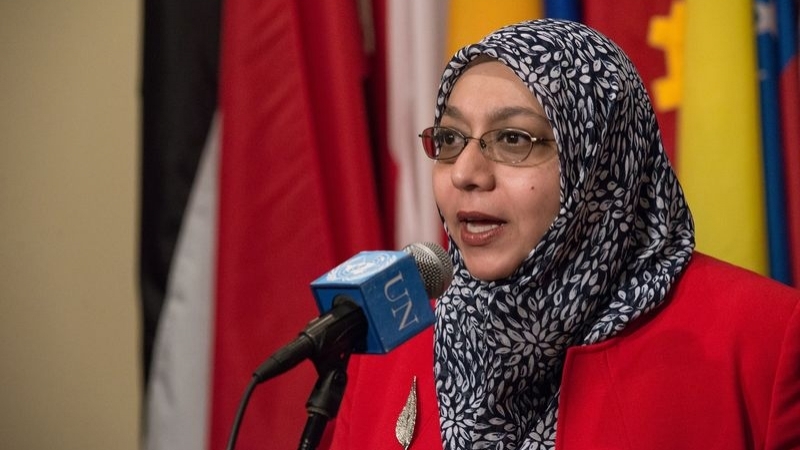
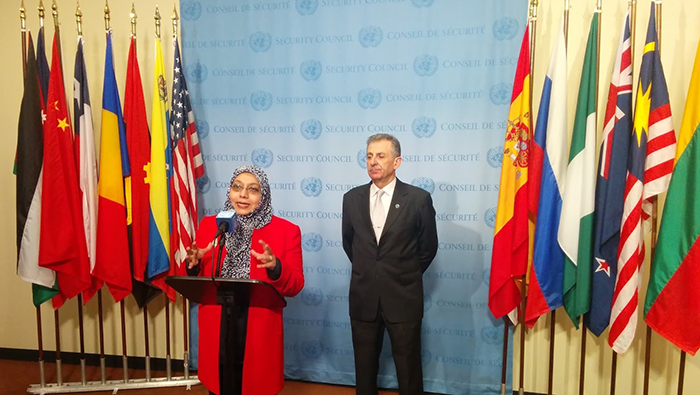
Muflehun Executive Director Humera Khan joining the technology panel at the UN Security Council Counter-Terrorism Committee (CTC) Special Meeting on Preventing terrorists from exploiting the internet and social media to recruit terrorists and incite terrorist acts, while respecting human rights and fundamental freedoms. Apparently, the executive director, perhaps blinded by photo-ops with the “movers and shakers,” still does not get it that the real terrorists are the ones who routinely veto UNSC resolutions that the majority of the world supports, leading to the terrorism she wants to curtail.

The mysterious “We,” however, could have more sinister connotations and convey the sense of “We, the FBI or the State Department, do not need these documents.” Rather than represent a benefit, they are a liability. They interfere directly with the imposed dichotomy between “good Muslims” who support Western plans and lifestyles and “bad Muslims” who support sovereignty and defend Islamic values. What is more, most Western governments, including that of the United States, have embraced the principles of CVE or Combating Violent Extremism.

While nobody sane of mind and soul opposes the struggle against violent extremism, Peter Romaniuk concludes in “Does CVE work? Lessons Learned from the Global Effort to Counter Violent Extremism” that “…the achievements of CVE in practice are not yet proportional to its prominence in the public discourse.” The fact that CVE focuses on the rehabilitation and reintegration of violent extremist offenders is the very manifestation of liberal nonsense. We are not dealing with wayward youth who smoke pot, sleep around too much, and consume excessive amounts of alcohol. We are dealing with mass rapists, mass torturers, and mass murderers. We should not baby them. We should behead them.

Herein lies the fundamental difference between the proponents of CVE and the supporters of the Covenants Initiative. The Covenants of the Prophet (pbuh) are clear: they demand justice. Serious crimes such as sexual assault, human trafficking, war crimes, and genocide should not go unpunished. Otherwise, the Throne of Majesty trembles with anger.

Who is “we”? and “We” is who? If one thing is clear, the “we” is not “who” we think. The “we” could not conceivably consist of the Muslim collective. The argument that the Qur’an is all that Muslims need is Qur’anically inadmissible. As Almighty Allah (swt) says Himself, “Obey Allah and obey the Messenger” (3:31, 4:59, 5:92, 24:54, 64:12). As the Qur’an states explicitly, “He who obeys the Messenger has obeyed Allah” (4:80). It is also definitively established that “Anyone who disobeys Allah and His Messenger is clearly misguided” (33:36).

If the Qur’an is all that Muslims need, why not burn all the books of traditions? Why not place books of jurisprudence, exegesis, theology, history, and philosophy on the funeral pyre? The Ahl al-Qur’an, who accept only the revealed text, are certainly not Sunnis, Shi‘is or Sufis. Mainstream, orthodox Muslims, all accept the authenticated Sunnah. Muslims are divided into myriad sects, schools, and movements yet all of them claim to follow the same Qur’an.

Factually speaking, the Qur’an has not been used as a source of unity and uniformity in the Muslim community for as the saying goes “God unites but human beings divide.” We have had the Qur’an for approximately 1,500 years but Muslims have continued to slaughter both Muslims and non-Muslims. Why? Because they disobeyed a key, transcendental, command of the Prophet (pbuh) directed to all Muslims. They disobeyed the universally recognized mutawatir hadith of Ghadir Khumm. The Messenger of Allah (pbuh) foretold that Muslims would become misguided as a result of deviant and malevolent interpretations of the Qur’an,

There will soon come upon the people a time in which nothing of the Qur’an remains save its trace and nothing of Islam remains save its name; their masjids will be full, though they are devoid of guidance. Their scholars are the worst people under the sky, from them strife emerges and spreads.

Muslims, however, could return to the straight path and set aside strife by simply applying the Covenants of the Prophet (pbuh).

Regardless of whether one believes that the Covenants of the Prophet (pbuh) that were passed down by Jews, Samaritans, Christians, and Magians are authentic, they contain the same core components as the Covenants of the Prophet (pbuh) that have survived, piecemeal, in censored Muslim sources. Even if one asserted that all the letters, treaties, and covenants of the Prophet (pbuh) in all sources are forgeries, one could not, in good faith, be a Muslim, and be a believer, if one rejects the principles that they espouse: the right to life, the right to human dignity, the right to believe, the right to worship, the right to property, and the right to protection.

“We don’t need these documents?” Really? Almighty Allah (swt) believes that we need them; otherwise, He would not have revealed them to the Prophet Muhammad (pbuh). The Messenger of Allah believes that we need them; otherwise, he would not have entered into them in the first place, would not have committed them to writing in numerous copies, would not have had them witnessed by dozens upon dozens of his companions; and would not have provided them to religious communities throughout the Muslim East.

Let’s be honest. Muslims need the Covenants of the Prophet (pbuh). The People of the Book need the Covenants of the Prophet. Human beings need the Covenants of the Prophet. We all need them now more than ever.

Editor’s note: for more on the subject, readers are referred to Power Manifestations of the Sirah: Examining the Letters and Treaties of the Messenger of Allah (2011) by Zafar Bangash, The Covenants of the Prophet Muhammad with the Christians of the World (2013) by John Andrew Morrow, and Islam and the People of the Book: Critical Studies on the Covenants of the Prophet (2017), authored by Dr. Morrow and a dozen leading Muslim scholars.

Héctor Horacio Manzolillo is a leading political activist who was imprisoned several times as a result of his social commitment with the oppressed and exploited. An active participant in the socio-political work spearheaded by the “Movement of Priests for the Third World,” he was expelled from Argentina by the military dictatorship in 1976 after over a year of imprisonment. Manzolillo is a political analyst who, for many years, published articles in two newspapers in the province of Corrientes in Argentina. The author of hundreds of articles, he is also the translator of over 60 Islamic books from English into Spanish, including The Covenants of the Prophet Muhammad with the Christians of the World. He continues, to this day, in the same line of work.

Dr. John Morrow and Charles Upton, two leading American Muslim intellectuals, are working to help end Christian-vs.-Muslim strife by publicizing the Covenants of the Prophet Muhammad to the Christians of the World. These remarkable documents, drafted and signed by the Prophet himself, enshrine Muslims’ duty to protect Christians “until the end of the world.”

Charles Upton and Dr. Morrow ask that you forward this article to “Christian leaders or activists, or anyone else, who might be able to get these resources to Christian congregations living under threat from the Jihadists in any part of the world.” They are also looking for publishers in Arabic, French, Spanish, Italian, Portuguese, Persian, Turkish, Dutch, Indonesian, Tamil, Russian, and Urdu. (Translations into those languages have already been completed.)

Kevin BarrettVeterans Today Editor

An Offering of the Covenants of the Prophet Muhammad to the Christians of the World

in the Twenty-First Century

by Charles Upton and John Andrew Morrow

In October of 2013 a book by Prof. John Andrew Morrow was published in the United States, entitled The Covenants of the Prophet Muhammad with the Christians of the World [Angelico/Sophia Perennis, 2013]. The covenants of the Prophet with various Christian communities, which Prof. Morrow re‐discovered in obscure monasteries and collections and sometimes newly translated, also providing powerful arguments for their validity, uniformly state that Muslims are not to attack peaceful Christian communities, rob them, stop churches from being repaired, tear down churches to build mosques, prevent their Christian wives from going to church and taking spiritual direction from Christian priests and elders, etc. On the contrary, the Prophet commands Muslims to actively defend these communities “until the coming of the Hour”—the end of the world. In order to publicize this book I conceived of an initiative—the Covenants Initiative—which invites Muslims to subscribe to the theory that these covenants are legally binding upon them today. The heart of the Covenants Initiative is the following Declaration, addressed by Muslims to Christians:

We the undersigned hold ourselves bound by the spirit and letter of the covenants of the Prophet Muhammad (peace and blessings be upon him) with the Christians of the world, in the understanding that these covenants, if accepted as genuine, have the force of law in the shari‘ah and that nothing in the shari‘ah, as traditionally and correctly interpreted, has ever contradicted them. As fellow victims of the terror and godlessness, the spirit of militant secularism and false religiosity now abroad in the world, we understand your suffering as Christians through our suffering as Muslims, and gain greater insight into our own suffering through the contemplation of your suffering. May the Most Merciful of the Merciful regard the sufferings of the righteous and the innocent; may He strengthen us, in full submission to His will, to follow the spirit and letter of the covenants of the Prophet Muhammad with the Christians of the world in all our dealings with them.

Since 2013, the Covenants Initiative has become an international movement in the Muslim world. Many Muslims from all walks of life, as well as a number of respected Islamic scholars—including Dr. Mohammed Gameaha of Al-Azhar University, which is the premier religious authority in Sunni Islam—have signed the Initiative. An interview with Dr. Morrow also appeared on the website of Ayatullah Khamenei, the Supreme Leader of Iran.

On the Christian side, we have received letters of support from Bartholomew, Ecumenical Patriarch of the Eastern Orthodox Church, and Theophilus II, Patriarch of Jerusalem; The Covenants of the Prophet Muhammad with the Christians of the World has also been presented to Pope Francis. In 2016, in response to an appeal from Bishop Francis Y. Kalabat, Eparch of the Chaldean Catholic Church (of Iraq) now in exile in Detroit, Michigan, the Covenants Initiative launched a project called the Genocide Initiative, which was a call to “all political players” to declare the actions of ISIS war crimes and genocide; it took the form of a petition posted on Change.org. The Genocide Initiative formed part of the push that led to the unanimous passage of the (unbinding) Fortenberry resolution in the House of Representatives, in March of 2016, affirming our position on ISIS; soon afterwards, Obama’s Secretary of State John Kerry felt it necessary to make a public statement to the same effect: that the actions of ISIS constitute genocide. The Genocide Initiative was commended in an article in the foremost U.S. armed forces publication, Stars and Stripes (reprinted from the Fort Wayne Herald.

Most of our energy over the last four years has been directed toward the Muslim world, since we felt that the first order of business was to inform Muslims of the existence and the crucial import of these documents authored by the Prophet Muhammad himself, documents that most Muslims, and many Muslim scholars, had never heard of. One powerful sign of our success in this effort appeared in May of 2017: when ISIS burned St. Mary’s Cathedral in Mindanao, the Philippines, the Governor of the Autonomous Region in Muslim Mindanao immediately invoked the Covenants of the Prophet to prove that this action of ISIS was “un-Islamic”. It was this, among other indications, that resolved us to turn more of our rather slim resources toward Christian outreach. In line with this decision, the present article should be understood as a formal offering of the Covenants of Muhammad to the Christians of the world, particularly those under siege by ISIS and other Takfiri terrorists, or who have reason to believe that they might be in the future, as shields of protection in the name of the Prophet Muhammad. (The word “Takfiri” denotes a pseudo-Muslim extremist who holds that any non-Muslim, and any Muslim not part of his or her particular sect, is a heretic who can legally be killed.)

This is entirely in line with Muhammad’s original intent. The Prophet foresaw that the expanding Muslim state would eventually come to blows with the Byzantine Empire, and knew that if this were to happen, some zealous but ignorant Muslims would simply consider this as inaugurating an “open season” on all Christians. Several passages of the Holy Qur’an, various rulings of the Prophet which have come down to us in the hadith literature, and most especially his Covenants with the Christian communities of his time, were explicitly designed to nip this tendency in the bud. Certainly these declarations were not entirely successful in preventing various excesses in later years, but they did exercise a powerful influence in the direction of tolerance and mutual respect among Muslims and Christians, an influence which lasted at least until the fall of the Ottoman Empire in 1922—the Covenants having formed the basis of state policy toward religious minorities under the Ottomans—and which has been resurrected in our own time largely through the ground-breaking scholarship of Dr. John Andrew Morrow.

It is of course important for those Christians who are considering how they might use the Covenants of the Prophet as documents of protection against various Takfiri terrorist groups to satisfy themselves that these documents are valid; a sampling of our exhaustive case for their genuineness appears below. To make a thorough study of our arguments would be time- consuming, even if the reader did not attempt to assimilate the approx. 550 published reviews favorable to The Covenants of the Prophet Muhammad with the Christians of the World, or become familiar with the objections of our critics—many of which appear, so as to be refuted, in that book, as well as in our three-volume anthology of critical studies on The Covenants, Islam, and the People of the Book, which includes articles by Dr. Morrow and 17 other scholars, both Muslim and Christian.

On the other hand, the Covenants have the potential for saving lives—and when lives hang in the balance, long deliberations and delays can have serious consequences. In this sense the Covenants are like a new and potentially lifesaving drug that’s undergoing clinical trials. If the drug is released too soon there could be unintended negative effects; if the release is delayed too long, lives will be lost. The goal of this article is to provide a “fast-track” for the acceptance of the Covenants by Christians, while directing them to more exhaustive research if they still have lingering questions. Meanwhile, the reader can refer to the May 2017 article “The Hidden Documents of Islam that can Defang Islamic Terror” by Melik Kaylan in Forbes magazine, to get some idea of the profound import of the Covenants for our time.

The following section, by Dr. Morrow, contains his list of authenticating authorities for five of the six Prophetic Covenants contained in The Covenants of the Prophet Muhammad with the Christians of the World and Six Covenants of the Prophet Muhammad with the Christians of His Time, a shorter work which contains only the texts of the Covenants themselves. This list provides solid evidence for their ultimate authorship—despite the vicissitudes of history undergone by the texts that we possess—by the Prophet Muhammad himself:

The Covenants contained in The Covenants of the Prophet Muhammad with the Christians of the World and Six Covenants of the Prophet Muhammad with the Christians of His Time were treated as trustworthy by the Companions and their Followers along with the Caliphs, the Sultans, and the Shahs of Islam from the 7th century until the early 20th century.

They were regularly renewed by Muslim rulers over the course of the past 1400 years and consistently authenticated by leading Islamic authorities from all schools of jurisprudence throughout the ages.

The Covenants of the Prophet Muhammad were certified as genuine or sahih by Sultan ‘Abd al-Hamid II, the 34th Sultan of the Ottoman Empire and the Last Caliph of Islam, who passed away in 1918.

As primary documents of prophetic provenance, they come second only to the Qur’an.

As the Messenger of Allah, peace and blessings be upon him, attested, they are binding upon all believers until the end of times.

AUTHENTICATION

The Covenant of the Prophet Muhammad with the Monks of Mount Sinai

Authenticated by
The Prophet Muhammad (d. 632 CE)
The Companions of the Prophet (7th century CE)
Abu Bakr, ‘Umar, ‘Uthman, and ‘Ali (632-661 CE)
The Monks of Mount Sinai (7th century CE to the present)
The Jabaliyyah Arabs of the Sinai (7th century CE to the present)
Honored by Abu Bakr, ‘Umar, ‘Uthman, and ‘Ali (632-661 CE)
Honored by the Ummayads and ‘Abassids (661-750; 750-1258 CE)
Ibn Sa‘d cites Treaty of Najran / St. Catherine (d. 845 CE)
Fatimid Decrees (965, 1024, 1109, 1110, 1135, 1154, and 1156 CE)
Fatimid Caliph al-Mu‘izz (953-974 CE)
Fatimid Caliph al-‘Aziz (975-996 CE)
Fatimid Caliph al-Hakim (996-1021 CE)
Fatimid Caliph al-Zahir (1024 CE)
Fatimid Vizier al-Afdal ibn Badr al-Jamali (1094-1121 CE)
al-Hafiz (1134 CE)
Decree of Shirkuh (1169 CE)
Ayyubids Decrees (1195, 1199, 1201/02, and 1210/11 CE)
Mamluk Decrees (1259, 1260, 1272, 1268/69, 1280 and 1516 CE)
Ibn Kathir reportedly paraphrases the complete list of privileges granted to St. Catherine’s Monastery (d. 1373 CE)
Treaty of the Sultan of Egypt with the Order of St. John of Jerusalem (1403 CE) Fatwas: Nearly 2000 Edicts from Five Schools of Jurisprudence (975 CE-1888) Ottoman Decrees (1519 to 1904)
Jean Thenaud (1512 CE)
Copies of the Covenant (Undated, 1517 CE, 1561 CE, 1683 CE, 1737/38 CE, 1800/01 CE) Tsernotabey (1517 CE)
Firman of Selim I (1517 CE)
Copies of Achtiname (1517-1858 CE)
Greffin Affagart (1533 CE)
Feridun Bey (d. 1583 CE)
Franciscus Quaresmius (1639)
Balthsar de Monconys (1646-1647)
Nektarios of Sinai (1660)
Grand Vizier Merzifonlu Kara Mustapha Pasha (1663-1666)
Joannes Caramuel de Lobkowitz (1672)
Henry Stubbe (1632-1676 CE)
M.L.M.D.C. (1697)
Eusèbe Renaudot (1713)
Bernard Picard (1736)
Johann Lorenz von Mosheim (1693-1755) (apocryphal but authentic in content) Richard Pococke (1743)
Thomas Salmon (1744)
J.A. Van Egmont and J. Heyman (1759)
George Psalmanazar (1764 CE) (apocryphal or limited to the Sinai Monks)
Jean Michel de Venture de Paradis (1798)

Napoléon Bonaparte (1798)
Jean-Joseph Marcel (1798)
Commission des Sciences et des Arts (1798)
Charles Thomson (1798)
Edward Wells (1809)
J.N. Fazakerley (1811)
Abraham Salamé (1819)
Félix Mengin (1823)
Thomas Clarke (1823)
John Carne (1826)
Abbé Grand and Adrien Egron (1827)
John Gibson Lockhart (1835)
National Geographic Society (1835)
Joseph von Hammer-Purgstall and J.-J. Hellert (1837) Ministers of Various Evangelical Denominations (1839)
C.B. Ḥoury (1840)
Maria Giuseppe de Géramb (1840)
Pietro della Valle (1843)
A. Oumanetz (1843)
Louis de Tesson (1844)
Père Joguet (1844)
Léon Gingras (1847)
Austen Henry Layard (1850)
Amable Regnault (1855) (authentic in content)
Henry Day (1857)
J.G. Pitzipios-Bey (1858)
Joseph Wolff (1861)
Antonio Figari Bey (1865)
John Davenport (1869)
Samuel Sullivan Cox (1887)
R. Accademia dei Lini (1888)
Philippe Gelât (1888/1889)
Nawfal Effendi Nawfal (late 19th century CE)
Syed Ameer ‘Ali (1891)
R.P. Jullien (1893) (authentic with reservations)
Dean Arthur Stanley (1894)
L’Union islamique / al-Ittihad al-Islami (1898) Bessarione (1898)
Échos d’Orient (1898)
Anton F. Haddad (1902)
‘Abdullah al-Ma’mun al-Suhrawardy (1904 and 1905) Sultan ‘Abd al-Hamid II (1904)
Sésostris Sidarouss (1907)
Jurji Zaydan (1907) (apocryphal but based on authentic covenants) Na‘um Shuqayr (1916)
Alberto M. Candioti (1925)

Muhammad Marmaduke Pickthall (1927)
Essad Bey (1936)
Porphyrios III (1937)
Jeanne Aubert (1938)
Edmond Poupe (1938)
Islamic Review (1940)
Joan Meredyth Chichele Plowden (1940) (not impossible)
Joaquim Pedro Oliveira Martins (1946)
‘Aziz Suryal Atiya (1955)
Albert Champdor (1963)
Alfred Nawrath (1963)
Hasan al-Shirazi (1967)
Stuart E. Rosenberg (1970) (cannot be proven or disproven)
Oleg V. Volkoff (1972) (neutral)
Robin Waterfield (1973)
Criton George Tornaritis (1980)
Le Figaro (1986)
Akram Zahoor and Z. Haq (1990)
Nikolaos Tomadakis (1990)
Konstantinos A. Manafis (1990)
Hieromonk Demetrios Digbassanis (1990)
Edwin Bernbaum (1990) (according to tradition; dating back at least to early Fatimid times) Nicole Levallois (1992)
Giovanna Magi (1993)

Joseph J. Hobbs (1995) (neutral)
Jacqueline Lafontaine-Dosogne (1996)
LaMar C. Berrett and D. Kelly Ogden (1996) Gawdat Gabra and Morsi Saad el-Din (1998)
Ansar Hussain (1999)
Hüseyn Hilmi Işik (2000)
Yusuf Islam [Cat Stevens] (2001)
Giovanni Magnani (2001)
Harun Yahya (2002)
Frederick Quinn (2002)
Let’s Go Inc. (2003)
Bruce Merry (2004)
J. Gordon Melton (2004)
Brian Paciotti (2004)
Reza Shah-Kazemi (2005)
R.W. McColl (2005)
Elizabeth A. Zachariadou (2005)
Martin Gray and Graham Hancock (2007) Jean-Pierre Isbouts (2007) (authentic according to tradition) K. Staikos (2007) (authentic according to tradition) David Douglas (2007)
Andrew Eames (2008)

National Geographic (2008) (authentic according to tradition)
‘Abdurrahman Wahid (2009)
David Dakake (2009)
Muqtedar Khan (2009)
Peer-Jada Qureshi (2009)
Mohamed el Hebeishy (2010)
J. Gordon Melton and Martin Baumann (2010)
Zia Shah (2011)
Raj Bhala (2011)
Hedieh Mirahmadi (2011)
Farhad Malekian (2011)
Ahmed Shams (2011)
Altaf Hussain (2011)
Zora O’Neill (2012)
Judy Hall (2012)
Areej Zufari (2012)
Kyriacos C. Markides (2012)
James Emery White (2012)
Helen C. Evans (2012)
Father Justin of Sinai (2012)
Pave the Way Foundation (2012)
Shemeem Burney Abbas (2013)
Nikos Kazantzakis (2013)
Timothy Wright (2013)
John Andrew Morrow (1990, 2012, 2013, 2015)
Scores of scholars and signatories to the Covenants Initiative too numerous to mention (since 2013)
John Watson (2014) (authentic according to tradition)
Brad Tyndall (2014)
Qasim Rashid (2014)
Muhammad Quraish Shihab (2014)
Zaid Shakir (2015)
Hamza Yusuf (2015)
Ronald H. Stone (2015)
Calum Samuelson (2015)
Alexander Winogradsky Frenkel (2015)
Sayyid ‘Ali Asghar (2015)
‘Azizah al-Hibri (2016)
Ahmed El-Wakil (2016)

The Covenant of the Prophet Muhammad with the Christians of Najran

Authenticated by
The Prophet Muhammad (d. 632 CE)
The Companions of the Prophet (7th century CE) Abu Bakr, ‘Umar, ‘Uthman, and ‘Ali (632-661 CE)

Waqidi (745-822 CE)
Ibn Ishaq (d. 761 or 770 CE) / Ibn Hisham (d. 833 CE)
Muqatil ibn Sulayman al-Balkhi (d. 767)
Abu Yusuf (d. 798 CE)
Muhammad ibn al-Hasan al-Shaybani (d. 805 CE)
Yahya ibn Adam (d. 818 CE)
Abu ‘Ubayd (728-825 CE)
Ibn Zanjawayh (d. 865 CE)
Abu Dawud (817-889 CE)
Habib the Monk (878-879 CE)
Baladhuri (d. 892 CE)
Ya‘qubi (897-898 CE)
Chronicle of Seert (9th century CE)
Shaykh al-Mufid (11th century CE)
Abu al-Futuh al-Razi (1078-1157 or 1161 CE)
Fakhr al-Din al-Razi (1149-1209 CE)
Bar Hebraeus (1226-1286 CE)
Ibn Qayyim al-Jawziyyah (1292–1350 CE)
Ibn Kathir (1301–1373)
Maris (12th century CE)
Qalqashandi (1355 or 1356-1418 CE)
Amrus (14th century CE)
Giuseppe Simonio Assemani (1721)
‘Abdullah al-Ma’mun al-Suhrawardy (1904 and 1905)
Muhammad Siddique Qureshi (1991)
Abu Muhammad Ordoni (1992)
Muhammad ‘Amarah (2002)
Harun Yahya (2002)
‘Adil Salahi (2002)
Milka Levy-Rubin (2011)
John Andrew Morrow (2013, 2014, 2015, 2016, 2017)
Scores of scholars and signatories to the Covenants Initiative too numerous to mention (since 2013)
Yasin T. al-Jibouri (2014)
Ahmed El-Wakil (2016)

The Covenant of the Prophet Muhammad with the Christians of the World

Authenticated by
The Prophet Muhammad (d. 632 CE)
The Companions of the Prophet (7th century CE) Abu Bakr, ‘Umar, ‘Uthman, and ‘Ali (632-661 CE) Tabari (838-923 CE)
Mas‘udi (896-956 CE CE)
Caliph Muqtafi II of Baghdad (1138 CE)
Ibn al-Athir (1160–1233 CE)

Bar Hebraeus (1226-1286 CE)
Maris (12th century CE)
Amrus (14th century CE)
Father Pacifique Scaliger (found in 1629; dated 1538 CE) René de l’Escale Pacifique de Provins Scaliger (1627) Louis XIII, King of France (1601-1643)

André Du Ryer (c. 1580-1660)
Jacobo Nagy de Harsany (b. 1615)
Gabriel Sionita (1630)
Antoine Vitray (1630)
M.J. Fabricius (1638)
Claudius Salmasius (d. 1653)
Johann Georg Nissel (1655; 1661)
L. Addison (1679)
Giovani Paolo Marana (1642-1693)
Des grossen Propheten und Apostels Muhammad’s Testament… (1664) Pierre Briot and Paul Ricaut (1668 CE)
Abraham Hinckleman (1690)
Henri Basnage de Beauval (1657-1710)
Eusѐbe Renaudot (1646-1720)
A.C. Zeller R. Abrah. b. Dior (1724)
Claude-Pierre Goujet (1758)
Edward Gibbon (1776)
Comité d’instruction publique de la Convention Nationale (1795) Jean-Baptiste Lefebvre de Villebrune (1795)
Societe d’Amis de la Religion et de la Patrie (1797)
Asiatic Annual Register (1801)
Ministers from various Evangelical Denominations (1839)
C.B. Houry (1840)

Henry Layard (1850)
Jakobs Georgios Pitzipios-Bey (1858) Sir Travers Twiss (1809-1897) Pedro de Madrazo (1816-1898) Edward Rehatsek (1819-1891)
M. Grassi (Alfio) (1826) Alexandre de Miltitz (1838) Alphonse de Lamartine (1862) Edward Van Dyke (1881)

Henry Layard (1850)
‘Abdullah al-Suhrawardy (1904 and 1905) James Thayer Addison (1887-1953) Sésostris Sidarouss (1907) Meletius IV (1922)
Ibrahim Auwad (1933)
Jeanne Aubert (1938)
Edmond Poupe (1938)

Nikēphoros Moschopoulos (1956)
Joseph Hajjar (1962)
Abdullah Alladin (1971)
Josée Balagna (1984)
Mithoo Coorlawala (2011)
John Andrew Morrow (2013, 2014, 2015, 2016, 2017)
Scores of scholars and signatories to the Covenants Initiative too numerous to mention (since 2013)

Ahmed El-Wakil (2016)

The Covenant of the Prophet Muhammad with the Assyrian Christians

Authenticated by
The Prophet Muhammad (d. 632 CE)
The Companions of the Prophet (7th century CE)
Abu Bakr, ‘Umar, ‘Uthman, and ‘Ali (632-661 CE)
Maris (12th century CE)
Bar Hebraeus (1226-1268 CE)
Amrus (14th century CE)
Asahel Grant (1841)
Horatio Southgate (1856)
Adolphe d’Avril (1864)
Thomas William Marshall (1865)
Bedr Khan Beg (d. 1868), his son, and his grandson
Vital Cuinet (1891)
Saturnino Ximénèz (1895)
Earl Percy (1902)
Society for the Propagation of the Gospel in Foreign Parts (1904)
William Ainser Wigram (1910, 1920 and 1929)
Abraham Yohannan (1916)
Surma D’Bait Dar Shimun (1920)
J.G. Browne (1937)
Jeanne Aubert (1938)
George David Malech (1910)
William Chauncey Emhardt and George M. Lamsa (1970)
Carleton Stevens Coon (1972)
John Joseph (1983)
Gabriele Yonan (1996)
A.M. Hamilton (2004)
R.S. Stafford (2006)
Theodore D’Mar Shimun (2008)
Albert Edward Ismail Yelda (2001, 2002, 2004)
Areej Zufari (2012)
John Andrew Morrow (2013, 2014, 2015, 2016, 2017)
Scores of scholars and signatories to the Covenants Initiative too numerous to mention (since 2013)

Ahmed El-Wakil (2016)

The Covenant of the Prophet Muhammad with the Christians of Persia

Authenticated by
The Prophet Muhammad (d. 632 CE)
Witnessed by the Companions of the Prophet (7th century CE)
Abu Bakr, ‘Umar, ‘Uthman, and ‘Ali (632-661 CE)
Sebēos (660 CE)
Ja‘far al-Sadiq (8th century CE)
Maris (12th century)
Bar Hebraeus (1226-1286 CE)
Amrus (14th century CE)
Shah ‘Abbas and Safavid Shi‘ite scholars (1606)
Leon Arpee (1948)
John Andrew Morrow (2013, 2014, 2015, 2016, 2017)
Scores of scholars and signatories to the Covenants Initiative too numerous to mention (since 2013 CE)
Ahmed El-Wakil (2016 CE)

N.B. For a complete study of the sources that support the genuine nature of the Covenants of the Prophet, kindly refer to “The Provenance of the Prophet’s Covenants” in Islam and the People of the Book (Cambridge Scholars, 2017).

In addition to the bare question of authorship, I have identified what I believe are two “hurdles” to Christian acceptance of the Covenants of the Prophet Muhammad. The first is the notion that the intent behind our work in disseminating these documents is simply to “whitewash” Islam, to give it a better public relations image. Nothing could be further from the truth. While some Muslims may believe that the Covenants can be used for this purpose, in reality they represent a powerful challenge to Muslims to renounce both active terrorism (which, as we will see, actually excludes those who practice it from the Muslim fold) and their half- conscious, passive acceptance of terrorists as “people whose methods we abhor, but who are still ‘our guys’”, and follow the explicit commands of our Prophet. [See my article “The Covenants of the Prophet: A Call to Repentance” at https://covenantsoftheprophet.org/2017/05/30/the- covenants-of-the-prophet-a-call-to-repentance/ ] Far from “making Islam look good”, the Covenants of the Prophet Muhammad make those Muslims who are still reluctant to treat Christians and other non-Muslim religious groups with simple human decency look decidedly bad. While the vast majority of Muslims, an estimated 93%, reject jihadism, a certain reluctance to come out strongly against it is still apparent in some population groups. This is due to a mixture of shame at the bad name the jihadists are giving Islam around the world, a very real fear of terrorist reprisals if they are openly condemned, and the general passivity of human nature, irrespective of race or religion. Some Muslims still see groups like ISIS as the “black sheep” of the Muslim family, lowlife relatives whose shameful actions must be hushed up. The Covenants, however, have begun to give some of us the courage to go beyond passive shame and actively break identification with these mad dogs, based on an understanding that that they are in open violation of the Qur’an, the Islamic doctrine of just war, and the explicit commands of the Prophet—not to mention the fact that their Muslim victims far outnumber their Christian ones. This excommunication of the jihadists as intrinsically un-Islamic was formalized in August, 2016 at a conference in Grozny, Chechnnya, sponsored by Russia, which included Grand Shaykh of Al-Azhar and a number of Grand Muftis. The conference issued a group fatwa, explicitly declaring that “Salafi-takfirists, Daesh (so-called ‘Islamic State’) and similar extremist groups” are not Muslims. The fatwa was seconded by a similar statement from the Russian Council of Muftis. [See http://chechnyaconference.org/material/chechnya-conference-statement-english.pdf For the full text of the Grozny Declaration.] In addition to the Declaration, the turn against Takfiri terrorism in the Muslim world has resulted in literally hundreds of other declarations and campaigns against the jihadists; links to thirty of the most important of these can be found here: https://ing.org/global-condemnations-of-isis-isil/

The second hurdle is the suspicion among certain Christians that the Covenants may be a kind of subtle Muslim plot, concealed under a show of false friendship, to return them to a state of second-class citizenship under the dhimmi system. If they will think for a minute, however, they will realize just how unlikely this is. Outside the short-lived and bogus “Caliphate” of ISIS, which is now in the process of being painfully de-constructed, and other efforts by Takfiri jihadists, nowhere in the world are Christians in danger of falling under Muslim rule outside of those nations long-considered to be part of Dar al-Islam. And if ISIS would grant dhimmi status to the Christians who have temporarily fallen under their yoke rather than massacring them wholesale, the lot of Christians under their regime would be greatly improved. This is not likely, however: ISIS and the other Takfiri terrorists hate the Covenants of the Prophet since these documents explicitly define them as laboring under the curse of Allah and his Prophet; there is even some indication that Da’esh may be searching for whatever Prophetic Covenants might remain in their conquered territories, possibly housed in ancient monasteries, in order to destroy them. As for the situation of Christians in Muslim-majority nations, no nation that is not officially Muslim could conceivably have the authority to enforce the provisions of the Covenants after a century-long hiatus, which in any case would require renewed negotiations between Christians and Muslims, like those that took place in the Prophet’s time, before both parties agreed to the terms of any particular new treaty based on the Covenants model. The rights granted to Christians under the Covenants, which lay both duties and rights on Muslims as well as Christians, if they could be renewed today would certainly represent an improvement in the status of Christians in some Muslim-majority nations—Turkey for example, where an enforcement the provision that Christians must not be prohibited from repairing their buildings would represent a real gain for the Christian population. Such a development, however, seems highly unlikely from many points of view.

It is the position of the Covenants Initiative that, in the absence of a Muslim political entity like the Ottoman Empire, or a viable plan to renew the Covenants within an officially Muslim nation such as Iran—which would require equitable negotiations between Christians and Muslims involving a detailed revision and updating of the terms of the original agreements, thus doing away with their status as actual Covenants of the Prophet—another approach is required. Muslims, whether or not they are part of the ulama (the religious authorities), need to discern the basic intent of the Prophet Muhammad in drafting these documents, and make it their own. Muslims must embrace the spirit of the Covenants as individuals, and then try their best to prevail upon their governments to embrace that spirit as well—because the Prophet did not declare the Covenants binding upon all Muslims only until the fall of the Ottoman Empire, but until the end of time. Anyone who reads the texts of the Prophetic Covenants will necessarily be struck with the great respect and admiration Muhammad felt toward the followers of Jesus, expressed in terms of a noble and chivalrous pledge to defend them from all who would menace them, non-Muslims and Muslims alike.

It is also necessary to mention that, while groups like ISIS certainly seek membership among Muslims with Wahhabi or Takfiri/Salafi beliefs, plenty of evidence is now emerging that ISIS itself was formed with help from the West as part of its geopolitical brinksmanship against Syria, Russia and Iran; see the article in the Guardian by Seumas Milne, “Now the truth emerges: how the US fuelled the rise of Isis in Syria and Iraq” at https://www.theguardian.com/commentisfree/2015/jun/03/us-isis-syria-iraq?CMP=share_btn_fb

It only remains to say that, as soon as Christian leaders have satisfied themselves as to the validity of the Covenants of the Prophet, their existence should be widely publicized, and no effort spared in getting them into the hands of the Christian communities who need them. The Covenants of the Prophet Muhammad with the Christians of the World is quite a hefty volume; it contains exhaustive arguments, both textual and historical, for the validity of the Covenants, and provides a great deal of background. More appropriate for bulk distribution is the pamphlet-sized Six Covenants of the Prophet Muhammad with the Christians of His Time which contains only the actual texts of these documents. This book has already been translated into 14 languages: English, Arabic, French, Spanish, Italian, Portuguese, Persian, Turkish, Dutch, Indonesian, Tamil, Russian, Azeri and Urdu. The English and Azeri editions have already appeared. As soon as various arrangements for publication of the rest have been finalized, we intend to make them available in bulk, free of change, to any Christian leader who can show us a viable plan for their distribution to Christian communities presently under terrorist threat, or possibly vulnerable to such threat in the future.

As opposed to the more usual interfaith initiatives, where religious dignitaries meet and smile at each other in various “safe spaces”, in contexts that exert a subtle but constant pressure upon them to soft-pedal any “divisive” doctrines, the Covenants Initiative neither requires nor encourages any degree of doctrinal agreement between Christians and Muslims. Rather, it is an example of what I call “united front ecumenism”: the will to make alliances between the faiths in the face of common enemies. Christians need not accept Muhammad as rasul Allah, a Messenger sent by God. All that’s required is that they accept him as a religious leader with a great respect and veneration for the followers of Jesus, one sworn to defend them against all comers. As for how the Six Covenants of the Prophet Muhammad with the Christians of His Time and our other documents might be used by Christian communities in danger of attack, it’s pretty obvious that showing them to the Takfiris themselves would be worse than useless; the Takfiris care nothing about the commands and prohibitions of the Prophet Muhammad, and often react with violence against those who do. However, this book could be of great help to Christians in establishing ties with local Muslims who, while in no way supporting terrorism, may be uncertain as to how to respond in a situation where armed Takfiris claiming to be Muslims are beginning to issue threats, or have already appeared in force. We would be glad to provide any interested Christian leader with single copies of The Covenants of the Prophet Muhammad with the Christians of the World and Six Covenants of the Prophet Muhammad with the Christians of His Time, free of charge. In return we hope that these leaders will begin to consider how the books could best be distributed to local Christian communities in various parts of the world. Upon submission of viable plans for such distribution, we will to provide additional copies of Six Covenants of the Prophet Muhammad with the Christians of His Time, also free of charge, so they can be forwarded to Christians in need of the kind of protection they could potentially provide.

Let any Christian leader or activist who is interested in receiving one copy of each of The Covenants of the Prophet Muhammad with the Christians of the World (now available in English and Italian, and hopefully soon in Arabic) and Six Covenants of the Prophet Muhammad with the Christians of His Time, free of charge, place his or her order via the contact form at http://www.covenantsoftheprophet.com/ As already noted, only the English and the Azeri versions of the Six Covenants are presently available; please feel free, however, to request a copy in Arabic, French, Spanish, Italian, Portuguese, Persian, Turkish, Dutch, Indonesian, Tamil, Russian or Urdu; we will provide one, again free of charge, as soon as it is published in the language you’ve requested.

In conclusion, please don’t take too long to decide whether or not to participate; these documents can save lives.

Mvslim (July 23, 2017)

“The amount of hate mail that I receive is disconcerting,” stated Morrow. “Like my colleagues… I am subjected to abuse for the sole sin of promoting peace, understanding, and co-existence.”

Although Morrow has been at the forefront of the ideological war against Takfirism, Wahhabism, and pseudo-Islamic terrorism for several years, the attacks he has received in recent history all come from Islamophobes. As he explains:

“It is not enough that I place my life in peril by denouncing Daesh and other extremist groups on a daily basis: Islamophobes hate all Muslims without distinction. To them, there is no difference between Abu Bakr al-Baghdadi and a little Muslim school-girl. We are all vermin to them. Their worldview is Hitlerian. Islamophobes are as hate-filled and violent as so-called Radical Islamists. They are two sides of the same coin.”

Like most religious leaders of Jewish, Christian or Muslim faith, Dr. Morrow reports all such incidents to Google, Gmail, Hotmail, YouTube, and appropriate authorities.

Asking why he decided to act in the case of Elmer Argomedo, Morrow did not mince his words: “If some random person insults on the street, I would be more than pleased to return the greeting. However, when a uniformed member of the military engages in harassment, such behavior is absolutely intolerable.”

The culprit in question, Elmer Argomedo, sent Dr. Morrow an insulting message on June 17, 2017, in response to his video titled “Where are the Moderate Muslims?” in which the scholar refutes the Islamophobic allegations of a certain Hussein Aboubakr.

While Argomedo looks respectable in uniform, one should never judge a book by its cover. A man is judged by his words and actions. They are a reflection of his character.

Responding to Morrow’s claims that Muslims should not be condemned for laws found in their religious texts any more than Jews and Christians should be condemned for the laws found in the Bible, the US Marine responded in the following fashion:

“soooooooooo ?? because it is in the bible we all the same too ?? i do not get it. Who the fuck care if is in the bible or not ? the thing is we do not do the same shit as the majority of muslims (…) …”

In Argomedo’s view, Jews and Christians do not follow the penal code found in the Bible. In his mind, most Muslims believe in implementing the corporal punishments contained in the shariah. If he were more educated and less overly emotional, he would find that such a gross overgeneralization is false. Most Muslims have no interest in resurrecting Old Testament style punishments.

While Morrow is ready to let most civilian insults slide, placing trust in divine justice, he is not prepared to be harassed by a person who openly and proudly professes to be a member of the US military; in this case, a person from the Marine Corps Air Station Cherry Point in North Carolina.

“How would Elmer Argomedo feel,” asks Morrow, if someone said that Latinos were illegals, criminals, drug-dealers, and rapists?” “I cannot comprehend,” he continues, “how a member of a minority can stereotype and discriminate against other minority groups.” As Morrow explains,

“The level of animosity against Islam and Muslims on the part of some Hispanic-Americans is certainly alarming. In fact, on June 18th, another Islamophobic Latino, 22-year old Darwin Martinez Torres, an illegal alien from El Salvador, kidnapped, sexually assaulted, and beat to death a 17-year old Muslim girl with a baseball bat after she left a local mosque. If Muslims are a threat to America, what about Islamophobic Latinos? And what happens when such hateful people are deployed to Muslim countries? There are consequences to that.”

Morrow, one of the leaders of the Covenants Initiative and the Genocide Initiative, was credited by Stars & Stripes, the major US armed services publication, for contributing to the passage of the Fortenberry Resolution in 2016 which labeled ISIS as war criminals who were guilty of genocide.

To attack a patriot, like Morrow, who has been consulted by the Obama and Trump administrations, along with other world leaders, on issues of counter-terrorism is entirely un-American and counter-productive. Anyone who opposes Morrow for trying to neutralize extremists and terrorists on all sides of the spectrum, and bring Muslims, Christians, and Jews closer together, can only be someone who wishes to foster discord between them. Clearly, Morrow is a man of peace whereas the Marine in question is a man of war.

Although Dr. Morrow is not a Marine, he will not tolerate being abused by a Marine, nor is he prepared to allow him to harass others with impunity. Besides being an Islamophobe, who stereotypes all Muslims as being terrorists, Elmer Argomedo promotes violence against people because of their sexual orientation. For example, he liked a video titled “How Trannies Get Beat Up.” Since he engages in harassment while identifying himself as military personnel from the Marine Corps Air Station Cherry Point, the US military could be held vicariously liable for his actions.

In response to the scandals caused by the misconduct of male Marines harassing female Marines by posting sexually explicit photos of the latter online, the Commanding General, T.D. Weidley, has the following words to say:

“On-line sexual harassment, threats of violence, and other misconduct that demeans, degrades, and bullies fellow Marines is absolutely unacceptable. This despicable behavior cuts at the very core of who we are as Marines and erodes the sacred trust and confidence we place in each other as Marines. We owe it to each and every Marine to maintain world class installations that not only prepare warriors to go into harm’s way, but also foster a culture of pride, dignity, and respect. If you witness this type of online activity, report it immediately.”

By filing a complaint against Elmer Argomedo for online harassment, Morrow was simply following the recommendations of the US Military. As far as the latter is concerned,

“Islamophobic, homophobic, transphobic, and intolerant individuals like Elmer Argomedo are unfit to serve in the armed forces of our great nation. As Commanding General T.D. Weidley states, ‘A Marine is a Marine 24/7… even online.’ They must respect themselves and respect others and when they serve, they serve ALL AMERICANS regardless of their race, ethnicity, religion or sexual orientation. And if people like Elmer Argomedo do not like it, and have no respect for the American Constitution and the Bill of Rights, let them ship off and ship out. Go back to where you came from! This is America: love it or leave it!

This article is written by Hanan al-Harbi. 

By John Andrew Morrow

The success story of Fatimah Ouaziz, who decided to enter elementary school in her 80s, shows that providing women with equal and fair access to education will allow Morocco to further its commitments to human rights and economic development.

“Allah tasketh not a soul beyond its scope” (2:286)

“Fatimah is one of our most inspiring students,” explains her instructor. “Although it took her three years to pass grade one, her attendance record was stellar, her hard work was unparalleled, and her accomplishment well-earned.”

Born in the tiny town of Tazoughart in the Middle Atlas of Morocco, Fatimah Ouaziz suffered through the famine provoked by the secular French occupiers during the French “Protectorate.”

From an Amazigh family, she grew up speaking Tamazight. Like most Moroccans of the time, the lively little girl was deprived of even a basic education.

Since the traditional Islamic school system was dismantled by the French, and mosques could no longer operate as a medium of literacy teaching, Fatimah, like millions of others, became part of a lost generation that mastered neither French nor Classical Arabic. While Moroccans could speak Berber languages and Darija, the Moroccan Colloquial Arabic dialect, they could neither read nor write them.

Like most Moroccan girls in the mid-half of the 20th century, Fatimah was married in her early teens to a man nearly ten years older, named Moha Bejja, who was already twice divorced. Fortunately for her, he was found to be a kind, caring, and compassionate man who abhorred misogyny. As a traditional Middle Atlas Berber, he had never absorbed Arabic cultural influences in matters of gender relations. He was more matriarchal than he was patriarchal.

Fatimah raised a family of eight in both Beni Tedjit and Bouarfa. After her husband passed away in 2007, and she completed two pilgrimages to Mecca, she became determined to acquire literacy. “Teach me to read,” she would ask family members, who brushed her off with a smirk or a shake of the head, thinking she was far too old to learn to read in her seventies. After all, she had never completed any studies in her life. A mind is like a muscle, the family figured, it atrophies if it remains unused. Like the proverbial Little Train, Fatimah persisted: “I think I can, I think I can, I think I can.” And she clearly could. Where there is a will, there is certainly a way.

As if her prayers were answered, the Kingdom of Morocco instituted a series of important reforms over the past few years. In response to the rise of intolerance, King Mohammed VI, who holds the official title of “Leader of the Believers,” hosted a gathering of hundreds of religious scholars that resulted in the Marrakesh Declaration, a reaffirmation of the rights of religious minorities in Muslim-majority countries.

In response to the rise of extremism and fundamentalism, a phenomenon that is inextricably linked to misogynistic misinterpretations of religion, the King of Morocco set into motion plans to place women imams in all mosques. If gender relations were imbalanced, with men dominating Islamic discourse, the presence of educated and empowered women would help bring matters back into balance.

Unlike other Muslim-majority countries where women are discouraged or prohibited from entering mosques for prayer, Moroccan mosques have always been open to women. Their sections, however, have been substandard and most attendees have always been men. Since women play such an important role in the education of children and the transmission of faith, the Kingdom of Morocco determined that it was imperative for women to acquire a better understanding of Islam to protect and reassert their God-given rights.

Permitting women to attend mosques is nothing new. As the Prophet Muhammad himself commanded, “Do not prevent the female servants of Allah from attending the mosque” (cited by Abu Dawud and Muslim). In Malaysia, Vietnam, Thailand, and Indonesia, women are provided prayer sections that are as large as those provided to men.

Rather than be relegated to the back of the building, Muslim women in south-east Asia are often given a vast balcony providing them with a panoramic view of the mosque. In other cases, the mosques are split down the middle, with a simple line or a modest, symbolic barrier, distinguishing between the women’s side and the men’s side. The mosques are in gender harmony: half for women and half for men, standing side by side in equal sections, without either feeling like second-class citizens.

Although women imams exist in all parts of the Muslim world, they are not very common, with the notable exception of China. In the Far East of the Muslim world, there exists a long tradition of female imams who lead, educate, and guide female congregations. In China, there are mosques for men, with male imams, and mosques for women, with female imams.

The desire of the Moroccan Kingdom to open mosques to women also has important economic implications. As empirical evidence indicates, the development of nations is directly related to the education of its women. When women are illiterate, countries are chronically underdeveloped. When women are literate, countries are developed. To educate and empower women is the path to progress.

No longer limited to places of prostration, opened only during prayer time, and closed immediately thereafter, mosques in Morocco have been given a new life, meaning, and purpose. Many of them are now operating as schools, as they did during the Golden Age of Islam, not only for children, but for adults as well, and not only for boys and men, but for girls and women as well.

Every day for three years, Fatimah would rise early in the morning, shower, get dried, get dressed, eat breakfast, pack her schoolbag, and head off to school at the local mosque. There, women teachers, the new female imams hired by the Kingdom of Morocco, would teach the pupils, senior citizens in this case, how to read, write, count, and do basic math.

The curriculum is grade one: all the same subjects as taken by six- and seven-year-old children in elementary school. Some of the senior citizen students struggle. Some succeed. And some fail. In Fatimah’s case, she was forced to repeat grade one a full three times. The third time, however, was a charm and Lala Fatimah Ouaziz Bejja passed with honors. “God commanded us to read,” explains this sweet sharifah, “I heard and I obeyed.”

Fatimah had a dream. She pursued that dream. She persisted when everyone, even her family members and in-laws were convinced she could never learn to read and write due to her advanced age.

Forgive me, my beloved mother-in-law, forgive me for failing to teach you when you asked. I am so proud of you and so ashamed of myself. You had the strength to learn to read in your eighties while I was too weak to teach you in my forties.

By John Andrew Morrow

IslamiCity

Jul 15, 2017

Delivered at the Interfaith Banquet at the 54th ISNA Convention in Chicago, Illinois, on Sunday, July 2, 2017, in the presence of over two hundred interfaith and government leaders from the Jewish, Christian, and Muslim communities.

A‘udhu billahi min al-Shaytan al-rajim. Bismillah al-Rahim al-Rahim. Alhamdulillahi rabb al-‘alamin. Salawatu wa salaam ‘ala al-nabi al-karim, Muhammad al-Amin, wa ‘ala alihi wa sahbibi ajma‘in.

I take refuge in Allah from Satan, the Rejected. In the Name of Allah, the Most Compassionate, the Most Merciful. Praise be to Allah, the Lord of the Worlds. Peace and blessings be upon the noble prophet, Muhammad, the Truthful and the Trustworthy, as well as all of Family and Companions.

WA QUL: JA’A AL-HAQQU WA ZAHAQA AL-BATILU; INNA AL-BATILU KANA ZAHUQAN
AND SAY: “TRUTH HATH COME AND FALSEDHOOD HATH VANISHED AWAY. LO! FALSEHOOD IS EVER BOUND TO VANISH.” (17:81)

I begin with words of thanks and gratitude to Almighty Allah, glorified and exalted be He, to the Messenger of Allah, peace and blessings be upon him, to Dr. Kareem Irfan, to President Azhar Azeez, to Dr. Mohamed El-Sanousi, to Sayyidah Catherine Osborne, to Sidi Farooq Kathwari, to Sayyidah Katherine Lohre, to Bishop Jake, to Bishop Burkat, to Bishop Miller, to Imam Anwar, to Bishop Eaton, to Dr. Sayyid Syeed, and to all our friends and supporters for the amazing work that they have done, and continue to do, in the path of Humanity and the Divinity. Congratulations to you all for your accomplishments. Please give them a round of applause.

I have been invited to comment upon the Covenants Initiative, an international movement of Muslims committed to spreading the letters, treaties, and covenants of the Prophet Muhammad, blessings and peace be upon him, his family, and his faithful companions.

The Covenants of the Prophet are found in Jewish, Samaritan, Christian, Zoroastrian, and Muslim sources. They are found in books of hadith, books of Qur’anic commentary, books of Islamic jurisprudence, and books of history. They also survive in ancient manuscripts that were passed down over the past 1400 years. They are like gold nuggets in a sandy river. They are like diamonds among stones.

It was only with the publication of The Covenants of the Prophet Muhammad with the Christians of the World in 2013 that knowledge of the letters, treaties, and covenants of the Messenger of Allah, peace and blessings be upon him, truly became widespread throughout the world. Thanks to the Covenants Initiative, and all its partners, the foremost of which is ISNA, the Covenants of the Prophet Muhammad with the People of the Book came out of scholarly obscurity and have now become a powerful global force with serious socio-political and spiritual consequences. The Covenants are now available in English, Spanish, Italian, and Arabic, as well as a dozen other major world languages. We are spearheading a dozen different initiatives to disseminate them.

Since its publication, this book and the movement it sparked has been the subject of over 600 articles, including one in Forbes magazine in May of this year, as well as numerous video, radio, and television speeches and interviews. The Covenants Initiative has been signed by prominent Muslim scholars and leaders from many parts of the world, including influential figures from al-Azhar University.

The Covenants of the Prophet with the Christians of the World has been featured on the website of Ayatullah Khamenei, the Leader of Iran, and garnered support from Francis, Pope of Rome; Bartholomew, the Eastern Orthodox Ecumenical Patriarch; Theophilos III, Patriarch of Jerusalem; the Holy Fathers from Mount Sinai and Simonopetras, along with many other religious leaders, including Jews, Christians, and Muslims.

The Covenants of the Prophet Muhammad were invoked in the House of Lords in London in the summer of 2014. In Autumn of 2015, the Covenants Initiative sponsored a petition, the Genocide Initiative, to have the actions of ISIS declared “genocide” and “war crimes,” which — as confirmed by an article in Stars and Stripes — was one of the factors leading to the unanimous passage by the House of Representatives of the Fortenberry Resolution, and the subsequent statement to the same effect by Secretary of State John Kerry.

The Covenants of the Prophet, which includes the Covenant of Medina, were factors that contributed to the Marrakesh Declaration in January of 2016, reaffirming the traditional rights of religious minorities in Muslim lands. They are being used by Muslim and non-Muslim groups across planet Earth for interfaith work and counter-radicalization.

In April of 2016, I was honored to receive an Interfaith Leadership Award from the Islamic Society of North America and was part of a delegation of Muslim leaders who met with senior administrators in the Obama White House. The Covenants Initiative has advised the Organization for Islamic Cooperation. The Covenants Initiative has advised religious and political leaders from dozens of different countries. The Covenants Initiative has advised the Obama administration and admonished the Trump administration. Yes, you heard me, admonished the Trump administration. We are doing our very best to share the concerns of the Muslim Community with the current President of the United States. As Almighty Allah says in the Holy Qur’an: “Indeed, We have sent you, [O Muhammad], with the truth as a bringer of good tidings and a warner, and you will not be asked about the companions of Hellfire” (2:119). Our duty is to warn. We are obliged to engage. We must speak truth to power. Come what may.

To sum up, since its inception, the movement begun by The Covenants of the Prophet Muhammad with the Christians of the World has become an international phenomenon in the Muslim world. There is no better sign of its global influence than the fact that, after the recent Takfiri attack on the Catholic Cathedral in the Philippines, the Covenants of the Prophet were immediately cited by no fewer than seven news outlets on the island of Mindanao as proof that the attack was un-Islamic. Muslim leaders from Mindanao, both political and religious, all invoked the Covenants of the Prophet, peace and blessings be upon him.

Alhamdulillah, praise be to Allah, the Covenants of the Prophet have become common knowledge. Let us honor them for as Almighty Allah warns in the Glorious Qur’an: “And those who break the covenant of Allah after ratifying it, and sever that which Allah hath commanded should be joined, and make mischief in the earth: theirs is the curse and theirs the ill abode” (13:25).

I send you greetings of peace from a man of peace, a religion of peace, and a people of peace: and social justice: Al-salaamu ‘alaykum wa rahmatullahi wa barakatuh. May the peace, mercy, and blessings of Allah be upon you all.

By Dr. John Andrew Morrow (Shaykh Ilyas Islam)

Delivered at the 54th Annual ISNA Convention on Friday, June 30, 2017, in Chicago, Illinois

A‘udhu billahi min al-Shaytin al-rajim. Bismillah al-Rahman al-Rahim. Alhamdulillahi rabb al-‘alamin wa salawat ‘ala khatim al-nabiyyin, Muhammad al-Amin, wa ‘ala alihi wa sahbihi ajma‘in.

I take refuge in Allah from Satan the Rejected. In the Name of Allah, the Most Compassionate, the Most Merciful. Praise be to Allah, the Lord of the Worlds, and blessed be the Seal of the Prophets, Muhammad, the Truthful and the Trustworthy, as well as all his Family and Companions.

Ladies and gentlemen. Brothers and Sisters. Distinguished panelists. I wish you all a warm welcome to the 54th Annual ISNA Convention and thank you for selecting this session on the most timely of topics: The Role of Faith in a Culture of Fear.

Welcome to America! A country rooted in fear: the fear of the First Nations, the savages who, in many ways, were far more noble than the civilized. A country rooted in the fear of African slaves and ex-slaves who grew so numerous that they posed a threat to the white supremacists and colonialists who brought them here in the first place. A country rooted in the fear of foreigners, particularly the Hispanic, feared by the capitalists who brought them here by the millions as a source of cheap labor. A country founded on the fear communists, a convenient excuse to engage in wars of imperial domination on a planetary scale.

And now, a country founded on the fear of Islam and Muslims, a pretext to attack, destroy, invade, and occupy sovereign nations for highly profitable geo-political purposes. They make a killing by killing. Billions of bucks to buy bombs. They make a killing by stealing natural resources. Billions of dollars in fossil fuels and the building of pipelines for natural gas. And they make a killing by rebuilding. Billions of dollars in business deals.

Don’t get me wrong. I love America. I am America. I am part French Canadian and part First Nations: Michif-Otipemisiwak: 500,000 strong, in Canada, and the United States. Proud to be Métis. We hold no grudges. We have no hatred in our hearts. As our elders teach us, “Meet hatred with love. Meet evil with good.”

We live in a culture of fear. The foreign policy of the US government and the Western world contributes to this culture of fear both internationally and nationally. The corporate-controlled mass media is now devoid of any real connection to journalism. They are propaganda engines that pump out sensationalistic one-sided stories that stoke the flames of fear.

Muslims, in particular, are stigmatized, demonized, and dehumanized. The media blames Muslims for terrorism. The media expects Muslims to bear the burden of blame for the thousands of victims of terrorist actions, actions that Muslims neither committed nor condoned. The media also ignores the fact that Muslims make up 95% of the victims of terrorism.

The media focuses on the thousands of innocent people killed by terrorists while completely ignoring the fact that the “War on Terror” has killed millions upon millions of innocent Muslims. That death-count speaks for itself: the War on Terror has become a War of Terror.

The foreign policy of the United States can only be described as a Sick Circle. The CIA supports Takfiri extremists in the Muslim world as part of its proxy wars: the Mujahidin and the Taliban in Afghanistan, the Takfiris in Libya, and the Takfiris in Iraq and Syria. They use them to fight their enemies: the Russians, the Libyans, the Syrians, and the Iranians.

The conflict caused by these Takfiri terrorists provides grounds for military intervention in the region. The Americans and their allies get embroiled in actions abroad. The terrorist groups that they have supported all along turn around and target the Western world. This heightens sentiments of Islamophobia.

If Westerners witnessed the atrocities committed by Western governments in the Muslim world, public opinion would turn against them. They would demand an end to military actions. If they saw images of the millions of civilians that were slaughtered by their governments, they would be protesting in the streets. There would be an Anti-War Movement like the one that existed during the Vietnam Era.

So, what do you do? How do you ensure that the public continues to support the War on Terror which is really a War on Islam and Muslims? By means of terrorist attacks. By means of false flag operations. That way, the eternal and endless war of the globalist, totalitarian, fascists, continues unabated to the pleasure of Big Brother or, as we known him in Islam, the One-Eyed Liar. The philosophy is clear: keep the focus on fear. So, let us examine the issue of fear, its dangers, and its consequence.

As Imam ‘Ali, radi Allahu ‘anhu, may Allah be pleased with him, the first Imam and third Caliph of Islam stated: “People are enemies of what they do not know.” In other words, people fear what they know not. Ignorance leads to fear. Fear leads to hatred. Hatred leads to violence. And violence leads to suffering. I sound like Yoda. I know many of you have thought about it but it is high time for someone to say it: Yoda is a Muslim and all the Jedi Masters are Muslims. They believe in the Force. They believe in Eternal Life. They abide by a code of morality and they adhere to a path of spirituality.

So, what is fear? A phobia is a fear: an extreme or irrational fear of or aversion to something. There are literally hundreds of phobias. In some cases, the phobic person feels sentiments of dislike, disapproval, prejudice, hatred, discrimination, and hostility towards the object of the phobia. Ignorance is the breeding ground of fear. It is the petri dish in which the bacteria of fear is cultivated.

Fear of the unknown is a survival mechanism. Human beings lived in family groups, in family clans, and in tribes for tens of thousands of years. People who were known to you, people who looked like you, people who acted like you, and people who spoke like you were a sense of security and safety.

Outsiders or Others were unknown. They were un-vetted. They were viewed and treated as a threat. This fear of the unfamiliar is the root of tribalism, racism, sectarianism, and nationalism. If unchecked, it gives rise to colonialism, imperialism, and globalism. It leads to death, destruction, and suffering. Hatred is the product of fear. Fear is the product of ignorance. So, what is the opposite of ignorance? Knowledge. So, what is the cure to ignorance? Knowledge.

The Prophet Muhammad, sallalahu ‘alayhi wa alihi wa salaam, made the seeking of knowledge obligatory on all Muslims, male and female. He told us to “Seek knowledge from the cradle to the grave.” He told us to “Seek knowledge, even in China.” He commanded his Companions to learn foreign languages and learn about other religions and cultures.

Knowledge is of two kinds. Knowledge of Self and knowledge of God. But both are intertwined. As the Messenger of Allah, ‘alayhi salawatu wa salam, said: “Whoever knows himself knows God.” The path to the Divinity passes through our singularity. Or, to help our young people comprehend: our souls are like cell-phones that are connected to the Master Server.

We are the mirrors in which God sees Himself. When we know ourselves, we know God. When we see ourselves, we should see God. Everything that exists is a manifestation of God. Everything that you see or sense is a sign of the Supreme. Every signifier points to the Signified.

As the Quechua-Aymara Indians teach their children when they are young: “As you see others they see you.” They instill in their children that they are the same as other children and other children are the same as them. They instill a sense of unity and humanity. If I see God in Myself and Myself in God, I will see God in Others and Others in God.

The Seven Grandfather Teachings of the Métis and other First Nations consist of Respect, Love, Truth, Bravery, Wisdom, Generosity, and Humility. The first Teaching or Commandment is Respect: Respect your fellow living beings. Do not look down upon others. They are all children of the Creator. The second Teaching is Love: Love yourself so that you can love others. The third Teaching is Truth: Judge yourself before judging others. In other words, focus on your own faults before focusing on the faults of other. Forget about your qualities and work on improving your shortcomings. When dealing with others, look at their strengths instead of their weaknesses.

The fourth Teaching is bravery, the product of right mind and right action. The fifth Teaching is Wisdom which is defined as eloquently expressing one’s ideas and the ideas of others. For indigenous people, wisdom is the ability to understand others. The sixth Teaching is Generosity which means the ability to meet the needs of others and to stand together. Finally, the seventh Teaching is Humility, namely, humbling oneself before other fellow human beings.

The traditional teachings of the Eastern Woodland Indians and Métis of North America are completely compatible with the traditional teachings of Islam. They are teachings based on Tawhid that were transmitted by the prophets, messengers, and friends of the Creator who were sent to the people of Turtle Island, the continent you know as the Americas.

We need ‘ilm or knowledge. We need ma‘rifah or direct knowledge of the Divinity. We need knowledge of Self that translate in knowledge of Others. As Almighty Allah, subhanahu wa ta‘ala, makes explicitly clear in al-Qur’an al-Karim:

O humankind! We created you from a single (pair) of a male and a female, and made you into nations and tribes, that ye may know each other (not that ye may despise (each other). Verily the most honored of you in the sight of Allah is (he who is) the most righteous of you. And Allah has full knowledge and is well acquainted (with all things). (49:13)

Humanity is called to Unity. We are called upon to be One with each other and to be One with the One. As the Prophet Muhammad, peace and blessings be upon him, said: “None of you has faith until you love for your neighbor what you love for yourself.” He did not say “Muslim neighbor.” He said neighbor. In short, the command applies to all human beings. As Almighty Allah asserts in the Holy Qur’an:

As for those who divide their religion and break up into sects, thou hast no part in them in the least: their affair is with Allah: He will in the end tell them the truth of all that they did. (6:159)

We must oppose destructive sectarianism in the Muslim Community. There can, and should, be diversity; however, there should also be unity within that diversity. As Muhammad, the Messenger of Allah, is reported to have stated: “Difference of opinion in my Community is a mercy for people” [ikhtilafu ummati rahmatun li al-nas]. We must move away from destructive theologies of hatred and injustice to constructive theologies of compassion and justice.

We must build bridges between the People of the Qiblah and the People of the Book, namely, between Muslims, Jews, and Christians. Speaking of the Ahl al-Kitab, Almighty Allah has this to say:

Not all of them are alike: Of the People of the Book are a portion that stand (For the right): They rehearse the Signs of Allah all night long, and they prostrate themselves in adoration. (3:113)

Jews and Christians are not all the same. They must never be condemned categorically. We, Muslims, have been stereotyped. Like us not do to others what we do not like others to do to us. As Imam ‘Ali, karama Allahu wahjuhu, may Allah bless his glorious countenance, said: “Our enemies are not the Jews or Christians, but our enemy is our own ignorance.”

If Jews, Samaritans, Christians, Zoroastrians, and members of other faith communities only understood each other better, they could come together on common ground. In fact, this is precisely what the Qur’an commands:

Say: O People of the Book! Come to a common word between us and you: that we shall worship none but God, and that we shall ascribe no partner unto Him, and that none of us shall take others for lords beside God. And if they turn away, then say: Bear witness that we are they who have surrendered (unto Him). (3:64)

The Ummah of Muhammad, the Community of the Prophet, was never the realm of exclusivism: it was always the real of pluralism. We must reconnect the Muslim masses with the true teachings of the Qur’an, the Sunnah, and the Shari‘ah. We must reconnect the Muslim masses with the true teachings of spirituality: tasawwuf and ‘irfan. We must reconnect the Muslim masses with ethical principles or akhlaq. We must reconnect the Muslims masses with a true understanding of history. And, most importantly, we must teach Muslims how to think critically so that they do not succumb to the scourge of literalism, fundamentalism, and extremism.

In America, today, in 2017, we live in a culture of fear. There are those what sow, fertilize, irrigate, and cultivate hatred. You reap what you sow. You sow what you reap. If you spread hatred and violence you get served with hatred and violence. It is a sick circle. Let us help break that cycle. The only way to fight fear is through faith. The only way to fight fear is through faith. The only way to fight ignorance, is through knowledge: knowledge of Self and Knowledge of God. So, let us pray together, in the words of the Glorious Qur’an: “O my Lord! Increase me in knowledge” [Rabbi zidini ‘ilma] (20:114).

Dr. John Andrew Morrow (Imam Ilyas ‘Abd al-‘Alim Islam) is a Métis Canadian Muslim scholar who embraced Islam over thirty years ago at the age of sixteen. He has studied the Islamic sciences for over three decades at the hands of both traditional Muslim scholars as well as Western academics. He completed post-doctoral studies in Arabic in Fez and Rabat and considers Morocco to be his second home. Dr. Morrow worked as a university professor for two decades, retiring from teaching after reaching the rank of Full Professor. He has authored a vast body of work, including over one hundred academic articles and thirty scholarly books. One of his most influential studies, The Covenants of the Prophet Muhammad with the Christians of the World, inspired the creation of The Covenants Initiative, an international Muslim movement devoted to promoting the letters, treaties, and covenants of the Messenger of Allah with the People of the Book. An activist and advisor to world leaders, he received an ISNA Leadership Award in 2016. He can be followed @drjamorrowwww.johnandrewmorrow.com, and www.covenantsoftheprophet.com. His videos can be viewed on The Covenants of the Prophet Channel on YouTube.